Paul Szmal: Good morning, 816, it's FLX Morning, the Friday extravaganza. It's the Wildlife Rockstars Bridges for Brain Injury program, and Sarah is with us. Good morning. Good morning, Ted. How are you? Good. I'm terrible with names. Casey, right?
Casey: Yes.
Paul Szmal: I got it. All right. I'm one for the year. You are. So good morning to both of you, and let's just start off. You weren't here last month, so give us kind of a recap of the summer, your kind of residency programs and then all your out and about programs that you did this year.
Casey: We did tons and tons of libraries. We did some scout programs. We did a Brain Injury Awareness March on for Brain Injury Awareness. We also went to a conference for Brain Injury Awareness in Albany. So we traveled. We did over, well, throughout the whole entire year, at the end of the year. So far, we will have over 150 shows that we have done. So we are still booking shows for November and December. But coming up, starting November 11th through the 15th, we have our Wildlife Week and our annual online auction. Yes. So right now, we are actually accepting any sort of donations, such as gift cards, gift baskets, local arts and crafts, overnight stays. Anything that people are able to offer, we're very appreciative to accept. And then we're able to auction those off, starting November 11th through the 15th, which is paired with our Wildlife Week, because all of the proceeds go towards the animal care.
Paul Szmal: All right. Now, of course, we focus on the Wildlife Rockstars, but that's part of Bridges for Brain Injury. It's a great program that helps people who've had traumatic brain injuries just recover. One way is through handling animals, and then there are other ways as well. And I've seen, and we've had a lot of the people tell their stories here on this program about how much it's all helped.
Casey: Yeah. And actually, throughout Wildlife Week, we will be posting videos on our participants telling their stories and similar things along those lines. But it's just such a rewarding program. And it's a fun way to do rehab, basically. So when you're working with animals, that's helping with that emotional support. When you're help cleaning, that works with that physical rehabilitation, and it's a fun way to do it. And, of course, getting out in public and presenting, I mean, that's a difficulty. Many people suffering traumatic brain injury, they have difficulty speaking, and then they become self-conscious about being out in public. So when they get to be out in public and help present these animals and then have hundreds cheering school kids, it makes you feel pretty good.
Paul Szmal: Yes, it does. And you see it every day. So they come in, and they're very reserved, shy, and don't even like to talk, just in a general conversation. And a few months go on, and they're reading scripts, and then a few months go on, and they're hosting the shows, and they go on our news segments. So it's amazing to watch them blossom.
Casey: If you want to see, by the way, there's a wish list. If you go to bridgesforbraininjury.org, click the Wildlife of Rockstars link, and there's an actual PDF list you can download of things. Just remind us a couple of the things, like paper towels and stuff for cleanup, that you can always use.
Paul Szmal: Yes, paper towels, cleaning products, sponges, laundry soap, dish soap. Those are staple items that we go through very, very quickly, so we're always in need of those. And then we have enrichment items. So there's a few different categories. If people are cleaning out their freezer and happen to have old venison, old beef, anything along those lines, we also are very, very appreciative to get those things.
Casey: All right, Kasey, let's meet our animals here. We have two of them today, and they fit in the palm of the hand.
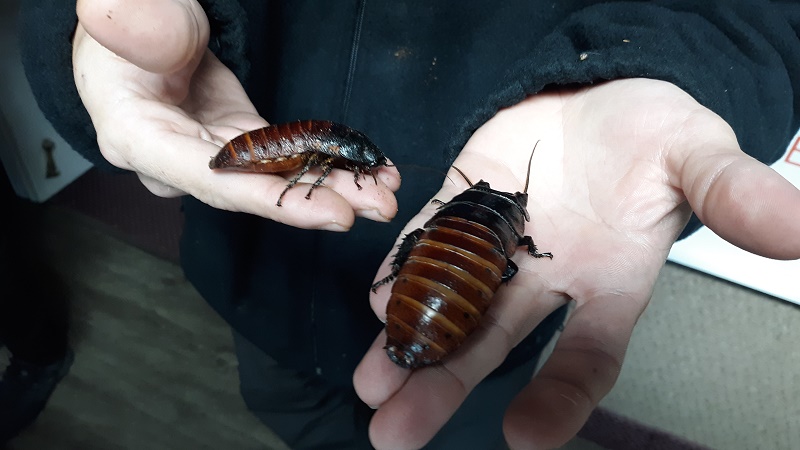
Paul Szmal: Oh, yeah. So today we have beetle juice and papa roach. These are Madagascar hissing cockroaches. And I have a male, and I have a female. So what's cool about these cockroaches is they have what's called sexual dimorphism, which means that you can tell just by looking at them which one is a male and which one is a female. Males have pronatal humps or horns that you can tell on the top of their craniums, which kind of just sit there. They also have longer antennae and more hairier. And females will either have just bumps or no bumps at all on the top. So it's a very big difference in the both of them.
Casey: Now is any of the coloring significant, or is that just kind of coincidence? I see the male in this case is a lot more black around the head in that first segment. The first couple of segments are more black than brown.
Paul Szmal: So the coloration of females and males will tend to be a similar color. What you're seeing is might be what's called molting. So when a cockroach is molt, which they will do several times in a year, they will drop their exoskeleton because they have what's called an exoskeleton instead of skin. Skin grows with us. Exoskeletons do not, so they have to get rid of it to get more. And then when they release that molt, they will be that bright white, and it'll take them a couple of weeks to kind of get that coloration. So you will see that maybe one is a little lighter than the other, because that could potentially mean a molt, which is very, very cool.
Casey: And so as I look at the two, the male is quite a bit bigger, longer legs too. The female's a little more contact and doesn't have, at least looks to me, not quite as much curvature in the skin. So males are bigger, as you can tell, like males are significantly bigger.
Paul Szmal: That is because males are the protectors. So males have to use their pronatal humps. They will use them to defend. They will use them to assert dominance. And they will also do what's called hissing, where they kind of get their name, where they shoot air out of these spiracles in the back that make it loud hissing noise. This helps them kind of assert dominance on other cockroaches or be dismissive towards other cockroaches to know when to mate. And also it is a way for them to hiss to tell that there's predators to the colony so the colony can get out and get safe. So they tend to live together in colonies?
Casey: Yes, they live in lots and lots of colonies. Since females can have up to 60 nymphs, is what they're called, or larvae, they can have up to 60 of them two to three times a year. So they can have a ton of children, yes. So they lay eggs?
Paul Szmal: So they do not lay eggs, they actually give live birth. So the eggs will stay in their body until, for about 60 days, they will then give the live birth to the nymphs. Those nymphs will take up to seven months for them to actually become adults, which they will molt six to seven times in that span to get to the requirement size to be a full adult.
Casey: Now you let me touch one of them, and they're very, very smooth. That's always the thing, people, because we always joke about, is it going to be cute and fuzzy, creepy, crawly? But I mean, they're crawly, but they're not creepy at all. One thing that you don't see on radio is they're not very active, especially the females just staying right there in your hand. The male's kind of exploring around, but it's not like you're trying to run around the room.
Paul Szmal: No. So right now, they're kind of just moving around, not worried, because I'm not a predator. I'm not going to eat them, so they don't have to hiss. If I were to pick him up with this other hand, which has the female in it, they would start to get that sound to get away from me. But other than that, they're pretty calm, and they're smooth because their exoskeletons is very hard and crunchy. So that is a very smooth, that's a protect against predators, so it needs to be a little bit harder than skin, so if something tries to eat it, they can defend themselves and run away. They also are really cool, as they do not have wings, so they are flightless cockroaches.
Casey: And so, do they molt those skins as they grow?
Paul Szmal: Yeah, so they will molt their exoskeletons completely, and then they will kind of be very sensitive for a couple weeks, like they'll almost be entirely white, and then they will get their color back over periodically.
Casey: Where do they live? Is it on the ground?
Paul Szmal: Yeah, they live on the floor, the forest floor, and they'll live near decaying matter, so like wood and other plants like that, which they will eat. They are omnivores, so they will eat kind of everything, but they mostly eat decaying matter. So they eat decaying animals, plants, logs, whatever they can kind of get, which is very helpful to the ecosystem because that breaks down that decaying matter. They go to the bathroom, the plants get good nitrates and nitrites, they grow big and strong, and that cycle continues.
Casey: So do colonies ever split up, do they reach a certain size where some lead the others to somewhere else?
Paul Szmal: So colonies tend to stick together, so they live up to about five-ish years, they can live a little longer under human care. So when they are in these giant colonies, they will grow and grow and grow, but in the wild, the environment has ways to kind of control that. They are prey species, so birds, mammals, lizards, other insects will eat them to keep that population down. So they never really get to, in the environment, to those huge, huge, because they will just eat everything and leave nothing for anyone. So the environment kind of, and the universe kind of keeps them in place so they don't overpopulate.
Casey: What do they have in terms of feet, or are they sticky or picky, or they can climb things?
Paul Szmal: So they have barbed-like legs, so they have six of them, so that helps them kind of grab onto things. So if I kind of go like this, they can kind of, yeah, they can hold themselves. That helps them climb. So that actually will prevent certain animals from wanting to eat them. So when they are babies, they're a lot easier to be a meal to another animal. But if you look closely, Ted, they're spiky.
Casey: Oh, okay. I didn't, yeah. Yeah. So some things might go and try and eat it and then kind of spit it back out. Okay. Yeah. I didn't see that. Yeah. And it's, I love the coloration. It's just kind of a deep brown. And do they have a specific number of segments?
Paul Szmal: So in their body, so they'll... Or does that change as they grow?
Casey: So they will have, they have the same segments as most insects, as they have a cranium, which is the top of their head. They have a thorax, and then they have their back end right here. So it's set up into three different segments.
Paul Szmal: Okay. Okay. Very good. And where did they come from? Madagascar. I mean, where did you get them from?
Casey: So you actually can get cockroaches, the hissing Madagascar cockroaches, right at CountryMax.
Paul Szmal: Oh.
Casey: Petco.
Paul Szmal: Oh. Yeah. Yep. So it's, that's probably how we acquired them many years ago, and we've just kept our colony going. Wow. So with our babies, we're actually able to use those and feed them out to our geckos, our bearded dragons, whosoever's interested in them. And then when they get a certain size and they get those spiky legs, we use them for education.
Casey: All right. Very good. Go to bridgesforbrainingjury.org. Again, you can download that wish list of things. Don't forget donations for the live auction. That'll be great. Online to help out, and it's good to see you as always. Thanks for coming in.
Paul Szmal: Thanks so much for having us, Ted.
Casey: All right. We love our wildlife rock stars. It's 826 now.