Paul Szmal:
Good morning, it's 837. It's FLX Morning Wednesday and it's time to talk a little bit of a solar power. We're joined by our floating three-county Cooperative Extension guy, Ryan Stachok, Environmental and Natural Resources Educator in Cayuga, Schuyler, and Seneca Counties. Good morning. Good morning, how are you today? I'm doing well and also Guillermo Metz is with us, Solar and Ag Senior Resource Educator with Tompkins County CCE. Good morning to you. Hello, good morning.
So, Ryan, we're going to start off with a seminar coming up on solar power issues. It'll be November 13th in Cayuga County, so talk about the seminar and we've discussed some of this before, some of the issues that landowners need to think about when deciding whether they want to sign a deal to host solar panels on their property.
Ryan Stachock, Guillermo Metz:
Yeah, thank you, Ted. One of the great things about working with Cornell Cooperative Extension is bringing education to the public, right, whoever wants to learn. So, it's really an honor to be working with the Cornell Cooperative Extension out of the three counties. This seminar coming up on November 13th, it's on a Wednesday and it starts at 930 a.m. and it will end at 230 p.m. at Cayuga Community College on Franklin Street in Auburn.
This solar and ag in Cayuga County, what you need to know workshop, is geared to make sure that the farmers and landowners in the Finger Lakes region, specifically Cayuga County, have the knowledge they need to make good decisions for themselves. Solar development on agricultural lands is becoming more and more common in Cayuga County, but certainly also in Seneca County, Schuyler County, and across the Finger Lakes and across New York State.
And so, in order to address some of these critical issues that are surrounding solar development, we want to invite all the Finger Lakes farmers and landowners. They're invited to this educational workshop. It's going to be hosted by Cayuga County, Cornell Cooperative Extension, and Cayuga County Farm Bureau. Again, on Wednesday, November 13th, from 930 a.m. till 230 p.m. at Cayuga Community College on Franklin Street in Auburn.
It's designed, again, for farmers and landowners to gain information on important issues regarding solar development on the agricultural lands, especially things that people need to know if they're going to lease their land to solar companies. There's a $15 registration fee, but it includes lunch, and registration is required. We're already up into the double digits right now for registration, so space is limited. So, I'm encouraging all the farmers, landowners, certainly municipal leaders throughout the Finger Lakes, planning board members, people that want to understand a little bit more about this, to certainly register for the program. And you could do that by visiting ccecayuga.org.
Paul Szmal:
All right, we don't want to give away the whole seminar, but just touch on maybe a couple of the top things that a landowner wants to think about and might overlook when they're making this decision.
Ryan Stachock, Guillermo Metz:
Yeah, you bet. So, I think we have a really good program built, and we're bringing in the experts from across the state, and actually across the nation. We're going to start off by talking about utility scale, solar development in New York State, and really underscoring the basics. And we're honored that David Kaye from Cornell University, who's a researcher and also a go-to person nationally for these solar issues, he's going to be speaking about the basics, which is going to be great.
We're going to give him about an hour of time to speak and answer questions, just so that people understand the basics of solar and utility scale solar development in New York State. Really trying to do a deep dive into that information, so that you understand all the fundamentals. He's going to be followed by American Farmland Trust, New York Regional Director Linda Garrett. And Linda's going to be talking about using solar as an ag viability tool.
So, the American Farmland Trust just did a tour of New York State over the last six or eight months, and they're putting together a document to help farmers make the best decisions that they can. And then we brought in MRB Group, a senior planning associate, to talk about solar energy system application reviews and the process. So, it's not just as easy as signing a lease. There's a lot of process landowners and companies have to go through with their local municipalities to get site approval, to get planning approval. And we're going to talk about that, so that people understand exactly what they're getting into.
And then we're going to conclude with Simon Honig, who is an attorney from the prestigious Colligan Law Firm out of western New York. And they're going to be talking about what farmers need to know about solar leases. So, before you sign on that dotted line, what is the verbiage that you really need to look out for in the different documents when you're talking about the legalities?
Paul Szmal:
Well, you answered what was going to be my next question, which is, should someone get a lawyer? Because, obviously, the utility companies drop these contracts. They're intimately familiar with what's in them. So, I assume it would be good to have legal representation, to have somebody to read it over and say, hey, this clause or that clause you might want to discuss modifying it.
Ryan Stachock, Guillermo Metz:
It's very important, right? I mean, we're talking about, you know, there's significant amounts of land. You know, it's a change in lifestyle for people that own these properties. And we just want to make sure that everyone knows exactly what they're getting into before they do that.
Paul Szmal:
All right. Guillermo Metz is with us, solar and agriculture senior resource educator with Cooperative Extension of Tompkins County. Let's talk about residential solar. A number of people have done it. There's a number of different ways that you can do it. Let's start with either rooftop right on your home or somewhere on your property. What are some of the things to think about and some of the advantages?
Ryan Stachock, Guillermo Metz:
Yeah. So, these are very different skills than what Ryan's talking about. But solar can be done at all these various skills. And rooftops been done for many, many decades. And it's still very viable. So, it is a way to basically lock in your electricity rates. So, you need to buy the panels and put them on your roof or on your property on the ground. And that's sort of an upfront cost that you might get a loan for. Then once it's paid off for, you essentially have free electricity. You're still paying for the connection to the grid if you're grid tied, which most people are. Which might be about $15 a month. But other than that, you're, you know, you've got the solar power making as much of your electricity as you've designed it to do. And it's basically a very low or no maintenance.
So, rooftop is absolutely a very viable thing for a lot of folks still.
Paul Szmal:
Do you know roughly what percentage of residential users are generating more than what they need and are able to send some back to the grid?
Ryan Stachock, Guillermo Metz:
Yeah. So, most people are grid connected. So, you're sending back all the time and you're taking when you need it. So, the net amount that you give to the grid at the end of the year, most people don't give a whole lot back. You can oversize your system and still get incentives up to about 110% of your system's needs. But you don't get a check at the end of the year anymore. You get credits that roll over. So, there's no real huge advantage to oversizing your system significantly.
The one caveat to that is if you have a foreseen need, like you want to maybe add an electric vehicle charger or an induction cooktop or heat pumps or something that takes a lot of electricity and you don't have it in yet, you can design for that and overbuild your system now so that you can accommodate that later. But otherwise, there's not a real need.
Paul Szmal:
What's the typical lifespan of this equipment? Are there people who were early adopters coming around to the point where they're going to have to replace panels?
Ryan Stachock, Guillermo Metz:
Yeah, yeah. So, it's the same as utility scale. The panels have a lifetime about 25 years. They're warrantied for generally and that means that they've lost some of their efficiency at that point. So, we're talking about silicon solar generally. It's your traditional panels that you see out there. They look like blue or very, very dark blue glass and they do have a glass coating but that's just silicon and that has a half-life. So, it degrades over time and that's just natural. They're guaranteed to produce something like 80% at 20 years, something like that.
So, you're still producing power after 25, 30, 40, even 50 years but not as much. So, at some point, it becomes more economical to replace them. And then the inverters are the other piece of the equipment that needs replacing probably before that. So, anywhere between 10-15 years, you might have to replace an inverter.
Paul Szmal:
For some people, whether if you're a renter, your home won't handle the load on the roof or maybe you just you don't have a property that faces the Sun in a real good direction, there's community solar. Explain how that works.
Ryan Stachock, Guillermo Metz:
Yeah. So, community solar, these terms we throw around, community distributed generation or utility scale, these are basically anything that's off-site that goes into the grid. And you, as like you said, a renter or someone who lives in an apartment building, you can subscribe to community solar. So, a company called Joe Solar or whoever has a solar farm and divvies it up and you can buy your power from this solar farm, essentially. So, it's available to everyone now, which is really wonderful. And it's just basically these terms are at different scales. So, when we say utility scale, it's a much larger project. But community distributed solar, it's pretty much anything that's off-site that you can sign up for.
Paul Szmal:
Are there still a lot of misconceptions about going solar that you have to listen to?
Ryan Stachock, Guillermo Metz:
Yeah. A lot of folks still think solar doesn't work in upstate New York. It's too cloudy up here, which is a very myth. It's untrue. We have plenty of sun. There's definitely places that have more sun and a lot of places in the world have less sun.
There's concerns, especially at the community and larger utility scale, that the panels themselves might leach chemicals into the ag land, former ag land. Or, you know, somebody might be hoping to return it to ag land in the future. That really is not true at all. They're very sealed and they're essentially 99.9% glass and silica, which is also basically glass. So, there are some issues with, you know, the production of them, where we're getting the materials and all of that. But it's one of the least impactful energy sources that we have available to us.
There is a concern when we talk about utility scale that we're losing ag land to these projects, which is absolutely true. The developers want to develop on flat, accessible land that is near utility lines. And often that is agricultural land. And farmers are struggling. So, when they're approached with these deals, they see it as an opportunity sometimes to keep the farm and farm a different parcel or another parcel and have solar on part of it. Or to just get out of farming altogether, because there's no succession plan. They don't have kids who want to get into farming. So, this is all happening and we're losing farms at somewhat of an alarming rate anyway. So, that is a concern for sure.
But the fact is, you know, these are farmers' choices, landowners' choices to weigh the pros and cons and to, you know, to go for solar if that's their choice. A lot of farmers across the state lease land rather than own it. So, they're squeezed out of places. They don't have that choice. They're just losing land that they can use. So, that is unfortunate.
These I wouldn't call misconceptions. These are definitely happening. The misconception happens where folks are thinking that the state is coming after your land somehow. That there's this ability of the state to act as sort of a utility and, you know, sort of take over farmland across the state, which is absolutely not true.
Paul Szmal:
Ryan mentioned this a moment ago. What are the opportunities for mixing and matching? Having some solar on your land, but continue farming?
Ryan Stachock, Guillermo Metz:
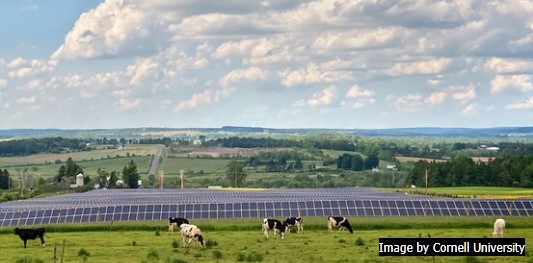
Yeah. So, we call it, I mean, there's different terms for it, agrivoltaics or co-siting ag and solar. And that is definitely possible. It depends on what you're trying to do and at what scale. So, at like a 5-acre, 10-acre site, 20 acres, you might be able to do sheep grazing. Even larger, you could do, you know, if you have enough sheep. There's not a huge market for sheep in New York State. And the processing for a lot of sheep really isn't there, and transportation and all that. So, the infrastructure isn't built up for a huge sheep market. But grazing sheep on solar farms is one of the more popular and, I would say, low-hanging fruit. It's really quite simple to do. We know how to do it. The sheep act as mowers, essentially. They keep the site mowed, so you don't have to just come in with mechanical mowers. So, they save money there. And they work, you know, they love the shade. It works really quite well.
That, you can sort of go up a level. We don't have a ton of sheep, but we do have a lot of cows. They're not pasture-raised, typically, you know, so they are. But if you have free-range cows, then yes, you can also have cows under and around solar panels. But there, you're talking about a much bigger animal. So, you want your panels to be higher up off the ground. You want, maybe, stronger racking systems, and that costs money.
And then you're talking about crops. A lot of, you know, corn, hay, those tall crops are not going to work well. You're not going to get huge combines running up and down between rows of solar panels. No one's going to want to do that. So, you're talking about other things we know do work, and some crops actually work better under solar, especially in the Southwest, where you're talking about heat stress and trying to maintain moisture on the farm. It works really well there. But there are things that work well here. There's experimental stations that Cornell owns out in the Hudson Valley, where they're looking at putting dwarf fruit trees, apple trees and things, under solar panels. So, again, you have to have those panels much higher off the ground. Adds cost. But there's a lot of things you can do.
It's just really important to have this conversation up front. If the farmer or landowner has any interest in combining solar with ag, it's something that's got to go into the design really early on. And it might add cost.
Paul Szmal:
I have to jump in here, because we're almost out of time for this segment. But I appreciate that information. Thanks so much.
Ryan Stachock, Guillermo Metz:
Absolutely. Yeah, thank you. And again, the Solar and Ag in Keuka County event is November 13th. That's next Wednesday at 930 a.m. Keuka Community College. Ryan, thank you. And thanks to all the Cooperative Extension folks for jumping in to bail me out for some guests here this week.
Paul Szmal:
You're welcome. We appreciate it. And just make sure everybody, get on and register for that as soon as you can.