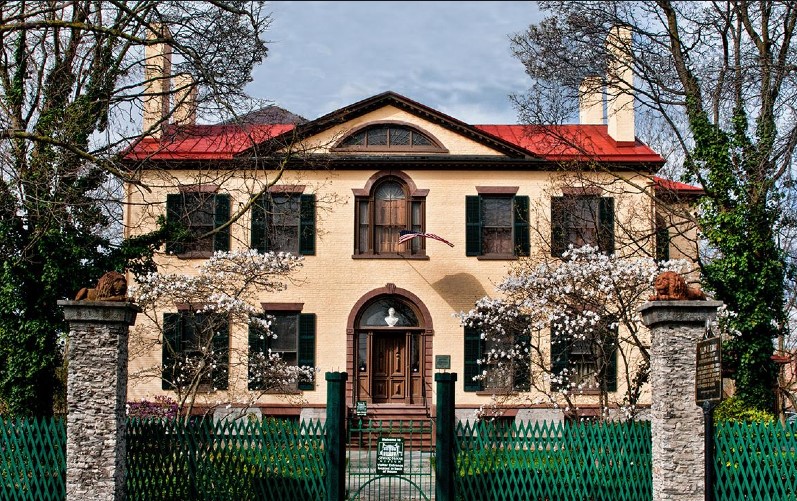
Paul Szmal: Good morning, 751 FLX Morning Friday. We're Zooming with Katie Grindstaff at the Seward House Museum in Auburn, SewardHouse.org. Good morning and welcome back.
Katie Grindstaff: Good morning, thank you.
Paul Szmal: Now we were doing spooky Halloween themed events this month and we had a scheduling glitch earlier in the week so one of these just happened but we want to talk about how it went was your lunchtime lecture yesterday with Zach Finn who used to work for you at the Seward House. How was that?
Katie Grindstaff: Yeah, it was it was a really great program, Ted, and he was talking about his new book, The Lady in White, and how some of that was inspired from his time here in the Finger Lakes and Cayuga County. That's pretty neat.
Paul Szmal: Now coming up on October 19th, this is interesting because we've had some discussions on our side of the Finger Lakes here around Geneva. The Rose Hill Mansion has been diving into the way that mourning and death was handled during that period in the 1800s. So on the 19th from 11 to 1230, it's death rites and Victorian mourning culture. It's a specialty tour of the Seward House, so explain.
Katie Grindstaff: There were really elaborate rituals around dying and death and mourning in the 1800s. Yeah, so it's a really fascinating topic because the Victorians, of course, they had a lot to deal with at the time. They had a lot of diseases that we luckily, for the most part, do not have anymore. Of course, also around this time, the Civil War was happening, so there was a lot of death, and with all that death, they were more comfortable, I suppose, with that, and they had different ways of dealing with it than how we express our grief today.
So some of those mourning rituals included putting hair into jewelry and into art. They also had post-mortem photography, since photography was relatively new, and just generally more comfortable with it, a lot more memento mori as well. So we're going to be talking about how the Sewards, they were just pretty much exactly the same. They had a bunch of those objects, and this is our annual Death Rites in Victorian Mourning Culture tour, so it's the only one we offer the whole year. So it's a really fun one, really interesting, and you'll get to see a lot of kind of spooky objects. We also have our Cabinet of Curiosities back up in our gift shop, which actually shows off a lot of those mourning objects as well.
Paul Szmal: Now what spirits or goblins might be around the Seward House? I would imagine over the years there probably been some tales.
Katie Grindstaff: I have never seen anything personally. I do not, I don't think that there are any, and if there is, it's all good energy. But some people, some people have had their own experiences.
Paul Szmal: By the way, all these events we're talking about, and a whole bunch more, are at SewardHouse.org. You can click the calendar link right on the front page. And everybody looks forward to this, the Haunted History Tours of Auburn. The first of these is October 26th, and costume guides will take guests both around the grounds of the Seward House, and then throughout the streets of Auburn, talking about some of these Victorian funeral practices, and ghostly lore, true crime, and all kinds of things, stories from history's hometown.
Katie Grindstaff: Yes, yes, this is one of our favorites for our programs, and it's going to be through the last weekend and up to the last day before Halloween, I suppose, of the month. We'll have two tours running a night at 6 and 7 p.m., and the tickets are on sale currently through our website. And it's going to be about an hour-long walking tour, not a very long walking tour, but it'll be around, kind of just around the block of the Seward House, going on to Genesee Street, going down to Seward Park, Equal Rights Heritage Center.
And we'll tell about six different stories, and they are all true, and some are very directly related with the Sewards, including talking about how their barn and carriage house, which we just are now rehabilitating, originally burned down. We'll talk about some Tubman connections, and then just also some other Cayuga County lore in general.
Paul Szmal: Wow, and not everything this month is ghoulish and Halloween. On October 24th, you celebrate the 200th wedding anniversary of William and Frances Seward. That's cool, tell us what's going to happen.
Katie Grindstaff: Yeah, so last year we had a performance called My Dear Father, My Dear Daughter, and so it'll be a very similar setup to that, whereas there will be a very dramatic reading between actors portraying Frances Seward and Henry Seward, and they will be discussing their love letters. They had a very, I wouldn't say romantic relationship, but it was very loyal and very respectful throughout their marriage, and they constantly were communicating with each other. When Frances was mostly here in Auburn, and Henry would have been in Albany or Washington DC for his career. So we're going to hear how their relationship actually played out.
I hear it is a tearjerker at parts. So yeah, everybody can join us in the drawing room, and we can discover more about their relationship.
Paul Szmal: All right, go to SewardHouse.org for these events. Also check out the digital assets that are online under Digital Media at the website. Katie Grindstaff's been with us. Happy October and Halloween, and thanks for being with us.
Katie Grindstaff: Thank you.