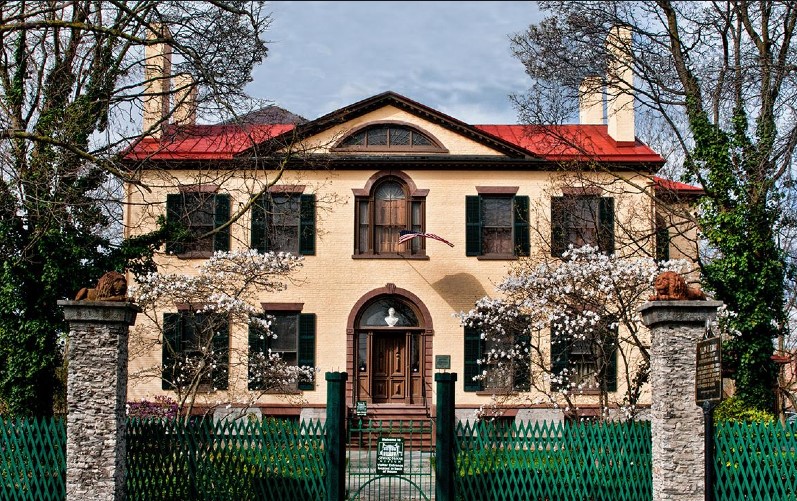
Paul Szmal: Good morning 816. It's FLX Morning Tuesday. It's our Guest-O-Rama edition. Four guests today, and number three is Katie Greinstaff with the Seward House Museum in Auburn, SewardHouse.org. Good morning. Welcome back.
Katie Grindstaff: Good morning. Thank you. We're going to talk about a lunchtime lecture series this week and then some holiday programming for Friday. This is neat. Coming up this Friday, the lunchtime lecture, it is from noon to 1 p.m. It's called Finding Francis, A Voice Lost and Found in the Seward Collection. This has to do with the organization of the Seward family papers, the beginnings of the Seward House Museum, and a couple of twists and turns along the way. So tell us a little bit about this story.
Katie Grindstaff: Yeah, so this is a really interesting presentation. It's new this year, so most people probably have not seen this before. But it is a bit of a deep dive into Francis's papers in particular that is at the University of Rochester. That's where a lot of our special collections are, including the family's letters and their diaries. And Francis's papers were treated a little bit differently than her husband's. So Henry's political papers, they were much more focused on in the 20th century when we were becoming a museum, sorry, 1951. And scholars focused, of course, mostly on his papers. So Francis was kind of ignored until about the last 20 years, really. And that's when people really started researching her significantly. But for that reason, her papers were treated very differently. And also the family had their own specific rules for how they wanted these papers to be treated. And a lot of information got lost in that archival process. The family even burned a lot of the letters that they didn't want other people reading about.
Paul Szmal: Wow.
Katie Grindstaff: Yeah, like keeping family secrets. So yeah, if anybody is interested in that, it is a brand new presentation. And it's also going to be our last lunchtime lecture of the year. So in her time, how well-known or how prominent would Frances Seward have been?
Katie Grindstaff: She's been very well-known locally. She also, during Henry's political career in Albany and Washington, she also would have been known there. Specifically in Albany, less so in Washington because she wasn't there as often. Of course, everybody knew that she was his wife. But she would have been very prominent locally.
Paul Szmal: So coming up in December, we have the first thing is the Candlelight Tours. And this has got to be beautiful. I've been to the museum. I've not seen the Candlelight Tour. But I mean, I can just imagine everything all lit up for Christmas, Victorian style. The first of those is December 6th. So tell us about the Candlelight Tours.
Katie Grindstaff: Yes, they're always a very popular favorite program of the Seward House. Coming up again in December, we have it showing for three different weekends, so eight different nights. So December 6th and 7th, 12th, 13th, 14th, and 19th, 20th, and 21st. And we have performances at 6 o'clock and 7 o'clock, so two each night. And basically, people get to come in and see our beautifully decorated house. We're going to be starting to decorate the very first week of December. The whole community is welcome to come in and see the house for free during our open house on Sunday the 8th. And then after that, they can come in for the performance in the evening if they would like. And basically, this performance is a lot of our staff and volunteers dressing up and getting into character as the Seward family. So people get to come in. They learn some Victorian Christmas history, some Seward family-specific Christmas history. And basically, the whole performance is centered around the question of whether Mr. Seward is going to make it home for Christmas or not. We do have our Steinway piano that is going to be back, so we can sing carols as well.
Paul Szmal: Wow. I'm just trying to imagine what Christmas must have been like in those days for people of that social stratum, you know, at the top. It must have been really just a big month-long festival.
Katie Grindstaff: Yeah, definitely. It was a period of great change for the Christmas that we understand today. I mean, they would have been living through at least Henry and Francis's lifetime. They would have been living through all of these different changes and cultural traditions. So yeah, it's really cool to learn that history. I don't think we've ever talked about this. Who were the Seward's peers in Auburn? What families did they hang around with?
Katie Grindstaff: Well, they were very close with the Wrights. So Martha Coffin Wright and David Wright. David Wright was a lawyer. He worked with Henry Seward on the Freeman case. They were really the only two supporting families for that defense. And of course, Martha Coffin Wright, we think, was Francis's best friend. And she is one of the women that organized the Seneca Falls Convention. And her grandson was Thomas Mott Osborne. So two very, very powerful families in the area.
Paul Szmal: Wow. SewardHouse.org is the website. Again, the Lunchtime Lecture Series is Finding Francis, A Voice Lost and Found in the Seward Collection. That is from noon to one on Friday. And then the Candlelight Tours are December 6th and 7th, 12th, 13th, 14th, 19th, 20th, and 21st. And the Holiday Traditions Open House is on December 8th. Again, SewardHouse.org. Katie, thanks so much. Great stories and always good to talk with you.
Katie Grindstaff: Thank you.