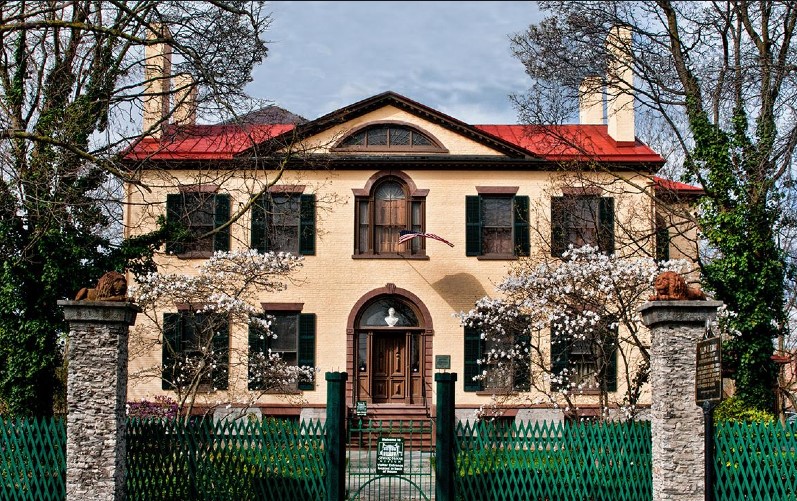
Paul Szmal: Good morning 816. It's FLX Morning Wednesday. It's our monthly visit with Katie Greinstaff with the Seward House Museum at SewardHouse.org. Good morning and welcome back.
Katie Grindstaff: Good morning Ted. How are you?
Paul Szmal: I'm doing well. It's great to have you here and I have to thank you again because I've been getting some great summertime reading for your Distinguished Speakers Series. I've read one of the books already and I'm gonna track down this one as well.
Tomorrow 530 to 830 it's Robin Bernstein who is the Harvard University Dylan Professor of American History and Scholar and we talked about this book briefly I think last month, Freeman's Challenge, The Murder That Shook America's Original Prison for Profit. Now some some places have experimented with for-profit prisons but it all started where else? History's hometown in Auburn. So tell us about Freeman's Challenge.
Katie Grindstaff: Yes, so yes we are very excited to welcome Robin. That is actually that's going to be happening tomorrow so you can all still get your tickets if you would like to come. $35 for a lecture, $75 for the VIP ticket that includes the reception at Eagle Rites Heritage Center and we are very very excited to have such a close related subject for a book with our current focus and exhibit at the museum rooted in reform. So yes this book is going to be discussing or does discuss William Freeman's trial who was a young man that was incarcerated in Auburn Prison and then defended by William Henry Seward and court utilizing where he utilized one of the early really strong pleas of insanity and talking more about the deeper meaning of what what that trial meant for our justice and carceral systems.
Paul Szmal: How much do we know about this original for-profit prison? Was it where the state prison is today or somewhere else?
Katie Grindstaff: Yes, yeah the prison Auburn Prison was constructed in 1816 same year actually as the Seward House Museum and it was partly the site was partly chosen by Elijah Miller who built the Seward House and yes the the Auburn prison system is kind of built on a mixture of solitary confinement and then congregate group labor for-profit originally private profit which Elijah Miller did benefit from and then of course later going on to be just profitable for the government.
Paul Szmal: Do you have in the collection, do you have photos or memorabilia going back that far?
Katie Grindstaff: All the way to 1816 unfortunately directly related to the Auburn prison we do not however we do have many many objects related to Elijah Miller and Auburn in general from that far back, yes.
Paul Szmal: So that'll be the final distinguished speaker series of the fall and that will be tomorrow on September 11th and the next lunchtime lecture this is September 27th from noon to one deep in the archives how the Susan B. Anthony House became a museum. Tell us about that with Aisha Pierre.
Katie Grindstaff: Yes we are super super excited to welcome back Aisha Pierre who is now the curator of interpretation at the Susan B. Anthony House in Rochester however she used to also intern here at the Seward House working with our collections so we are very excited to welcome her back and since we are both historic houses she's going to be discussing based on her research at the at the Susan B. Anthony Museum how historic houses actually become museums and and kind of going more into that into that process so that's going to be of course at the Eagle Rides Heritage Center from noon to one as all of our lunchtime lectures are and it will be free.
Paul Szmal: Sounds very good the next one in October is on October 10th from noon to one I we all know about the haunting stories of the Seward House and in and around Auburn I found my ghosts on 33 South Street with outreach coordinator Zach Finn.
Katie Grindstaff: Yes so we will also be welcoming back Zach Finn who used to be in the education outreach position here and he currently works at the Pomeroy Institution, Pomeroy Foundation and he also has a writing career on the side and he writes historical fiction and he has just penned his second novel The Lady in White and that is going to be discussing or it will be inspired from some of our haunted history here in Auburn of course that will be leading up to our later spooky specialty tours and haunted history tours later on in October so we've got lots of lots of spooky programs lined up and then of course that again will be at Eagle Rides Heritage Center from 12 to 1 on October 10th and will also be free and open to the public.
Paul Szmal: And if you go to the website SewardHouse.org and hover over visit you'll see the tour page and it's got all these different specialty tours these are by appointment for groups of 6 to 16 that go into sort of specific aspects of the Seward and Lincoln history so tell us some of the specialty tours are available.
Katie Grindstaff: Yeah so we always have specialty tours available upon request but we are offering a very special one that we only do once a year on October 19th and that is our Death Rites and Victorian Morning Culture specialty tour so we'll be discussing some of the morning morning rituals that the Sewards practice here what was kind of common for the time and we will be showing some of our collections that are related to that so we have hair jewelry there's also hidden symbols of death and artwork we also have just kind of general Victorian morning culture history of photography of people that have already died so very very spooky things things that we don't really practice anymore today but but we're commonplace.
Paul Szmal: That's interesting, I have the folks from Historic Geneva on every month and they have Rose Hill Mansion and they're also they they've done a display set in kind of a similar time period so there was a very a very ritualistic way of mourning and in way that they handled death in the mid-1800s.
Katie Grindstaff: Yes definitely yeah the Victorians along with the Sewards they were they were very very familiar with death so it was much more commonplace and they dealt with things a lot different because of course because of the Civil War and also because of disease.
Paul Szmal: Right and also to put a bug in people's ears for the holiday season you have the candlelight tours at Christmas time that must be spectacular.
Katie Grindstaff: Yes yes we do have those on the weekends of December so yes we are very excited to get into our holiday programming. Specialty tours are $15 per person and again these are by appointment for a small groups of 6 to 16 so you can really get the full experience. Call 315-252-1283 or email info at SewardHouse.org to check on those and again don't forget the Distinguished Speaker Series is tomorrow beginning at 530. SewardHouse.org website.
Paul Szmal: Katie thanks, I always learn a little bit more history and I get great book ideas from you each month so thanks again.
Katie Grindstaff: Thank you Ted.