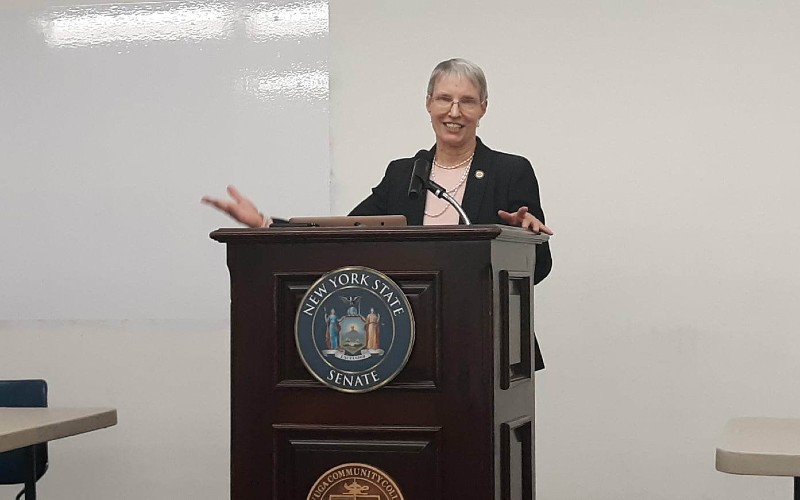
Paul Szmal: We're joined on Zoom for a monthly visit by 48th District State Senator Rachel May. Good morning and welcome back.
Rachel May: Good morning, Ted. I want to start with this because for one reason, I think you're the only Democratic politician who comes on this program, which is funny because it has a liberal host. But anyway, there is some consternation and some introspection among Democrats over the results of the presidential election. What's your take? Is there something Democrats need to do differently? What do you think of the Kamala Harris Walls campaign?
Paul Szmal: Yeah, so I do think we need to communicate a lot differently. I have to say, I did better in this election than I've ever done. And I feel like being out there talking about problem solving rather than always focusing on those hot button issues that seem to dominate all the coverage of our elections. I think, you know, letting people know what we really do, and that we're out there listening and, you know, really out in the districts trying to make sure we understand what the problems are and what government can do to make a difference. I think the more we do that, and the more we get out and just directly visit all the different areas of our districts and make sure people feel they have a voice with us, I think that makes a big difference. And that's what I heard constantly in the campaign.
Rachel May: How do we turn around the information disparity where there are a lot of voters these days going to the polls who believe things, especially believe things about the Democrats that are not true?
Paul Szmal: Well, that's a hard one. I mean, there are quite a few billionaires right now who control vast swaths of the media landscape. And I don't see a way of taking that away from them, which is why I'm really focused on direct communication, kind of barnstorming, going out to local libraries and having events there where people can come and ask questions. And I can explain some of the things that we've been doing, and I don't see any other way given the control of the big media right now.
Rachel May: We just had the story in the news about the New York State Empire Awards. Senator Helming gave out some. You're going to be giving out some during this holiday season. So tell us about that award, and tell us about what you've been hearing when you asked for nominees. People came forward and said, yeah, I know a good small business.
Paul Szmal: Oh, my goodness, yes. We wanted to, in honor of Small Business Saturday, we wanted to give a bunch of awards at the end of the year. And when we asked, we got so many nominations. It was really lovely to see how people really respect the businesses in their neighborhoods. So we're giving a couple, quite a few in Auburn, actually. A couple I wanted to mention are Ryco Enterprises. This is a young man, Ryan Coe, started a lawn care business. He's now 30. He's got two dozen employees, and he is very involved in giving back to the community. And it's going to be fun to honor him. There's Muldoon Dry Cleaners in Auburn also. They do good work. They've been doing good work for a long time, and they give back in a lot of ways, including pro bono dry cleaning for charities. So we heard a lot about businesses that provide a good service, but they're also really involved in their neighborhoods.
Rachel May: I love to hear about these businesses. We have the folks from the Auburn Chamber of Commerce or Keuka County Chamber of Commerce on each month, and I always love to tell the story of the business of the month. I mean, there's so many people out there that, in this day of cyber everything and Amazon everything and big box everything, have found a way to succeed in their communities.
Paul Szmal: Right. And you can't do lawn care remotely, you know. It's got to be a personal service. And so the people who really are doing that with care, we want to respect them and honor them.
Rachel May: Since we're in December, it's that time where we look back at one year and ahead at the next. So let's look back at 2024. You had a pretty good session in terms of getting some of your bills signed.
Paul Szmal: I did, yeah. I have to say, this governor likes to veto a bunch of bills right before Thanksgiving, so we're all a little bit raw from that experience. But I have had quite a few bills signed as well. One recent one was to change the rules about physician assistance, which is an important thing because, even though it's kind of a technical bill, what it will do is make it possible for there to be more health care professionals in rural areas, because we're finding whole health care deserts in some of our rural areas where there just aren't any physicians, and even physician assistants haven't been able to practice there. So now that'll be easier, and I feel good about that. I feel good about a bill that wasn't, my name wasn't on it, but I worked on it really hard about treatment in place, which allows, also for rural areas, it allows the emergency medical services to get paid by insurance if they show up and treat somebody in place. It used to be that they had to take you to a hospital before they would get paid, and that just added so many hours to every call that it made it really hard for them to respond to a lot of emergencies. So we're hoping these are going to really help rural health care, which is in crisis right now.
Rachel May: I think we talked last time you were here, there's one bill that you are still hoping will be signed by the governor, and that's the Native Seed Bill. Remind us what that will do.
Paul Szmal: Yeah, so we have a need for planting a lot of native plants. There are all kinds of programs to plant trees in cities, to re-vegetate lands that are eroding, and that kind of thing. And you want to use native plants for that, but we just don't have enough of the seeds or the seedlings to actually do that work, and it can take years. So with the help of Janice Wiles, who has Go Native Perennials in Skaneateles, we are hoping the governor's going to sign our bill to really support and expand that kind of business, creating a native seed stock for planting in the state.
Rachel May: One of the first things we'll be looking at in the 2025 session, I always ask this time of year, and that's the budget process. We've slipped back into a late budget last year after we got several years of an on-time one. How do you see the budget discussions shaping up, and what might be the hang-ups toward getting one on time?
Paul Szmal: So we're actually in pretty good shape this year as a state. We've had good revenue, and I don't anticipate a lot of budget cuts, but there are some big ticket items that people are talking about. For example, the supports for food assistance, for example, that so many families depend on to keep their children fed aren't keeping up with inflation. And so increasing some of those supports, which then saves money in other places in the budget, but you have to do that upfront. There's going to be a lot of people coming to us for more money, more money for infrastructure. We're a little worried now that the federal government is going to pull back a lot of its support, and so we're going to have to find the money for some of those things here. And I'm going to be fighting for refugee assistance. We found this eight years ago in the first Trump administration when they almost completely curtailed new refugees coming into the country. We in Central New York are home to a lot of new Americans, and they need support in the first year or so to get on their feet. And then they become very important contributing members of our economy and our society. But we need to make sure that we're still supporting them and not just cutting them off from services. So those are some things we're going to be fighting for, I think.
Rachel May: All right. We'll have more discussions of those as we get into the new year and the new session. State Senator Rachel May, I thank all of our lawmakers for generously giving their time. We have a broad segment on this program, and we appreciate the ability to add you to that list and look forward to many more talks.
Paul Szmal: Always a pleasure, Ted.