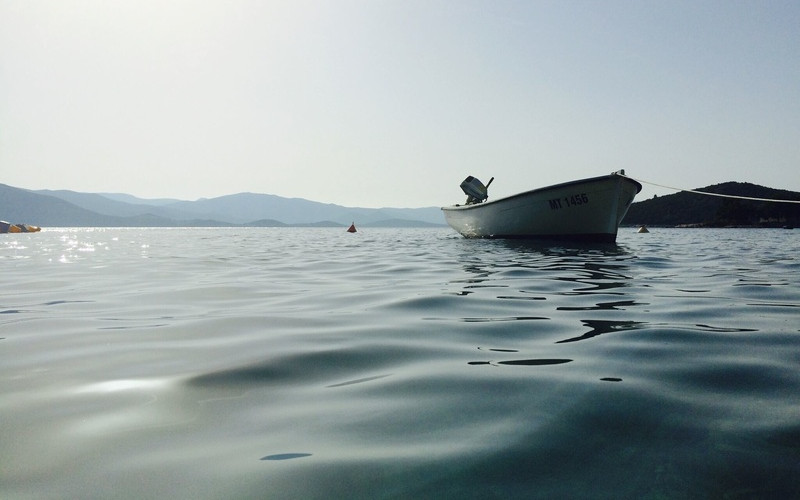
Paul Szmal: FLX Morning continues, it is coming up on 8-16, chilly 29 across the Finger Lakes, but people are still out boating, and will be throughout the fall months, even into the winter months. So our safe boating correspondent Ira Goldman is here to give us an update on things you need to know as we head into the winter time and fall and winter boating. Ira, good morning. How are you, sir?
Ira Goldman: Good morning, Paul. Yes, I'm fine. I hope you are as well.
Paul Szmal: Yes, absolutely. What do you think the most important boating safety rule to remember is right now?
Ira Goldman: Well, all the time, the most important rule is to wear a life jacket, and as we get to this time of year, particularly for smaller boats, less than 21 feet long, between November 1st and May 1st in New York State, it's required that everyone on board wear a life jacket. And as you said, boating isn't over. A lot of people out fishing, duck hunting, moving boats into winter storage areas. So it's always important to be careful. And regardless of the type of life jacket you have, make sure they're in good condition. And if it's an inflatable, which are quite popular because they're compact, you need to check that the inflation cylinder, carbon dioxide inflation cylinder, has not been discharged.
Paul Szmal: Do those carbon dioxide cylinders have a shelf life? I'm sorry, do they have a... How long do they last, usually?
Ira Goldman: They don't have any expiration date on them. They have an indicator that tells whether the trigger has been pulled. And if you take the cylinder out and there's a hole in the neck where the pin went through, then you know it's been discharged. If that is the case, and you have to need it, all of those life jackets have a tube. You can inflate it by mouth. And one of the things that's good to do every year is take that tube out, blow up the life jacket, make sure it holds air over the night, so if you need it, you know it works.
Paul Szmal: Absolutely, yes. What kind of effect has the fall and late season drought in the area had on area lakes and streams, Ira?
Ira Goldman: Well, the water level in most of our lakes goes down in the fall to begin with, and the drought has made that even more significant. And so when you're going somewhere, maybe to a launch ramp or a place to go fishing where you've been before in the summer, you need to keep in mind that the level is lower, and things like rocks and trees that may have been submerged in the spring and summer are going to be potential things to hit. The other problem is that as the lake water levels go down, the launch ramps may be too short to allow the trailer wheels to stay on the hard surface when the trailer is far enough into the water to retrieve the boat. And so it's really important to check the water level, check the ramp before you just put the trailer in the water to make sure that you're not going to have the wheels caught behind the lip of the trailer ramp.
Paul Szmal: Yeah, that could be a definite problem when you go to try to pull the boat out for sure. As the air and the water temperatures start to go down, is there an increased risk of hypothermia for boaters this time of year, Ira?
Ira Goldman: Of course, and certainly as the air temperature goes down, if you get wet, the evaporation will make it feel even cooler. Water temperatures don't go down quite so fast, but they're still cool enough that you really don't want to fall into the water if you can avoid it. But the advice for dealing with the weather is the same as for any outdoor sport this time of year. Dress in layers, use outer clothing that will block rain and water as appropriate. And like a day like today, where it starts out at 29 and by the end of the day it'll be up in the 40s or 50s, you can peel off those layers as the day gets warmer and you'll still be comfortable.
Paul Szmal: Yeah, it's important to keep that outer layer on, though, on a day when there is going to be rain in the area or something like that. Generally, a good idea to, even if you're going to strip off a couple of layers, I would think I already keep that outer layer in place at all times while you're on the water.
Ira Goldman: I fully agree, and as you are out and are active, you do perspire, and that does absorb into the inner layers. If you take the outer layer off that blocks the wind, that's going to speed up that evaporation, you'll feel colder. So a lightweight outer layer is always a good idea to keep on.
Paul Szmal: We're talking about safe boating during the fall and winter months with Ira Goldman here on FLX Morning. If someone has emergencies on the water this time of year, what kind of communication will they be able to have in terms of calling for assistance?
Ira Goldman: Well, as you said, this time of year there's not as many people around, so you will need to require help from professionals, either the Coast Guard or the Marine Patrol. In the local area, in the Finger Lakes, if you call 911 on a cell phone, the dispatcher will tell the dispatcher where you are, they will dispatch the appropriate local Marine Patrol. A thing to keep in mind is that they're not out on the water all the time, so it will take some time for them to get the boat on and reach you. But they can dispatch a road patrol deputy to the area who can potentially get some assistance from others along the shore. If you're on a bigger body of water, like Lake Ontario, it's important to have a Marine VHF radio, a very high-frequency radio, that will contact the Coast Guard. And the current models of these radios are very inexpensive, and even the handheld versions have an emergency button that will transmit a distress call and a GPS position automatically. That allows the Coast Guard to find you with their fairly sophisticated systems that are linked all around Lake Ontario and the other Great Lakes.
Paul Szmal: It's great to have that modern technology at work.
Ira Goldman: For sure, and it's been in place now about 20 years, and the thing that sometimes people would be confused by is they might be on the east end of Lake Ontario, they call the Coast Guard and they get a response from Group Buffalo rather than perhaps Rochester or Sotus Point. But that's because the Coast Guard systems are all linked together, so it's like a 9-1-1 dispatcher set up in Buffalo for all of Lake Ontario.
Paul Szmal: And it doesn't now matter what time of year you're going to be operating a boat on a body of water, whether it be a river or a lake, you do need to have that safe boating certificate.
Ira Goldman: That's correct. As of this year, if you're operating a motorboat in New York State, you need a safe boating certificate. Some people call it a license, but that's not really what it is. It's a proof that you have passed the safe boating course that's been approved by the National Association of Boating Law Administrators, and it's good in almost every state in the country. New York State has approved a number of online courses which can be found on the New York State Parks and Recreation Department website, but the state and most other boating educators like myself encourage people to take an in-person course where the instructor and other students can exchange information online or in person. And these courses are taught by the County Sheriff, the Finger Lakes Boating Museum in Hammonsport, Coast Guard Auxiliary, and the organization that I'm part of, which is the America's Boating Club. And the important thing is that these courses just cover the very basic safe boating skills. But for anyone that doesn't already have significant experience, there's a lot of other things that are very useful to know when you're boating. Things like boat handling, weather, sail, of course, there's things like engine maintenance. And these are available from the America's Boating Club, both online and locally. We have squadron groups in Auburn, Ithaca, Webster, New York, which covers Sotus Bay, and Watkins Glen. And these courses are also offered online and virtually. The difference being online is just a narrated presentation, whereas virtually it's conducted by a live instructor on Zoom. And you can find all of these by going to americasboatingclub.org and look for the Learn menu in the upper left-hand corner.
Paul Szmal: Ira, as always, we appreciate the information. Thank you, sir.
Ira Goldman: Thank you, Paul. We'll pick it up again in the spring, I hope.
Paul Szmal: Absolutely. Have a great holiday.
Ira Goldman: Same to you. Have a good day.
Paul Szmal: It is 8.27 now on FLX Morning.