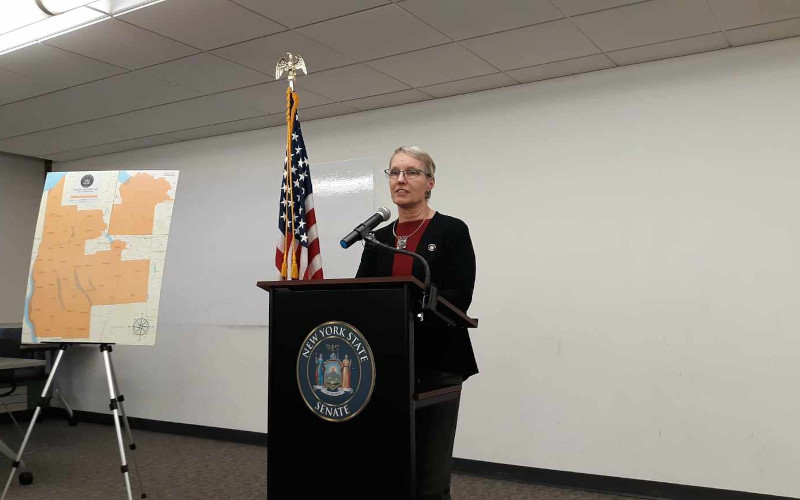
Paul Szmal: And good morning. Welcome to FLX Morning for this Tuesday, March the 4th. It is 35. We do have one school announcement. The Wayne Central School is closed again today due to a water main break. Staff should report. Welcome aboard. I am Paul Small. Greg Cotter will be joining a little bit later on this morning. Right now, we're joined by State Senator Rachel May. Good morning, Senator. How are you this morning?
Rachel May: Good morning, Paul. I'm doing great. How about you?
Paul Szmal: Doing well. Doing well. I wanted to jump into some of the budgetary stuff. We were discussing some of this with Assemblyman Brian Mantello just yesterday. I know that this happens to be Consumer Protection Week. Are you working on anything in particular related to that for the state budget for this year?
Rachel May: Yeah, there's a number of pieces of legislation that we expect to be embedded in the budget, although often the legislature tries to take those out and work on them separately. But for example, the click to cancel legislation, the governor asked for. We're working on changing it a little bit. But the idea is if you can click to subscribe to some kind of service, it ought to be equally easy to get out of it. I imagine everybody listening has had the experience of doing a one-week free trial, and then when you try to end it, they don't want you to. They make you phone in and speak to a customer service representative who may be hard to reach. So we want to make it so it's just as easy to get out of those agreements as to get into them.
I'm working on some bills. One is on rental car fees. If you've rented a car, you might realize that they charge a lot for gas if you don't fill it up when you return it, or they sometimes have surcharges for tolls. And we just think that that's not appropriate for what rental cars should be doing, rental companies. And then more generally, the federal government is getting rid of a lot of the guardrails on financial fraud and foreign corrupt practices and money laundering. And I feel like here in the state of New York, we really need to see what we can do to protect our consumers from a lot of those kinds of practices.
Paul Szmal: Now, in addition to that, it's National School Breakfast Week, Senator, and I know that there have been some concerns from the federal level trickling down on how school lunches and school breakfast programs might be affected. What are you doing on the state level to work towards maintaining those?
Rachel May: Well, what we are going to propose, I think, in the budget is and what the governor proposed was universal school breakfast and lunch throughout the state, which is critical. As somebody said yesterday on the Senate floor, you don't get in your car if there's no gas in it. You shouldn't start kids at school if they don't have the fuel in their systems to actually pay attention, do the work. So we're going to do our part for that. But some of the money has in the past come from the federal government. And I don't know if we're going to be able to plug those holes. It's really a shame that the federal government is talking about abdicating its role in helping our kids succeed.
Paul Szmal: Do you find that there are a lot of things as you work through the state budget process where there has been federal assistance that may now be coming into question as to whether it's going to be there or not?
Rachel May: There's a lot, especially in health care, but we have to make the budget by April 1st. And it's hard. We're making it in a climate of great uncertainty about what our federal partners will be doing. We're going to do the best we can here to produce a budget that's good for New Yorkers. And we may have to revisit it. I don't know how that will work if the federal government makes big changes.
Paul Szmal: Based on the deliberations that you've been having inside the state Senate, and I know the Assembly is working on their one house budget right now, do you think that we'll get a budget on time for April 1 as intended?
Rachel May: I have to say from our end, it's going faster than it's ever gone. And part of that is I think the governor didn't pick a lot of fights with us in her initial budget. Sometimes governors take out big, important things and make us buy them back. And she didn't do that as much this year. So I think it's probably going to be a smoother negotiation. But there's always something that comes up at the very end. And we'll have to see what that is and whether it can be resolved quickly or not.
Paul Szmal: I also wanted to ask you about a farm equipment repair bill that you've been working on.
Rachel May: Yeah, this is also in the consumer protection space. So I've had this bill for several years. It's about farmers will get a big, you know, a combine or something. They're really complicated pieces of machinery with a lot of technology as part of them. And over time, the big companies that make them have made it almost impossible for the farmers to repair them. And there's an agreement that comes with it, you have to have John Deere or whatever Caterpillar do the repairs for you. And the problem with that is if it breaks down in the middle of planting or the middle of harvest, you can't just wait days and days to get it repaired, you're going to lose a huge amount of your business.
And so farmers who are typically pretty self-reliant want to be able to repair them themselves. And that's a matter of having access to the repair manuals. And we want to make sure that that's available so that they can get on with their with their farming without big delays and big expense of trying to get it repaired by the company.
Paul Szmal: Are there any other particular budget items that you'd like to highlight that maybe your constituents have asked about?
Rachel May: Yeah, I had a town hall meeting the other day. And there were a lot of questions that came up. I'm pleased that we're going to be doing, I heard the news just before we came on about a water main break, we are trying to put a lot more funding into clean water infrastructure so that local governments will have the funding to make those repairs in an expeditious manner. So we have both, we're adding money to the general fund for clean water infrastructure, but we're also trying to create a new program that where the money would just go directly to the municipalities and they can decide what to do with it. And I think that's always municipal leaders prefer it that way. And I'm hoping we're going to finally get it in the budget this year. We've been trying for a few years.
Paul Szmal: All right. State Senator Rachel May, thank you very much for joining us this morning and getting up early with us.
Rachel May: My pleasure, Paul. Take care.