Paul Szmal: And welcome back to FLX Morning on Finger Lakes News Radio. It is 8.38. Our guest joining us now is Chris Lajewski from the Montezuma Audubon Center. Good morning, Chris. How are you this morning?
Chris Lajewski: Good morning, Paul. I'm well. How about you?
Paul Szmal: Good. I have to share a story because I don't know which one it was that I saw yesterday when I was traveling, but I got to see close range either a hawk or a falcon. I don't know if we have falcons in this area or not. I know hawks are pretty common, Chris.
Chris Lajewski: Yeah, this time of year before leaves pop out on shrubs and trees, quite easy to see birds of prey. We do have red-tailed hawks. That's our most common hawk species. It's a fairly large bird, stands about two feet tall from head to tail, can be seen sitting on top of utility poles, even on power lines and certainly in trees. They're hunting for small mammals, even small birds on occasion. We do have falcons here in the Finger Lakes region as well. A peregrine falcon is the largest and fastest falcon that we have. It can fly, when it's in a dive, upwards of 200 miles an hour, which is just incredible.
Paul Szmal: Wow.
Chris Lajewski: Then we have a couple of smaller falcon species, the Merlin and American kestrel. They're more six to eight inch length range. If it was a larger bird, I'd say it was the red-tailed hawk.
Paul Szmal: Ah, okay. That's probably what it was. I know I've seen quite a few hawks around back here in the field behind our radio station building and so on and so forth. I wanted to ask you about the, because the weather gets so idiosyncratic this time of year where one day it can be 70 degrees and the next day it can be 20 degrees, if that has any effect on the bird migration patterns?
Chris Lajewski: Well, despite what people may see when they look outside their window or even step outside for that morning walk, we are in spring migration here across the Finger Lakes region. We're starting to see some songbirds returning to the Finger Lakes. Up at the Audubon Center yesterday, I encountered the first northern mockingbird of the season, at least for me. It's not a rare bird, certainly, and we will have them regularly throughout the breeding season, but always fun to see that and or hear that first bird of a particular species in spring. We are also seeing the first shorebirds migrating back into the area. Greater yellowlegs has returned to the Montezuma Audubon Center marshes and both of those species will feed on insects. And so with the milder conditions generally that we've been experiencing over the last couple of weeks, insects are becoming more prevalent. The adults of a particular species are starting to fly around. We certainly have the first mosquitoes coming out. We have various flies, even starting to see some honeybees buzzing around the early blooming native wildflowers in the forests of Montezuma. So despite this maybe step backwards today in terms of weather, overall spring migration is underway and it's a great time to visit Montezuma because we have an abundant amount of accessible areas for people to enjoy with 20,000 acres of public land and 30 miles of designated hiking trails. There's no shortage, whether you're down at the National Wildlife Refuge and enjoying the wildlife drive and their visitor center, or come on up to Route 89 in Savannah where the Audubon Center is located. Enjoy our facility, our indoor exhibits, and our 200 acres, two miles of trails.
Paul Szmal: We're talking with Chris Lajewski from the Montezuma Audubon Center here on FLX Morning. Our species spotlight for this month focuses on a bird that has purple in the name and I hope is purple in color as well.
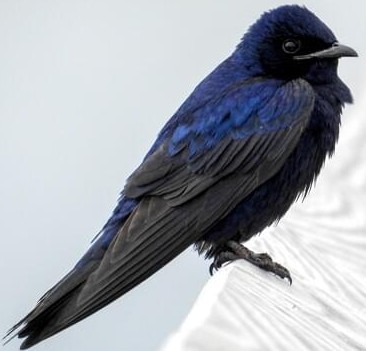
Chris Lajewski: Well that's right. The Purple Martin is a native bird that has just returned to the Montezuma Wetlands Complex and other areas of the Finger Lakes region. I encountered the first Purple Martins returning to the Audubon Center last week. These are a swallow species, so they're related to barn swallows and tree swallows. They have generally angular or pointed wings with a forked tail. The male adults of this species have a glossy purple color, especially when the sun is shining on them. They have this iridescent purple color, just a gorgeous looking bird. And then the females and juvenile birds are slightly less brightly purple, more of a gray purple in color. These species generally now return to nesting boxes that people have put up. Now before people started tinkering with habitats and altering forest ecosystems where natural cavities were abundant and Purple Martins could nest in readily, they were in nesting cavities, holes in trees. But now with the decline of their habitat, the Purple Martin exclusively relies on large housing units that people have put up. You might encounter those along lake shores, stream sides, even near wetlands and ponds. We have two housing units at the Audubon Center. They've been regularly used by Purple Martins for the nearly two decades that the Audubon Center has been there.
Now these Martins are an incredible species because they will spend the winter down in the Amazon Basin of South America. That's a good 3,000 miles south of the Finger Lakes. The males are the first to return to the nesting units, set up the territories, decide which units they're going to take over, and then the females will generally return in a couple of weeks, maybe three weeks down the road. Both males, females, and eventually the juveniles will feed on insects, large insects in fact. So dragonflies and damselflies, bees as well. And so it's a great species to look at visually, very melodious song. And if you're not a fan of large insects and stinging insects, this is a good species to have around, keeps those populations in check.
Paul Szmal: And as we head into spring, you might want to think about planting some proper plants that birds might enjoy.
Chris Lajewski: Yeah. We have, at Audubon, we have information on our Plants for Birds website that can help people identify native plants to go in landscaping. Could be on a balcony, it could be in your front yard or on your back porch. But native plants will benefit birds in so many ways. They provide food, whether it's the berries, the seeds, or even the nectar from these plants. But then also, especially the larger native plants like shrubs and trees, they can provide the vital shelter that our native birds need in order to nest and raise young and continue the species. So it's Audubon.org slash Plants for Birds. And when folks go there, they can find retailers right here in the Finger Lakes region that sell native plants. So whether you're in Geneva or Ithaca, Rochester, or Syracuse, there are plant nurseries that specialize in native plants.
Paul Szmal: And so many benefits to native plants, really. Not only for the birds and other pollinator species, but also benefiting us because visually they're quite nice to look at. They typically have nice flowers, whether it's a spring or fall, or even some of our native plants will bloom in the fall season. And they're quite easy to take care of. They're adapted to our climate here. And so generally they don't need the constant care and attention that an introduced species or an annual species needs. You don't have to water it regularly. You don't have to fertilize it. Certainly you don't have to use any type of pesticides for it. So you just kind of plant it and enjoy it. And that saves time and you can enjoy, folks can enjoy the rest of our spring and summer months here across the Finger Lakes region doing other things. So again, that's Audubon.org slash Plants for Birds. If folks are thinking about what to put in their landscape coming up this spring season.
You're putting out a call for volunteers to help restore Montezuma's habitats as well. What can you tell me about that, Chris?
Chris Lajewski: Well at the Montezuma Wetlands Complex, we have this program that's a partnership between the Montezuma National Wildlife Refuge, Montezuma Audubon Center, as well as our New York State Department of Environmental Conservation folks, and another great organization, the Friends of the Montezuma Wetlands Complex. And we call this program MARSH. That's an acronym. It stands for Montezuma Alliance for the Restoration of Species and Habitats. And we're kicking off the first MARSH events of the season coming up tomorrow. And that's Wednesday, April 9th. We're going to be working down at the Montezuma National Wildlife Refuge, removing woody invasive plants. We're going to be focusing on bush honeysuckle and common buckthorn. These, if left unchecked, can take over grassland habitats and forest habitats, crowd out the native vegetation that has been growing in those areas. And of course, our birds will not utilize these invasive plants. They won't eat the berries or the seeds, and they generally don't nest in those areas. So we're going to be working, as we always do, very hard to remove those invasives to make it more hospitable for native plants to grow, and then therefore the native birds will thrive.
All of our events typically take place on Wednesdays and Saturdays, and they will run from 9 a.m. till noon. So we have about three hours worth of work. We provide all the training, the materials, supplies, equipment, gloves that are necessary for the work. And then after the morning of work, our wonderful organization, the Friends of Montezuma, will provide lunch for all the volunteers that participate. There might be sandwiches, chips, beverages, or pizza, depending on the size of the group. Our first marsh event at the Audubon Center is coming up on April 12th. Again, we're going to be focusing on the woody vegetation removal in our forests as well. So a lot of opportunities throughout April and May for people to get involved. We have more information on our website, ny.audubon.org, slash Montezuma. If people are looking to get involved, help us enhance and restore habitats across the Montezuma Wetlands Complex.
Paul Szmal: And I wanted to, before we wrap up, give you a chance for you to shout out about the annual benefit coming up on June 9th.
Chris Lajewski: That's right. We're going to be once again at Wayne Hills Country Club over in Lyons for our largest fundraiser of the year. And it's an opportunity to support the conservation work Audubon conducts at Montezuma, as well as over at Onondaga Lake in Syracuse. We're looking to raise about $20,000 through this event coming up on Monday, June 9th. We're going to have a lot of opportunities for people to support our work. Even if they are not able to join us for a day of golf at Wayne Hills Country Club, they can join us just for the dinner, which will be coming up at 5 p.m. on Monday, June 9th, right there at Wayne Hills Country Club. And if that day entirely is blocked out for folks, we have an opportunity for them to support our work through our online auction, which is going to run from May 30th through June 10th. Again, looking to raise thousands of dollars for habitat restoration, our Next Generation of Conservationists program, which inspires and works with high school and college age students and getting that next generation of conservationists involved in our work, as well as just being open to the public and being accessible and welcoming and connecting people to Montezuma and other important bird areas across the Finger Lakes region. So again, folks can go to our website, ny.audubon.org slash Montezuma, for more information, register and sponsorship opportunities.
Paul Szmal: All right. As always, Chris, we appreciate the channel. Check in with you next month.
Chris Lajewski: Great to talk with you, Paul. Thank you.
Paul Szmal: All right. It is 8 52 on FLX Morning.