Paul Szmal: Good morning, it's 8.38, FNLX Morning brought to you by Enstec Automotive and Trailer, your go-to destination for hauling and vehicle services. 2567 Edwards Road, Waterloo, online at enstecautomotive.com We're joined now by the mayor of the Village of Ovid, Aaron Royce. Mr. Mayor, good morning. Thanks for your time.
Aron Roison: Good morning.
Paul Szmal: So, when did you first hear of the fire and what did you do and see that night?
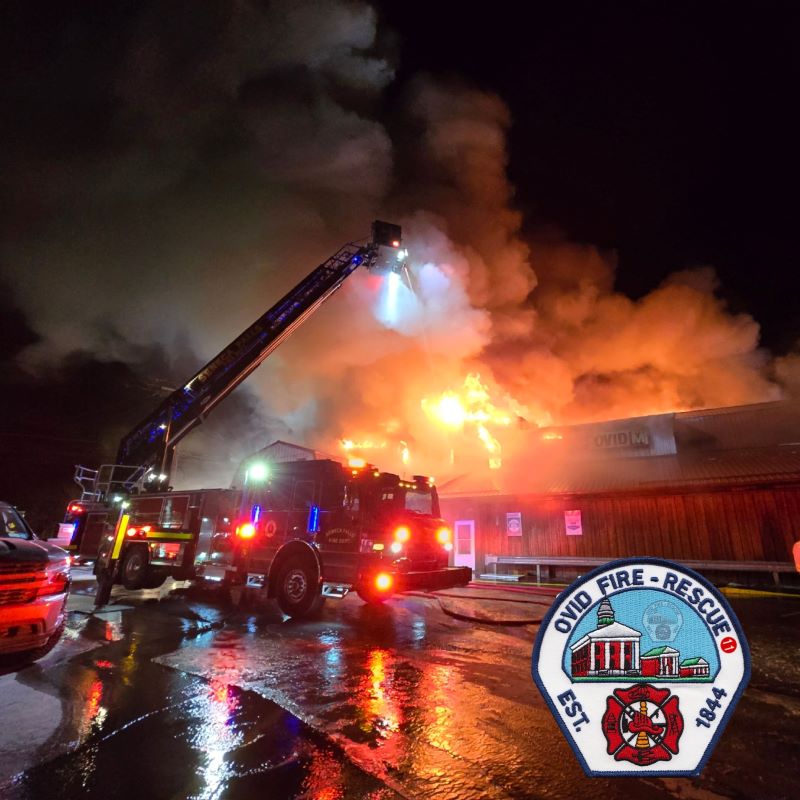
Aron Roison: I first heard of it probably about 20 minutes after the alarms went off. I drove down to the Village Main Street and was just completely in shock on what I saw. Just the entire block was starting to go up, starting with the Big M, and it just was a horrifying sight.
Paul Szmal: Let's talk about the efforts of the firefighters that night. Miserable cold night. Guys were out there, clothes literally freezing to their bodies, and people had to drag them off the line and say, go warm up.
Aron Roison: Yeah, those firefighters, they did tremendous, tremendous efforts, second to none, with handling the fire, with making sure that order was being kept, along with the law enforcement and the first responders. It was an incredible collaborative effort, but yeah, those guys did real incredible feats that evening.
Paul Szmal: It seems like the worst of events brings out the best in people. Give us your reaction to just the almost instant effort in OVID and all around to say, what can we do to help?
Aron Roison: Yeah, it was the outpour of assistance, of compassion, empathy, understanding, and then the support from all of the local entities, from the charities to the food banks to the state, all the way up, even to the governor's office reaching out to me to ask what we needed as a village to find some sort of center. So it's been, in all of this, we know as a village and a town that we have incredible support.
Paul Szmal: One of the things that everyone wants to know about is the possibility of Big M rebuilding. I know the owners are still considering that, and we talked to Jeff Shipley at the Chamber about that. What can you tell us about that process? Is there anybody talking to them or trying to work with them? And what do you know about the rebuild, or hopefully rebuild, of Big M?
Aron Roison: Right now, everything's still up in the air. It's still in the recovery period. So, you know, everybody's just trying to find their footing right now. So it's still in the process of conversations.
Paul Szmal: Is there any kind of help available from the state? Is there anybody, local lawmakers or governor's office that you've been in touch with?
Aron Roison: Yeah, there's been a couple of economic outreach committees and bodies that I've been in contact with that we're working on a plan and a framework to see what needs to be done, and then how that can turn into a larger potential development of the village and town.
Paul Szmal: Where are the people from the apartments staying right now?
Aron Roison: Currently, they're staying with other households or family members. Everyone is accounted for. Everyone has a roof over their head right now. So for that, they're safe.
Paul Szmal: You must have a little bit of a feeling, you know, why us? I mean, it's the second major fire in about 10 years. The South County experienced some very severe flooding a few years ago. I mean, are there times that you just say, why is this happening to us?
Aron Roison: Yeah, you know, we have a village that has a lot of history. It's an iconic village, and a lot of those buildings are over a century old. So, you know, it's just one of those things where we are finding ourselves in this position again, and we just keep moving through it, and we'll find our way.
Paul Szmal: We just talked to our friend Frank Capozzi at Catholic Charities of the Finger Lakes. They're one of the lead agencies in coordinating all the efforts, and we're going to have him on tomorrow morning. People all want to help, but you want to sort of have a coordinated effort. What's the best thing that people in the public can do to help the village of Ovid right now?
Aron Roison: Right now, you know, we're pretty well stocked with food and clothing for the time being, but the biggest thing is financial donations and to either contact United Way or the Ovid Fire Relief Fund. Catholic Charities, as well, is another organization that's accepting donations. But the biggest thing is to not forget. You know, this happened a week ago today, or since Tuesday, and the big thing is not to forget Ovid. You know, a month from now, two months from now, you know, relief will start dying down, but the importance of remembering what happened, because the significance of this fire didn't impact just the village, but thousands of people that come to the area throughout the year, especially coming into the tourist season. So, you know, there's going to be this ripple effect, so everyone needs to keep Ovid in their purview.
Paul Szmal: Long-term, what can you do to ensure the success of Ovid and of South County? It's obviously a lot of rural areas across the Finger Lakes. I live in a rural area in Yates County, and we're seeing drops in school enrollment and just a lot of difficult economic headwinds to battle. What can you do and what can we all do to ensure that Ovid stays healthy 100 years or more from now and that the south part of Seneca County does?
Aron Roison: I think a lot of it is just being engaged with your community. Reaching out, talking to neighbors, participating in the local commerce as much as possible. For our growth, you know, it's just being aware of what there is on the south end and, you know, what it was and what it can become. I mean, we're all in this together, and I think it's just going out and having an experience. For our growth, it's things that we're working on with more rural development organizations. So we just got to keep together.
Paul Szmal: I know one of the groups that was displaced was Steps. I've talked to some of those people in the past, and they're doing great work in the south part of the county. Have they found new office space, and are they pitching in to help?
Aron Roison: Yeah, they're reaching out, you know, organizing other voices to help find solutions for the situation that all of us are in. I don't think they've set up a new concrete spot yet, but they have the mobility to continue that incredible work that the Steps program does for the community and local business.
Paul Szmal: Is there anything I've left out that you'd like to talk about, or a message you'd like to spread to the folks in OVID and beyond?
Aron Roison: I think all it is, I think what I would like to say is, and to reiterate, that, you know, these catastrophic experiences that communities go through, OVID's not singular, but OVID right now is experiencing something that is devastating to so many people, but so many people that don't even know about it yet until they come here. Once the season kind of continues to keep warming and there's more people around, it'll start to impact more and more people exponentially. So, you know, I think, like, having that information and knowing that we can continue to have this effort go on for the next six months, year, two years, and this can stand as something that can re-embolden a community like we've never seen before.
Paul Szmal: Well, thank you for that reminder, because it is, you know, like you say, the people going through the hurricanes in the Southeast, you know, it's easier for them to get forgotten, and the whole rebuild will take a very long time. We appreciate your time this morning, and most of all, thanks for showing us what a community can be and how good people can be. That's the greatest lesson, I think, out of this. So, again, we appreciate your time this morning very much.
Aron Roison: Thank you very much.