Paul Szmal: Good morning, it's 816, it's FLX Morning Monday, and we have Christy Richards with us from Ontario County Public Health. Good morning. We're going to talk about a couple of things. First is suicide awareness and prevention, and that's this month, September, and then coming up in November, there's some suicide prevention training. So let's start with, as we get further away from the pandemic, is there any sign of the problem lessening? Was the pandemic part of all this, or where are we with suicide in our society?
Christy Richards: Suicide is and continues to be a huge burden across the United States. When you look even globally, it's estimated 800,000 people lose their life by suicide. That's about 40, every 40 seconds, a life is lost by suicide. It's the leading, it's the 10th leading cause of death in the United States. In Ontario County, you know, it's fluctuated over the years, we've lost about 70 residents from suicide between 2016 and 2023. And you know, I'm always hesitant to talk about numbers, especially when it comes to local numbers, because it's not just numbers, it's people's friends, their mothers, their fathers, their co workers. So I like to talk about the positive end, I like to talk about the programs that we have in place to help people that are really, really struggling.
Paul Szmal: All right, so let's do that. What I know 988 is one thing that you can call, what are some of the other options available to somebody if they just if they feel like they've, they've got no hope?
Christy Richards: Absolutely. 988 is a wonderful option. They've taken that long suicide hotline, they brought it down to just three critical numbers, 988. And you know, many times I talk with people that are struggling, they don't realize that that phone is actually picked up in Canandaigua, right there at the VA. So I think it really helps people to understand that those are local folks helping local folks, you know, I think that's really helpful. If you're in a crisis, if you're thinking about ending your life by suicide, you can always pick up the phone and call 911 as well. That's your crisis number. And we have a beautiful program through the Clifton Springs Hospital called CPAP. And they're able to assess people either over the phone, over an iPad, in the emergency department in their home. We're really blessed to have really great mental health care here in Ontario County.
Paul Szmal: Is there an intersection between mental health problems and drug abuse?
Christy Richards: Yeah, absolutely, absolutely there are. You know, and that's one of the reasons why programs like FLACRA are so important. Here in Ontario County, we have a beautiful program called FLACRA. And they work with folks that are in that intersection between mental health and drug abuse. And they help both aspects of that issue.
Paul Szmal: Are we getting any kind of a handle on why there's been this increase? Is life harder today than it was? Do people lack coping skills? I mean, that's the million-dollar question is, why is this happening?
Christy Richards: You know, I think that if we want to go all the way back to the root cause, a lot of times it's adverse childhood experiences. You know, when you talk in public health about upstream, how are we going to fix things upstream, meaning what's the root of the cause? And I think a lot of that has to do with adverse childhood experiences. There's a lot of data around this. Kaiser Permanente and the CDC both have done a lot of research into this. It's on their website for people that are interested in this. And basically, in a nutshell, it's ensuring that children have one person that they can really count on, one person that's going to, you know, help them and guide them through childhood. That one person is the resilience factor needed to help people in the long term.
Paul Szmal: Has most of the recent increase been among young people, or is this an across-the-board all-ages problem?
Christy Richards: I think mental health crisis, you know, the schools will tell you that students are absolutely struggling. When it comes to actual suicidality, older folks are at the higher risk.
Paul Szmal: What about bullying and cyberbullying specifically? Would we be better off if we just didn't let our kids have phones until they were 18?
Christy Richards: Oh, you know, that is, I don't know. I don't know that answer. You know, I know that they use their phones in other ways as well, you know, to support each other. So I think that's really up to each individual parent if they want to have that discussion. With a child's therapist, if they're in therapy, I definitely encourage that. But I don't know if I have the answer to that. I think it's really up to each individual parent.
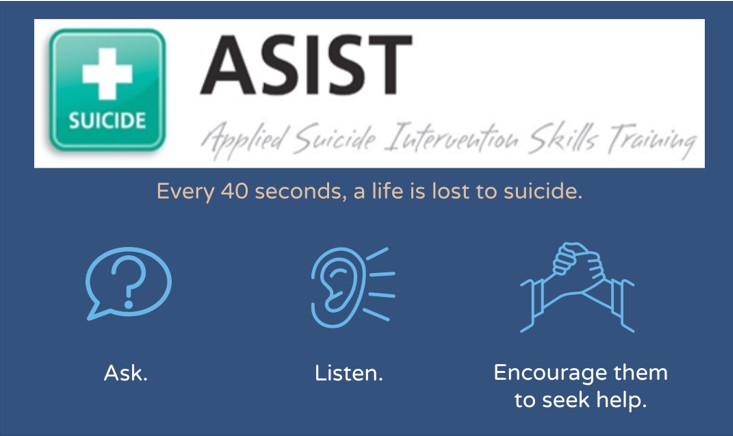
Paul Szmal: Coming up in November, you have a really intense two-day training. It's called ASIST, with a one S on either side of the I. It's A-S-I-S-T. That stands for Applied Suicide Intervention Skills Training. This is November 18th and 19th from 830 to 430, day-long training at the county complex. Tell us what people are going to learn and how they can apply this.
Christy Richards: So this is one of my absolute favorite trainings, especially for anybody that's going to have a lot of interaction with people in general. So like nurses, social workers, people that volunteer through non-for-profits, that kind of thing. ASIST was created by Living Works, and it's endorsed by the New York State Office of Mental Health. It's a two-day interactive workshop. It has really great discussions, simulations, and a lot of practice time helping the learner to understand how we identify people that are having suicidal thoughts, and then how we connect them to care. It is two days. You do have to commit to both days. It's here in Ontario County at the 3019 County Complex Drive. You don't have to be an Ontario County resident to come. We do ask that people over 18, because it is such a heavy topic, we are looking for people over 18. It's hosted by the Ontario County Suicide Prevention Coalition. We host about two a year. They fill up really fast. And I think it's one of my favorite ones, because we always were taught as nurses to ask about suicidality, but we weren't taught to ask how, and most importantly, we weren't taught to really understand what to do if someone said yes. I have used the concepts that I've learned through ASSIST multiple times in helping people to connect to that CPAP program that I mentioned, and I think it's a really great opportunity to get this mental health training out there to as many people as possible in our county.
Paul Szmal: For those of us who are not trained, almost everybody expresses some sort of suicidal thought at some point in their life. How do we tell when it's the real thing and there's a real risk, and what do we say and do and what do we not say and do?
Christy Richards: Yeah, I think that one of the most important things is if you're having suicidal thoughts, that you go ahead and jump on that 988 line. I think that's really important to get that connection to help immediately. I don't think as trained ASSIST people, it's not our job to decide who is going to follow through with these thoughts. It's our job to connect people to care. And I think it's really important that people understand that. So our job is to provide that warm handoff to a therapist and make that connection. There are some good resources out there. Suicide Prevention Month is September 1, is NAMI, the National Alliance on Mental Illness at NAMI.org, N-A-M-I.org. They have a whole set of resources, and this training would be terrific, and maybe we can talk about it again when it gets closer. The Applied Suicide Intervention Skills Training, ASSIST, two days. It is intensive. You're going to get your money's worth here. It is November 18th and 19th, 830 to 430, both days, County Complex Drive, and there is no fee for the training. It's for professionals or anybody who wants to really know what to do in a crisis situation.
Paul Szmal: Christy, thanks for coming in, and thanks for sharing this with us. We really appreciate it.
Christy Richards: Absolutely. If the public can help me share the 988 hotline, that would be wonderful. Thank you so much.
Paul Szmal: Absolutely.