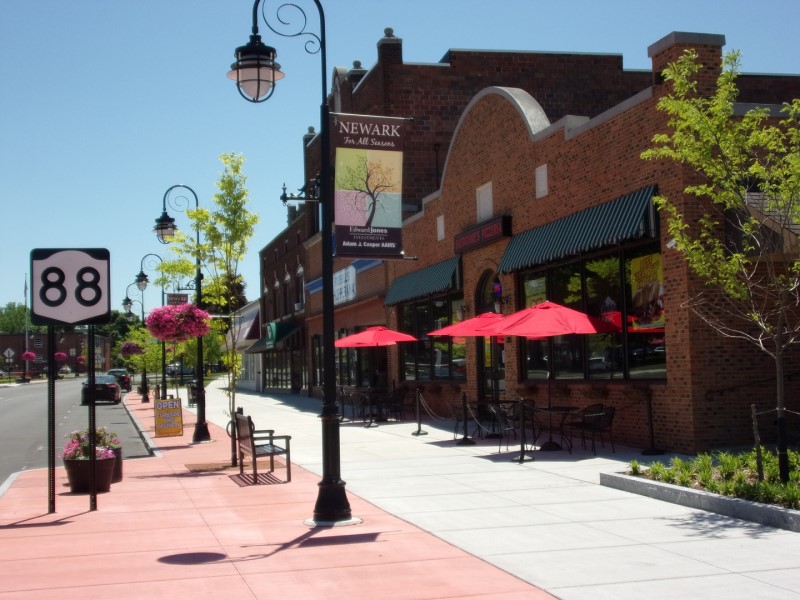
Paul Szmal: Our guest on FLX Morning is the Mayor of the Village of Newark, Jonathan Taylor, back for his monthly visit. Good morning, good to have you back once again.
Jonathan Taylor: Good morning, thank you for having me.
Paul Szmal: A theme in our conversations over the last several months has been employees and board members going off for training. So this time the Code Enforcement Officer, Chas Gambino, is going to be getting some training at RIT. I would imagine that municipal codes are probably getting more and more complicated every day.
Jonathan Taylor: Yeah, municipal codes are changing all the time. You know, the state hands out new regulations. And every year this training comes up, this particular training. And all of our Code Enforcement Officers over the years have gone to this training. So yeah, it's something that is continuously changing. As they say, the only thing that's constant is change. And certainly with codes, that's the case.
Paul Szmal: One of the things that usually happens in January meetings is budget transfers from department to department. One department needs a little more, one didn't spend everything, so the money gets moved around. Anything of note in those transfers at the last meeting?
Jonathan Taylor: No, not really. It's just kind of clean-up work that we want to make sure that the line items are funded for the projects that are needed. Certainly during the year you have things that surprise you weren't expecting. You always try to be conservative in budgeting and over budget for line items. But there's always that case where it just doesn't work out the way you want it to. So you make those transfers to make the budget work at the end of the year.
Paul Szmal: There was a public hearing at the meeting for public input on the replacement of a culvert for the Blue Cut Road project. Was there any comment? And then tell us about that project.
Jonathan Taylor: Yeah, there was one comment, very favorable, really happy with the way the project came out. It was the most immediate neighbor. And this was the Blue Cut Road culvert replacement. It had been needed for a long time. The village was able to gain a $1 million CDBG grant to replace the culvert. And as one of the requirements of that grant, we needed to have a public hearing at the end of the project. That was completed this past summer, late summer, early fall. It was a good project. The road's open now. The culvert's much wider than it was before, allowing for safe vehicular and pedestrian traffic. And we're really excited to have that completed.
These projects aren't the ones that everyone kind of clings to. They don't recognize maybe the importance of them, but they certainly are important to our infrastructure and keeping the road open and everything. Along with that, we replaced some of the water main and sewer main while we were in there. So now that culvert should be in good shape for a long time to come.
Paul Szmal: Is that Community Development Block Grant money, do you get a set amount every year, or do you have to apply for it project by project?
Jonathan Taylor: No, you have to apply project by project. And so yeah, it's not automatic. And actually, we had probably applied for that grant at least twice before we received it. Because certainly there are other projects throughout the state that might have priority. And so, you know, we were able to get to a point where, you know, ours was funded and we had the right formula for the grant. And we're able to gain the grant for the culvert project.
Paul Szmal: There was discussion at this week's meeting about the water treatment service contract with a company called WaterWise. This is for the digester building and control buildings. Is that to operate the building or supply it or what?
Jonathan Taylor: No, it's a maintenance thing that we have to do every year. They come in and it's a really small contract. And we annually approve the next year's agreement with WaterWise for that maintenance piece. So not uncommon and not a huge expense item.
Paul Szmal: You appointed a new commissioner, Michael Gonzalez, to the Canandaigua Lake Watershed Commission. You're the alternate. I didn't realize that that was one of those municipal organizations. We talk with the Awasco Lake Watershed Management Council each month. It's the same thing.
Jonathan Taylor: They're represented by the municipalities around the lake. Yeah, and every municipality or everyone who draws water from Canandaigua Lake is part of that commission. You know, we draw a lot of water from that lake and such. Our fees and everything to be a part of the commission are based on the amount of water that we draw. And having a seat on that water commission is part of our responsibilities. So, you know, Mike represents us well as needed. And if I ever have to pinch it, then I'm the backup.
Paul Szmal: You have a reservoir replacement project on the agenda, the Allerton Hill Reservoir. Is that a complete replacement or is it like a tank or something that has to be repaired? Tell us about that job.
Jonathan Taylor: Yeah, we actually just had the pre-construction meeting this morning. And that is with LG Evans. And CPL is the engineer. It's going to be a four million gallon tank built by DN Tanks, similar to the tank that we put in over at our water treatment plant in Schwarzville. But it'll actually be twice the size. I believe from what they tell me, this is one of the largest tanks they've ever built. And it's going up on our, up by our, next to our current reservoir, up behind Wegmans in the village.
Currently up there, there's basically an in-ground reservoir with a bladder in it. That cover to the bladder is aged quite a bit and in a state where we can no longer repair. About every year we spend $10,000 to $25,000 repairing that cover. And it's getting to the point where it can't be repaired anymore. So this project started several years ago, the planning process. We applied for some grant funding. We received a $3.96 million water infrastructure grant through the state that we received. And we also received $700,000 in BIL money, bipartisan infrastructure law money, to go towards the project. The project's a little bit north of $8 million. But we have almost, have about $4.5 million in other funding. So it's really going to help keep the costs down to the end users, all our water, all our 29,000 water users between the village of Newark and the communities that surround us.
Paul Szmal: So we've talked all through 2024 about the police department staffing getting up to full speed. Now you've lost a couple. Two part-timers have resigned. Are there plans to replace them?
Jonathan Taylor: No, we're really thankful that Mr. Steve and Mr. Richie were able to help us through a time where we were down on numbers, where we went through that time where there was a four-hour period we weren't covering with our, Newark Police Department was covered by the sheriff and state troopers. We're really thankful to have them on board. They helped out a lot. And at this time, they both have other ventures that they're moving on to. And we no longer need to fill in the holes like we had to before now that we have a full staff of our full-time employees. So really happy to have them involved. And they're still quite involved in the community. So we appreciate that.
Paul Szmal: So it was planned that at some point those positions would expire?
Jonathan Taylor: Yeah, they'd either expire or they would just not want to be in a position where they might be called in because of other things they're doing. So we still have a couple other part-time positions that are still in place. But going forward, we won't have as many. And hopefully we won't have the need for the part-time employees.
Paul Szmal: More police department training. Sergeant Salerno is going to attend Use of Force, a refresher course in Erie County. Matter of fact, that's going to be next week. Tell us about that training.
Jonathan Taylor: Yeah, so it's always important. One of the numbers that the state looks at, and actually the chief just did a year-end recap of numbers. Crime was down significantly in 2024 and other things. But one of the numbers the state wants to know about is use of force. And in the state's definition of use of force, it even means if a taser is pulled out but never used. So we keep track of those numbers. For 2024, there were what we call 15 uses of force. I'm sorry, I don't remember exactly how many were when a taser was pulled. So it's not even as high as it sounds.
But the use of force training is critically important. All training is important. Use of force is certainly critically important. And they do get into situations, certainly, where they may have to restrain an individual or whatever the case may be. And to be able to do that properly and correctly and safely is really vital and vitally important. So it's very important training. And we look forward to the opportunity to send our officers.
Paul Szmal: We had Katie Bronson on from Wayne Economic Development just the other day to talk about the pitch competition coming up. And we were talking about all the great economic news around the county and in the village of Newark during the past year. Anything new on that front or anything else that you want to get across to people before next month?
Jonathan Taylor: Well, I think the hotel is still looking for a late spring, early summer opening, the Mike Hotel. Coventry Commons mobilized last week, and they started the work in the re-manufacturing building. That was a DRI project. They're going to be putting 101 apartments in that old building. The St. Elizabeth conversion to apartments on West Miller Street is probably likely to go to construction within the next two months. So we have a lot going on in the village of Newark. It's exciting times, and we're going to see a lot happening this spring and through the summer and right into the fall. So a lot happening, and it's all good stuff.
Paul Szmal: And this is always the time of year where everyone watches the tea leaves coming out of Albany and what might be or might not be in the budget. Is there anything that you've seen that you like or don't like about any of those proposals so far?
Jonathan Taylor: Yeah, unfortunately, I haven't really had a chance to read the governor's press release that was just sent out yesterday to see what the highlights are and potentially lowlights. But we're going to start to weed through that and see what is going to be advantageous to our communities and what might not be, and then we'll work to advocate appropriately.
Paul Szmal: All right, Mayor Jonathan Taylor, Village of Newark. We appreciate your time each month, and keep bringing us the good news throughout 2025.
Jonathan Taylor: Thank you. Great to talk with you.