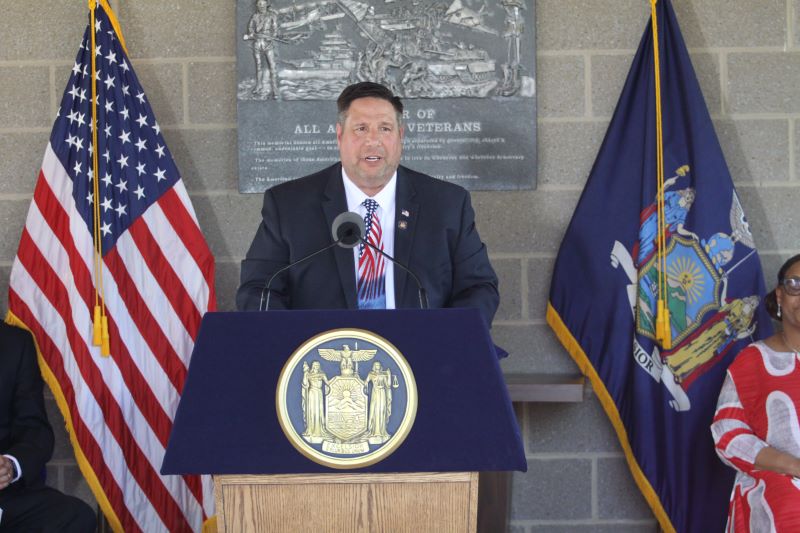
Paul Szmal: Good morning, it's 8.37, it's FLX Morning Monday, and it's time for our monthly Zoom with Brian Mankilow, the Assemblyman representing the 130th District, Wayne County, and Points North in our listening area. Good morning.
Brian Manktelow: Good morning, Ted, and welcome this morning, and thank you for having me on. Always glad to have you here.
Paul Szmal: So the session is over, or maybe not. We may have a special session. So is this where the Governor has to issue a message of necessity to call everyone back?
Brian Manktelow: Well, she could do that, but really it could be done by each House, by the Senate, and by the Assembly. Speaker Hastie could call us back in to the Assembly at any time. And we are anticipating that now that the primaries are done, we were told possibly sometime in July we'll be heading back, and I think one of the things that we'll be discussing will be the pricing that takes place in New York City. If you drive a vehicle in to deliver something, you have to pay a price to do that, and that's one thing that wasn't taken up prior to the session being done, and I believe we'll be doing that.
Paul Szmal: Now, I didn't realize that involved commercial vehicles. I can understand for private vehicles, you know, letting the market set the price, you say, okay, we're going to charge you $15 if you come into lower Manhattan at the busy times, and you can choose to avoid those times. But I didn't know, I mean, commercial vehicles really have no choice.
Brian Manktelow: Yeah, and that was one of the, when this was originally brought forward a year or two ago, congestive pricing is what it's called, and if you're a deliveryman, if you're delivering bread to different restaurants, stores, wherever in New York City, you have to pay to be able to do that. And that's added cost for the product, added cost to get it there, and ultimately, the consumers are going to pay for that, and their goal was to use some of that funding to help offset the cost of the MTA, you know, the mass transit system in New York City. And you know, so we're making people pay that don't really use the system, instead of making sure we charge enough money to cover the expenses to run that, to run the subways and stuff in New York City. You know, much like the thruway, we constantly are seeing rate hikes on the thruway to use it because we need to cover the cost. Well, that's really what should be going on in New York City, and that's not happening.
Paul Szmal: Are there any studies, any place else that's done this, showing whether it works, whether people will say, okay, I'll avoid the busy time to not pay the 15 bucks?
Brian Manktelow: Well, I think right now, there's, it's one thing whether it's a private person like you and I driving into the city, that's one thing, but this, if you're going to deliver, you have to pay it, and there's no choice, you have to pay it. And that's really one of the sticking points, because I know that some of the people we've talked to that actually deliver in the city, you know, they would like to come in in the middle of the night, you know, because it's less traffic, of course, easier to get around, and but they won't look at that, and I think that's part of the issue.
Paul Szmal: I've also seen discussion that the issue of casino licensing and or online casinos might be brought up in this session. Do you know anything about that discussion?
Brian Manktelow: We've heard bits and pieces of that, but nothing really in front of us yet. I haven't seen anything moving forward. That doesn't mean it won't happen, and you know, sometimes in Albany, we don't get to see anything until it's actually out there. Sometimes or all the time?
Paul Szmal: Sometimes or all the time?
Brian Manktelow: Well, I'll say, okay, most of the time, I'm trying to be trying to be nice this morning. So yeah, most of the time, we don't see pieces of legislation until, you know, sometimes an hour or two before we end up voting on it.
Paul Szmal: And of course, you and I both know that's done for a reason. So we can't talk to the people back home that we'd like to ask questions to. Now, how is this going to affect your radio station? How is this going to affect your little coffee shop or your daycare? You know, that's what Albany tends to do. We'll come out with it, get it passed, and then we'll look into it then. And that's what we're afraid of.
Brian Manktelow: If there is a special session, can individual members bring up things? Could you bring up something that you wanted to get passed during a regular session, but could not? Or is that controlled by the leadership and the governor?
Paul Szmal: That's controlled by the leadership. I mean, I think if it was a vital bill that I had brought forward that was, you know, first of all, I would have pushed it during session. I would have did everything I could to move it forward. That meant giving it over to a majority member. I would have did that just to get it to go through. It could be done, will be done. I really doubt that would happen, like I said, unless it's a very precise bill that needs to be passed, like right now. And I think that would happen, but that would be pretty tough.
Brian Manktelow: So one of the things that you like to do when you're back in the district, go to some of the events and things during the summer, but also just take the temperature of the average person on the street. What kinds of things are you hearing from the constituents since you've been back?
Paul Szmal: Yeah, I think since we've been back, you know, we do get around. We go to a lot of different things. And I do like to talk to people because I want to know what they expect of New York State and what's going on there. But again, we've talked before, you know, the pricing of food, fuel, everything is just so high. But then when you add on the amount of taxes that we pay in New York State, you know, I was at the airport up in Rochester yesterday and my wife's flight was delayed. So I had some time to talk to people and people that work there, people that were flying. And they're just tired of paying all the taxes in New York State. And rightly so.
Again, we pass a $230 billion plus budget again this year, up from when I first started Ted six years ago, I think it was $156 billion. Now we're at $230 plus billion budget. You know, people are tired and people need to be able to breathe and enjoy themselves and they really can't. And that's what I hear out there. People are leaving the state and, you know, we bring that up in Albany, Ted, and people say, well, no, that's not the case. Here's the numbers. Here's the numbers. That's not what the numbers are. The people that are leaving the state are the people that have good jobs that they can afford to leave or retired and how are we going to ever replace them here in New York State? And that's what we're seeing across the board. There is no workforce left in New York State.
Brian Manktelow: Well, and again, that goes back to that age old upstate downstate divide. The New York City economy is not the same as the Wayne County economy.
Paul Szmal: Absolutely. When the state passed the minimum wage bill, you know, they let upstate again, you know, lag behind, which was a good thing, but we just don't have those prices up here to support that money. And then, you know, I talked to a restaurant owner just last week and, you know, to bring someone in just to bust a table at minimum wage at $15 an hour plus everything that goes on top of that, workman's comp, unemployment insurance, everything, social security, everything that's added onto that. You can't sell enough food to make that happen. And that's why we are seeing a lot of the businesses just fold because they cannot afford to do business in New York State. And that's the reality of it.
Our fast food chains, they're a little different because they don't bust tables and they can also put in the kiosks where you come in and you order your food, pay for it and then just pick it up. Totally different than going into a small diner or a bigger restaurant. It's just the math doesn't work. You can't sell that much food that fast and people can't afford to pay that much.
Brian Manktelow: And also, it's not just the cost of labor, but it's the availability of it. Right now, we have relatively low unemployment and it's very hard for businesses of all kinds to find people to work at all.
Paul Szmal: Yeah, that's absolutely right. That's probably, when we talk and meet with businesses, that's probably the number one thing we hear is, I don't care what the business is, we can't get a good, solid workforce. Or if we do get a workforce, they only stay at it for a few weeks and then they just quit because they really, they just don't want to work. And since COVID and where we've gone to after COVID, we've made it almost too easy for people not to work in this state. And now we're reaping those, I won't say benefits, we're reaping that, we're reaping the part of that that has drawn this to where it is today. And it's just impossible to do business right now. And I feel for the business owners, and I'm trying to do everything I can in Albany as well as a lot of us as legislators, and we'll continue to do so.
Brian Manktelow: I know in your district and in your life, ag is a big concern. Are you hearing any particular concerns from farmers or how are they doing these days?
Paul Szmal: Yeah, just prior to coming out of session, Ed, one of the biggest things we heard was there was a bill that was possibly moving forward that would limit the time that people can work when the temperature is above 85 degrees. And I think there was a low end to that too as well. And we know in ag, we know, all of us that work, we know that you have to work when the temperature is above 85 degrees. That's what America is. We work, we're a capitalist system and we like to work and we do work and these employees like to work. And from the ag side, a lot of our workers that are coming from South America that work in our farms, you know, they don't mind the heat. They like to work in the heat. And to put that forward would be terrible. And we were able to put the brakes on that prior to session coming out. And I know that was one of the biggest concerns for our farmers prior to session being out.
Brian Manktelow: I know you haven't been out for long, so I hate to look ahead already to the next session, but moving forward, what will be some of your priorities and those of the Republican Conference and the Assembly?
Paul Szmal: I think right now, you know, as we just finished up, really we just finished the budget up a couple of months ago, you know, for me, we'll be tracking where some of those dollars are going, talking to some of the non-for-profits, talking to some of the businesses, because the state has this keen ability to tax everybody, but then not allowing the money to go where it needs to go. And we learned that this year when the comptroller came out about the funding for our veterans. You could check a box off New York State taxes, and a portion of that money would go to a veterans group or organization, and the state was holding on to that for years. So that's one of the things as the ranking member on the Veterans Committee, I'll continue to track that this summer, probably going around the state meeting with the different veterans offices in every county. That's my goal.
Of course, it's an election year, so we're busy there too as well, but lots and lots of things to do. People ask me, are you glad to be home and you can rest a little bit? I'm glad to be home, but rest, absolutely not. We work just as hard, if not harder, back at home as we do in Albany, and as long as I'm going to serve, I'll do that.
Brian Manktelow: Well, we appreciate that. 130th District Assemblyman Brian Manklow, thanks for that work, and thanks for sharing your information with us each month. We appreciate it.
Paul Szmal: Absolutely, Ted, and to you and all the listeners out there, happy 4th of July, and I hope people really think about where we are as a country.