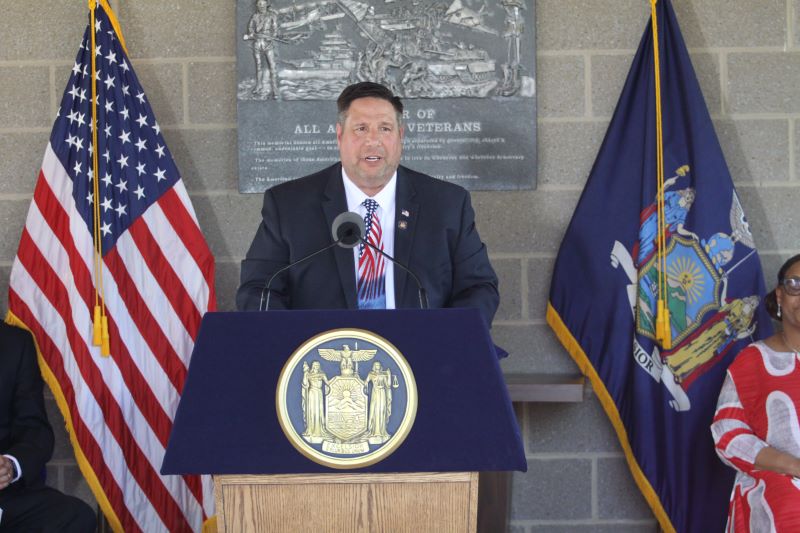
Paul Szmal: Good morning, it's 837. It's FLX Morning Monday. It is our December visit with 130th District Assemblyman, Brian Mankilow. Good morning and welcome back.
Brian Manktelow: Well, good morning, Ted, to you and I hope you had a nice Thanksgiving for you and your family.
Paul Szmal: We did and I hope the same for you.
Before we get into issues and Albany stuff, I do want to talk about the Toys for Tots program. You're participating again this year in conjunction with the Marine Corps. Tell us about the program.
Brian Manktelow: Yeah, anybody that wants to stop by our office, Ted, can drop off a few gifts for, you know, children that aren't so fortunate. And I know there's many private businesses across the state, across our area, that are doing the same. So it's just a nice way to give something to maybe someone that's not quite so fortunate.
Paul Szmal: You've already had a meeting in Albany as a conference. You chose your leader. Who's going to be the GOP leader this year?
Brian Manktelow: Yeah, it will be Assemblyman Will Barkley again this year. We did that last Monday and Tuesday in Albany. And we're looking forward to getting back there. And I think we made a great choice again, Ted. And, you know, Will does a great job leading the conference and, you know, we got a lot of work ahead of us.
Paul Szmal: I was going to say, do you think that makes a difference having a local guy?
Brian Manktelow: It does because, you know, Will understands our area. You know, we have a great contingency down in Long Island. We have a great contingency out west. But also here in the central area of New York State, you know, having that experience, and he's been there for, I think, now 22 years, understanding, you know, what's going on. And he travels across the state, you know, throughout the year. So he has a great idea of what's happening. So yeah, I think it's a huge difference for us because he kind of knows what's important to us in our area.
Paul Szmal: When I first came to the Finger Lakes, it was right in the middle of the time when the budget was never on time, year after year after year. Then we went through that period where we got some on-time budgets. Now this past year, we're back to the old days again. What do you foresee in this year's budget process?
Brian Manktelow: Well, Ted, to be honest with you, I hope that we can do another, I hope we can do an on-time budget. I think the people of New York State, you know, expect that and they should have that. You know, they send us there and we need to make sure we do our job. But I keep my fingers crossed because I really don't know how it's going to go.
When I first came in the Assembly back in 2019, Ted, Como was pushing an on-time budget. It was nice to see that happen because, you know, at the same time we have our school budgets that will be coming up at the same time. And they really need to know where they stand within the budget process. And it's hard on them and hard on our local school boards and our local taxpayers.
Paul Szmal: I know one of the things I hear from the municipalities that I have on the air is everyone was happy that after a long time with the AIM funding not changing, it went up in this past year's budget. And they're hoping that won't be just a one-time thing.
Brian Manktelow: Yeah, I think it needs to continue to move forward with the times. You know, inflation is eating everything up. You know, the cost of doing business, as we know, as homeowners or businesses is so expensive. And the same for our municipalities. So we will continue to push and advocate for that in the state budget coming up this next year.
Paul Szmal: So as we said, you got together as a conference in Albany and kind of mapped out the priorities for the coming session. What are some of those priorities?
Brian Manktelow: Yeah, I think some of the, Ted, some of the few things we talked about is really holding the state accountable. You know, right now there's a program out there called Early Intervention where we have individuals that go out to houses and they actually service young children from zero to three to get them acclimated into, you know, moving forward into pre-k and then into school. And one of the issues right now is we passed that back last April, and to this day we have not seen one dollar go out to our contract workers for that service. That's eight months behind, Ted, and that's unconscionable. Why are we holding that money?
So within the last week or ten days, we sent a letter to the governor's office, to the state ed as well, and on behalf of all of our taxpayers across the state. And that was a bipartisan effort on both sides of the aisle, and hopefully we can get that money released. And, you know, I just don't understand why we're holding the money.
Paul Szmal: I know you told me you had some issues as well with the State Liquor Authority. What's the nature of that?
Brian Manktelow: Yeah, so my understanding, Ted, years ago the State Liquor Authority used to meet every two weeks to look at individuals who want to either, you know, put in a liquor store or get a liquor license for a bar, a restaurant, whatever the situation is. Now it's once a month, and it's slowed the process down even more. It's already a slow process to begin with, Ted. Right now it's taking eight to twelve months to get a liquor license, and we are supposed to be a state that's open to business, and a lot of these businesses are small businesses, small business owners, and we need to push that sooner. So that's one of my priorities. As soon as I get down there, is meeting with the State Liquor Authority before we get to the budget process.
Is it a budget issue, or is it just we're not accomplishing what we need to do, Ted? And I'm gonna be right on that, because I have several different individuals here in Wayne County over the last two years. You know, ever since COVID hit, it's really even seemed to slow down even more. So that's one thing I'll be pushing, because we are open for business, or we should be, and I just don't understand why people have to wait so long.
Paul Szmal: It's the same thing regardless of anybody's thoughts about cannabis. It was made legal, and the rollout of the licenses has been horrifically slow. People took out leases on buildings, and made business plans, and then couldn't act on them. It just, it doesn't seem to me like it should be a partisan issue. It seems like an issue of getting these commissions staffed up and moving quickly.
Brian Manktelow: Well, Ted, I think it's an issue with leadership in Albany. It's a top end. You know, if we're gonna do all these programs, and going back to the EI, the early intervention, we knew what they were doing. They put in a whole different billing system. So if we're going to do something major like that, Ted, I think we should do a small pilot program somewhere within the state to, you know, make sure we work out all the kinks of what's going to happen with the new program, and then we can roll it out across the state. And that's what we should be doing across the board, because we cannot hold up our businesses or local people. It's just, it's just a disservice to them, and I think leadership needs to take a look at that at the top end in Albany, and again, I'll be reaching out to the governor's office to make sure we're going to do this, because it just, it breaks my heart that we have people that pay taxes, and when it's time for them to get service, it just takes forever, and that's not what we're here for.
Paul Szmal: Agriculture is a huge industry in the 130th, and you spent a lot of time talking to farmers. What are some of their concerns, and what would you like to be able to do for them in this coming session?
Brian Manktelow: Well, I think the number one, I guess the number one priority, Ted, is working with the Department of Health, and I'll give you an example. I had a local fruit grower here in Wayne County that the Department of Health came in and inspected their living quarters for the workers, and it was a, it was the first building that they put up, and that was a model for the Department of Health, and this is how it should be done. Well, when people change in different areas across the state and in the Department of Health, they look at things a different way, and they, we can't do that, so meeting with this fruit farmer, understanding now he has to make major changes to a building, what, which was approved back 10 years ago by the original Department of Health, and now he's got to make extensive changes, and it's going to cost them a lot of money, and when we see people move forward or move to different areas of the state, we need to make sure that what was done back then is still honored, and why, why should he or she have to put up a whole lot more money just to make sure that this one individual at the Department of Health sees it differently.
Paul Szmal: It's interesting you brought that up, because there's a farm near me that I drive by every day going to and from work, and there's, apparently there's some kind of state program, because they just replaced some of their worker housing. They had this old mobile home, and now it's been replaced with a much nicer, newer building, so I guess there is some sort of state program for migrant worker housing.
Brian Manktelow: Yeah, that's how this individual started with that first house, that first house 10 years ago. The state was very involved in it, helping them set it up, telling them what needed to be in there, and they did that. They did it to the state regs back 10 years ago, and now all of a sudden they want to come in, and these were not, these were not major changes. It wasn't with the water system, or the sewer system, or the heating system. This was about shelf space on a wall that each individual has to have this much space. But I hope they don't come in my house, because in some of our homes locally, we definitely don't have a lot of space, believe me.
Paul Szmal: And, oh go ahead.
Brian Manktelow: I was just going to say, coming up on Thursday is Pearl Harbor Day. We don't have too many of the greatest generation left around to keep that memory alive and tell those stories.
Paul Szmal: Yeah, I, you know, a few years ago, it's probably been 10 years ago, I was out at Pearl Harbor, the actual Pearl Harbor location, and there were one or two individuals that were actually there that day, and I had a chance to talk with them. And you're right, those individuals that were there that day, of course we have the individuals that are still there, you know, in the tomb on the Arizona. And yeah, it's a great way to remember Pearl Harbor. It's a great day to think about what they gave and think about where they are and who they were and how that affected us as generations moving forward here in the United States. So I have a couple different celebrations, or I'm sorry, remembrances to go to, and I'm looking forward to that, maybe saying a few words as well.
Brian Manktelow: This is our last conversation of 2024. Anything else you'd like to say to the constituents at the end of the year?
Paul Szmal: Yeah, I just want to say, you know, enjoy your holidays, enjoy Christmas, enjoy New Year's. You know, take time to spend with your family, because that's the most important part, Ted, our families and the people that we live with and are around. So, you know, really think about that and spend time, especially with our children and grandchildren.
Brian Manktelow: Well, you know, what a blessing. Yeah. Well, I'll tell you, we have been very blessed ourselves over the years by the incredible access that we were given by our lawmakers, including you, and we appreciate that each month and are so happy to be able to spread that news to the listeners and the residents of the 130th. So thanks again, and Merry Christmas, and we'll talk to you in 2025.
Paul Szmal: Well, thanks, Ted, Merry Christmas to you and your family and all the listeners. Thank you.