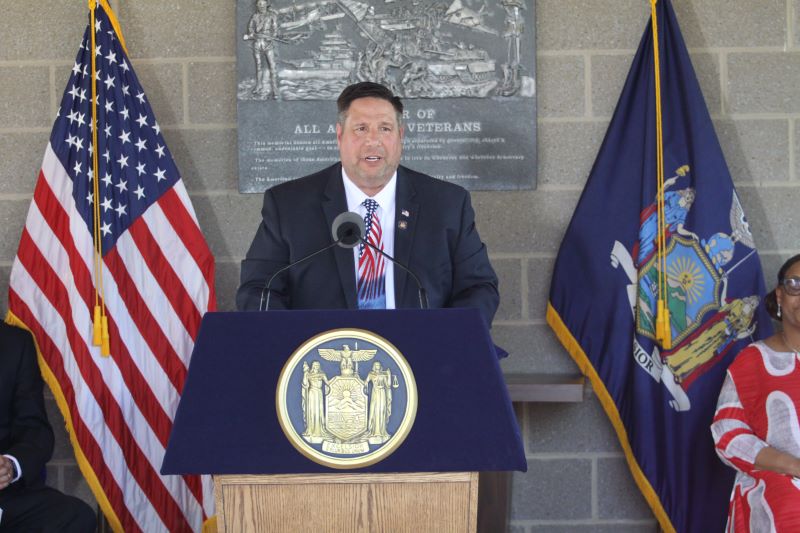
Paul Szmal: Good morning, it's 8.38 now, it's FLX Morning Monday, brought to you by Enstech Automotive and Trailer, your go-to destination for hauling and vehicle services, 2567 Edwards Road, Waterloo Online at enstechautomotive.com. He represents the 130th Assembly District, Yates County in Point South, or Wayne County I should say, and Points North, Brian Magdalo, good morning.
Brian Manktelow: Good morning, Ted, and Happy New Year to you and your listeners.
Paul Szmal: Almost gave you a new district there.
Brian Manktelow: That's okay, we're used to it. Yeah, that's true. New session coming up this week. It begins with the swearing-in. What do you remember from your first swearing-in ceremony? That has to be pretty awesome to have friends and family around, and not only take on that responsibility as a lawmaker, but thinking about all the distinguished people who've served in that body for the last couple of hundred years.
Brian Manktelow: Yeah, Ted, it's pretty... it's really a pretty remarkable event where a lot of us are heading down this afternoon to get ready for that swearing-in within our conference tomorrow, and then of course on the Assembly floor on Wednesday. And thinking back six years ago to this time, you know, not really understanding the depth and just the overall duties of what you're going to be doing as an Assembly member. And it was just remarkable to have that experience, to have some of your family with you, and just seeing how big the grounds of the Capitol are in the legislative office building, and just getting your feet under you and ready to go. So I look forward to watching the swearing-in and being part of it, and hoping that our new members will take it all in as well, Ted.
Paul Szmal: Do you get some social time off the job where you can make friends and get to know some of your fellow members as people away from work?
Brian Manktelow: Yeah, we do, Ted. Lots of times, you know, depending on when session is done for the day, you know, we can either get together, you know, within our offices or even out for a light supper or dinner at some point. And then, you know, as we get our committee assignments, some of those new members will be on the committees with us, and we'll have our pre-committee meetings, so we'll get to know them through that portion of the experience as well.
Paul Szmal: So let's talk about some of those committee assignments. You're the ranking member on the Veterans Affairs Committee. I know that's got to be a big honor and a very important one for you.
Brian Manktelow: It is. I love taking care of our veterans and their families, Ted, and, you know, we were down a few weeks ago for one of the public hearings down in Albany, and it was to do with our veterans and, you know, making sure we're taking care of them. So I've already got a lineup of things that I want to see get accomplished this year. I'll have a new member on the other side of the aisle. I'm not sure who that is yet, but I'll see today when I get down there. But I'm looking forward to it, and taking care of our veterans, of course.
Paul Szmal: Big one is Ways and Means. Does that give you a better seat or a bigger voice at the table at budget time?
Brian Manktelow: It does, Ted. What it allows me to do is, if you're not on the Ways and Means Committee, Ted, you can only go to the – you can go to all of them and listen, but you can only speak on the committees that you're assigned. Because I'm on the Ways and Means Committee now, I can speak at every single budget hearing, whether it's health, whether it's energy, whether it's local governments. Whatever it is, I have an opportunity to speak and ask questions at every one of those budget hearings. So that's a great thing for me, because I really have a pulse on what's important to our people back home, especially our residents, our local governments, Ted. And it allows me to ask some pretty tough questions, and I'm going to do that again this year. I'm actually already, Ted, preparing for some of those questions already as we speak.
Paul Szmal: Are the committee assignments completely or primarily seniority? Do you put in requests, and then competing requests are decided by seniority, or how does that work?
Brian Manktelow: It's a combination of all of it. Our leader for the Republican Conference, Will Barkley, he does the assigning of the committees. So some of it's experience, you know. If you're an attorney or you've been a local judge, you probably will be put on the Judicial Committee. You know, like I'm on the Veterans Committee, local governments, energy, ENCON, because of my farming experience, and, of course, Ways and Means. So it's experience, and there's a little bit of seniority there, but I would say it's more experience than seniority.
Paul Szmal: So you're a member of the Local Governments Committee. What do you primarily do on that committee?
Brian Manktelow: Well, a lot of the local laws, Ted, that come through, say you want to name a road in your community, the Ted Baker Memorial Highway, that right there would have to come through local governments. And that's just one small part. Anything that has to do with local governments, you know, the AIM funding, some of the policies and procedures that our local governments have to deal with, a lot of that will come through that committee, as well as Ways and Means. So and, you know, being a former town supervisor and county legislator, it gives me a lot of background and experience and knowledge.
Paul Szmal: I have the feeling the Ted Baker Highway would be voted down along party lines.
Brian Manktelow: Oh, I think we could get you through, Ted.
Paul Szmal: And then, of course, the Energy Committee, which is huge right now, because we're going through this whole debate about electric vehicles, and a lot of the real legislative action is around energy issues.
Brian Manktelow: Yeah, absolutely. And one of the first things that we're getting ready to do is, you know, meeting with some of our local big truck producers, manufacturers. We're going to be setting up a meeting here with some of them, because they have concerns, you know, what are they supposed to be ordering, how are they supposed to make them, you know, what's it going to be like in two years or three years? And the lag time to get a big truck, I mean, like a tractor-trailer, a 10-wheeler for our local highway departments, it takes one to two to three or four years sometimes to get those trucks in the pipeline. And they're struggling with what do we do, how do we do this, if the electric trucks aren't available and we're not supposed to buy the other ones, what do we do? So I'm working on that. That's probably priority number one as far as the Energy Committee for me.
Paul Szmal: So we have the things like electric vehicles, we have moving away from natural gas and stoves and things. Are there any of those that you think are maybe okay, but are just moving too quickly?
Brian Manktelow: Yeah, absolutely right, Ted. You hit the nail on the head. I think a lot of us are in favor of all this in time, but baby steps when the technology is there, Ted, when the availability of the electricity is there. And I think a lot of us, especially in upstate New York and our area going up north, because of our winters, because of our power failures, it's good to have two or three sources of heat, whether it's electric, whether it's natural gas, whether it's propane. I know for my home, I want those options. I don't want those options to be taken away. Because if it's strictly electric, what are we going to do when the electric goes out? Big question. And it's about giving people the freedoms and the choices they want. I think everybody is really on board with taking care of our environment, for sure.
Paul Szmal: Talking with Assemblyman Brian Mankil this morning, let's talk about goals for the upcoming legislative session, yours and the Republican conference. I talked to Senator Helming. One of the things that she mentioned were state government mandates. The state comes in and says to towns and cities, you must do this, but we're not going to help you pay for it.
Brian Manktelow: Yeah, that's a great point that the Senator talked about, and we feel the same way in our conference, Ted. These mandates put such a cost on local governments, our schools, and we really need to take a look at these, Ted, because some of these mandates just aren't working. And if we want to save the taxpayers money, it's a great way of doing that. Let's look at the things that are mandated, let's look at how they're working or not working, and if they're not working, let's pull that mandate back. So a big mandate for our schools is transporting children with special needs, and we are trying to find better ways of making that happen, more cost-effective, instead of traveling from, say, Lyons to Rochester. Is there something we can do within our county, within our BOCES district? There's a lot of things that we could do, and sometimes government always just wants to keep throwing more money, more mandates. That's not always the answer. Let's look at what's not working and let's save those dollars. That way we don't have to raise taxes down the road.
Paul Szmal: What are your top district-specific things that you'd like to accomplish for the 130th?
Brian Manktelow: I think a couple different things, Ted. I know we've still got some water issues out on Lake Ontario, some of the sand that needs to be moved. Secondly, up in Webster, making sure that the Fair Life plant comes up and online, because that will be so beneficial to our dairy farmers and our farmers not just in my district, but across this area in the state, from Syracuse all the way to Buffalo. That's probably my number one priority, because that will be the biggest benefit long-term for this area, especially being an agricultural district, an agricultural area, Ted.
Paul Szmal: And now we'll finish up with the elephant in the room, and that's the budget talks. How are we going to do this year?
Brian Manktelow: Well, we'll see what the governor comes out with. We'll be hearing her State of the State here on the 14th, I believe. So we'll see with that. That's the start of it. That's what we'll see. I know we've already been contacted by a lot of the people that we represent, a lot of the agencies. We're already setting up our meetings with them, making sure we understand what's important to them. You know, and if I had just a second, EI, early intervention at our schools or preschool from 3 to 5 and from 0 to 3, you know, we passed that in the budget last year, and those people providing those services still are not getting funded. And that's probably the number one priority once I get to Albany today and tomorrow is to find out why we're holding that money. Here we are going into the next budget season, and we haven't paid them, and it's my understanding it's not going to be retroactive. That's not fair to the people that are doing the services.
Paul Szmal: All right. The session begins this week, and we'll start hearing budget news very shortly, I'm sure. Assemblyman Brian Mankilow representing 130th District, welcome back for another term, and thanks for your time once again, as always.
Brian Manktelow: Well, Ted, thank you very much for allowing me to speak, and good to hear from you, and I hope we have a great new year.