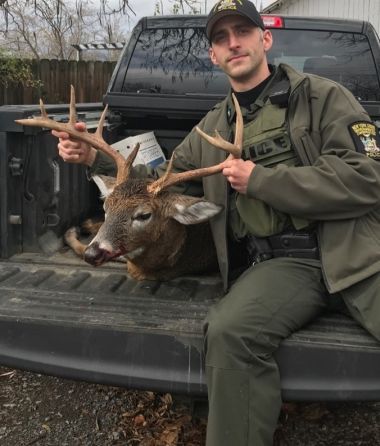
Paul Szmal: We had a little communications glitch on Zoom the other day, but we're happy to have Assemblyman John Lamondis with us this morning. Good morning.
John Lemondes: Good morning. How are you?
Paul Szmal: I'm doing well.
We're going to talk about something a little bit different today. We're going to focus in on deer season and big game hunting in general. So are you a sportsman yourself?
John Lemondes: I am. I am. And thank you for being open to this topic. And how did you do this year? So, uh, not great so far. I have, uh, I have one doe and I have to, uh, uh, I've got to call that in today as a matter of fact, and I'm hoping to get out in the late season here, muzzle loading, and then maybe even the late bow season as well. So, um, but, uh, you know, it's always tough in the election year to get out.
Paul Szmal: So let's talk about the importance of deer hunting and all kinds of hunting to the state. It's a source of revenue. Obviously, uh, if you live in any kind of suburb or anything, you see deer running around, it's a way of keeping that population in check. So it has its benefits.
John Lemondes: It does. Uh, you know, there's number one, it's our, it's our, it's our heritage. Number two, the protein source is exceptional. I mean, hunters for the homeless provide, uh, thousands of pounds of highly nutritious food to our homeless all over New York state. Uh, the exact amounts can be seen on the DEC website. And I think that's a great service that, that, you know, I say service in quotation marks that, that, that hunters provide, um, to our, our homeless population and our shelter population.
And also I'd like everybody to think of it like this too, uh, because I want to see more, especially kids, uh, get, get into hunting. And when you look at the number one, uh, auto collision per year in our state, it's deer incidents. And so, you know, uh, somebody, somebody gave me a, a really good, uh, um, way to think about that. And it's really simple. It's, it's when you, when every, every deer that's taken by a hunter saves a family of four on our highways in New York.
Paul Szmal: So you got the dogs with you today?
John Lemondes: Yeah, sorry. No, I believe me. Uh, one of the things about doing zoom, I've had a garbage trucks in the background. I had a squawky blue Jay one time.
Paul Szmal: So what is the overall state of game hunting in New York? Is there anything that we should be doing to, to try to jumpstart it? Cause I think it has, I think hunting is one of those things that's gotten a reputation as an older people's thing. And like you said, not as many kids are taking it up. So is there something we could or should be doing at the state level to turn that around?
John Lemondes: Yeah, I think dads need to get off the couch and put their phones down and get their, get their sons and daughters out in the woods, you know, uh, put the beer down, put the Doritos down, uh, turn the game off and get outdoors. Um, I, I try to do that with my kids. I've got, you know, a son and a daughter. I've treated, uh, I've treated them both the same and, and, uh, um, you know, that doesn't mean because it works for my family that it's going to work for anybody else's. But I think it's something that that's a great, wonderful outdoor sport that you can incorporate multiple other things with, you know, at the, at the very least physical fitness, uh, uh, photography, all kinds of, all kinds, there are all kinds of benefits and, and not to mention the, the conservatory aspect of it, of, you know, with anything, if you have an, a population of anything that is unchecked, you have a second order and third, second order and third order problems with it.
And, and, and one of those, as I've already mentioned, it is the increased rate of, of collisions. And, you know, just, uh, somebody on my team just last year had a horrendous accident. And, and, I mean, we hear about this in the news all the time and, and, and, you know, more hunters in our state won't stop the collision problem, but it, it, it'll help mitigate and help manage it. And this, as you mentioned, Ted, with, uh, deer in neighborhoods, I mean, there's nothing like putting in expensive, uh, uh, shrubbery or other landscaping and then have it, having it decimated by deer, like, oh my God, what happened?
Paul Szmal: Well, and as somebody that has driven to work in the dark every morning for the last 18 years, you don't have to tell me about missing deer. I came pretty darn close the other day. I haven't hit one in like 12 or 13 years and it wasn't serious when I did, but I, I've, we've all known stories of people that did hit them at high speed.
John Lemondes: Yeah. I, you know, I was coming back from a town hall meeting in Auburn. I think it was in, uh, beginning of October, end of September. And I hit one right there on route 20. You know, there, there were three of them crossed. So I followed the golden rule of don't swerve. Cause I would have hit another car. Um, and I couldn't avoid the last one of the three I had. I hit it and it, you know, it caused damage.
Paul Szmal: You were talking about getting more kids out hunting. And I know we do have some organizations that work on that kind of thing. We have a lot of good sportsmen clubs. One of my monthly guests on this program is the folks from the Montezuma Audubon Center, and they conduct a youth waterfowl hunt every year, uh, along with safety training to, to get kids interested.
John Lemondes: Yeah. I think, uh, those are, those are great. Um, the, the pheasant programs to locally, uh, they're all over central New York. The, the, I've met with the Cuyahoga County, uh, um, pheasant, uh, organization, as well as the Onondaga County. And then the youth, the youth hunts, I, you know, with all of the other things that we've discussed on your show over the past couple of years about, you know, problems and challenges in our state, we get it right with youth hunting and the youth weekends where, um, for, for, for deer, turkey, as well as waterfowl and pheasants, those are exceptional, um, exceptional, beneficial, exceptionally beneficial, um, opportunities. And I, I've, I've done that myself and, and those are, you know, there, there's nobody else. There's nobody out there. It's, it's, uh, um, uh, done at, you know, in the beginning of the season and they're great. And that's a great way to get, to get kids interested. And, and not just the, you know, it's a lot of times people that don't hunt that don't know anything about, I think it's all, it's all about killing. And that's the least important aspect of it. It is part of it, but, you know, I try to balance that with people when I'm talking to them that, uh, that are against hunting or, or would never, may not be against it, but would never participate in it. Everything they buy from the grocery store. And I put that in quotation marks too, has been killed as well. You know, people just don't look at it like that. And there's nothing wrong with harvesting your own, your own high quality food.
Paul Szmal: Do you think some of this is due to the changing attitudes about guns in general? I grew up in Northern New Hampshire. I remember, you know, people pulling into the high school with a gun in the rack in the back window of their pickup truck. If you did that now a SWAT team would be called in.
John Lemondes: Yeah, I know. And I did the same thing. I'm, I'm a Liverpool graduate and we've got some of the, um, you know, the clay marsh was, was right there. Different, different waterfowl spots. I can't tell you how many times my friends and I, after school would go, we'd go duck hunting for an hour. And, and I, you know, kids today miss that. And to your point, there is, you know, there is that aspect of gun safety that cannot be, you can't turn your back on that. That has to be, that has to be taught. It has to be disciplined. And, and the, the other thing that I want to mention though, is when people think about hunting, hunting, it's dangerous. Hunting, you know, according to the Center for Disease Control, who tracks all of our, um, incidents in, in, uh, incident rates, um, the, the injury rate for hunters is lower than almost every other sport in the United States. And so people rarely look at it like that.
If, you know, for example, let me bring in that. So that was nationally. Let me bring it back to New York. Um, last year in 2023, we don't have 2024 data yet because the hunting season, the big game hunting seasons are still on. Um, we had two fatalities in 2023 and, um, 12 overall incidents of which six were self-inflicted. So, um, you know, any incident is too many if, so to speak, I think that's the way that I like to look at it, but nonetheless, we can't eliminate risk in anything that we do. There's always risk. And, and if you contrast that to the number of people killed on our roadways every day, um, you know, going back to the Center for Disease Control statistic, uh, hunting is, uh, one of the, one of the least dangerous sports that we participate in.
Paul Szmal: Assemblyman John Lamondes has been our guest this morning. We're at the, uh, District 126, uh, points east in our listing area. And, uh, thanks for the conversation. Like I say, it's not something we've talked about very much and it's something that's important and I'm glad we covered it and we appreciate your time.
John Lemondes: Thank you, Ted. Have a great day.