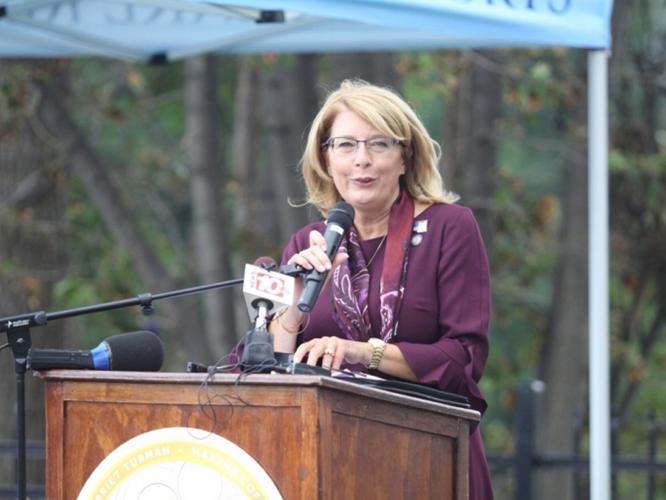
Paul Szmal: Our guest on FALX Morning represents the 54th State Senate District. We're back with State Senator Pam Helming. Good morning, happy new year, and welcome back.
Pam Helming: Thank you, Ted. Good morning to you, and happy new year.
Paul Szmal: So the new legislative session is about to get underway, so let's talk about some of the things that you and the GOP Conference would like to accomplish, starting with these costly government mandates where government says you have to do something, but sorry, there's no money from us to do it. What are some examples of some of those that we could get rid of?
Pam Helming: There are so many examples, and I think from my prior experience as a local elected official, as a town supervisor responsible for developing a budget, I'm super sensitive and aware to when those unfunded mandates are passed down. I think, you know, there are so many mandates, even look at our volunteer fire departments and the mandates that are placed on them, but the lack of funding to support those, it results in higher property taxes for people. There's so much that happens in our schools as a result of unfunded mandates. You know, they're required to provide certain services, but again, there's not adequate funding from the state of New York, so again, results in higher school taxes. We see impacts at the county level with Medicaid programs and other programs where, again, the state mandates the Cadillac of services, if you will, but does not provide adequate funding. Again, that all translates into higher taxes for folks. There are a number of areas where I think we need to just be more reasonable at looking at the mandates that we're pushing. You know, the governor recently signed into effect the Climate Change Superfund Act. That's a concern for me, what impact that is going to have on cost of living for people. There are just a number of mandates and issues across the board, like I said, that impact schools, county, local government, our local farmers, and there are so many areas where we can make changes to make New York more affordable for folks.
Paul Szmal: Well, and when it comes to that climate change proposal, I mean, you have to ask yourself, is this about battling climate change, or is this about enhancing state revenues? I mean, it's, you know, you can't change the weather by punishing businesses.
Pam Helming: Right, Ted, I'm so glad you brought that up, too. Is it about increasing revenues for the state of New York? I think that's exactly what this is intended to do. It's not going to eliminate emissions. It's going to increase consumer costs. And it's a look back, if you will. I'm not sure people understand that. But this, this new bill that the governor signed into law is actually a look back and will charge producers of fuel based on their emissions from 2000 to 2018. They'll have to pay a certain percentage to the state of New York. The state of New York is looking to get from these businesses a total of $75 billion. Now, come on, these these companies, they're going to pass that on to consumers. And that's the number one challenge I think we have in New York State is our cost of living. It's just too high. It feels like it's out of control. You know, the governor every now and then says something that gives me hope that she realizes that cost of living is a concern. And it's something that needs to be addressed. And that then we go on past these mandates on businesses or like we just talked about our local governments that translate into higher costs for people. So I, I that is my number one priority starting next week when we go in, well, it's always been my number one priority, but I'm going to take an even closer look at our mandates. And these bills that get passed and have language buried in them that really, the bottom line is they're going to translate into increased costs for the average citizen. And Ted, I think that ties into what we're seeing too. So many people continue to move out of the state of New York. Cornell recently released a study where they looked at the next 20 years and they're predicting that New York State, we can continue to see this mass exodus of people, which really ties into workforce issues for local businesses. So they have the challenge of higher costs. They have a limited workforce and it's like a giant puzzle where all these pieces need to fit together and we need to do more work as legislators.
Paul Szmal: The governor's state of the state proposals are trickling out one at a time. One of them is an inflation refund that would be a direct payments to taxpayers, but, but you're calling for more lasting solutions. But how do you say to somebody on the other side, you know, gee, Senator, why are you opposing us getting money?
Pam Helming: Right. It's really hard to, you know, especially you look at the governor's timing. She came out right before the holidays and announced this cash back, if you will, for New Yorkers, you can receive anywhere from 300 to $500. So one time payout, but what wasn't clear, I don't think when the governor made that announcement is that, look, she has to get approval of the legislature. We don't even go into session until as you pointed out next week, if that gets passed, then it has to be signed into law. Then the, um, the rules surrounding it have to be developed before those checks can even start to roll out. So I think it was kind of misleading to people who thought they could expect a check here in the next few weeks. What I, and a few of my colleagues who were on the New York state Senate economic development and commerce and small business committee are urging the governor to do is to dedicate state funds to paying off the unemployment insurance fund debt. So, uh, way back when COVID happened and the government shut down all the businesses, New York state experienced a debt with their unemployment insurance fund. And I should point out to anyone who's listening, this does not in any way impact anyone's ability to collect unemployment insurance. In New York state, we do something unique. We put the burden of paying for unemployment insurance on the backs of our small businesses and our farmers as well. So when all the businesses were shut down and there was a debt in this fund, um, many other States used federal dollars to pay down their debt. New York state borrowed money from the federal government, but did not pay down the unemployment insurance debt. And they passed that off to our small businesses and our farmers. So what I'm saying is let's use some of this, these funds that the governor is saying these unexpected or unanticipated revenues to pay off that, uh, unemployment insurance fund debt that will take a burden off of our small businesses. It will help them, I think, do better. You know, they won't have to then continue to raise their prices to cover the amount of money that the government expects them to pay. I think it will help, uh, stabilize our small, many small businesses. Think of our main street businesses. They can't, they can't take on any more, uh, bills from, from the government. It's putting jobs into jeopardy. So I think that would have longer lasting, um, better goals or better outcomes, not only for the small businesses, but for people as a whole.
Paul Szmal: In the public safety arena, you're calling for more collaboration with local law enforcement, uh, preventing crime and especially repeat offenders. I mean, I, I do our police beat here every morning and I just had one today where someone got a stay away order, served against them and went right back to the same place the next day and violated it immediately. So how do you propose we get a handle on this?
Pam Helming: So I've been working with, I have, I'm in constant contact with the sheriffs in my district. I've been working closely with Monroe County Sheriff Todd Baxter and the consortium for safe communities. That consortium is made up of church leaders, elected officials, business leaders, um, a very diverse group of individuals concerned about public safety. And we're in the process of finalizing what's called, I'm calling the dangerousness standard bill. And this bill would allow judges to ensure that offenders were a danger to the community, that they're not released from custody in the absence of a cash bail system. So it gives judges more discretion to hold individuals. Now, I, I know that there are many people who believe that the judges currently have that discretion, but if you actually look at the mental health rules, the language there, the judges have the ability to send someone who they feel could be a threat or an evaluation. Um, so they go for an evaluation. And what I hear is oftentimes, you know, they pass that evaluation and they're released right back out. So judges, their hands are tied in what they can do. And this would allow them, it would just give them another tool if they feel that based on the evidence that's presented to them, that an offender is a danger to themselves or to the community and allow them to be held.
Paul Szmal: You also have a bill that would provide pepper spray for use in self-defense. How would that work?
Pam Helming: Yes. So, uh, this was brought to me by a young woman, a local woman who, um, had a very troubling experience where she was attacked by someone. And after the attack, she went to counseling and she talked to folks. She wanted to learn how to protect herself going forward. Uh, the individual who attacked her, she still sees this person on a regular basis and she wanted some sort of protection. And she thought that one tool that she could use would be a self-defense spray, like a pepper spray, but come to find out, uh, you have to be 18 years or older in order to purchase and possess the pepper spray. And this young woman was 16 years old. So working with her talking to some local law officials and others, I've introduced legislation that would allow an individual who's between 16 and 18, who also has an order of protection, um, or who's been a victim of a crime to possess self-defense spray, like a pepper spray. To me, that's, that's common sense. Like we have to give people some means to protect themselves.
Paul Szmal: We talked last time about some of your success stories in terms of sponsored bills. One of them is a Parkinson's disease, uh, research registry that will be established. Uh, that one passed the assembly, the governor signed it into law. How would that registry be used?
Pam Helming: So this registry would help us identify and support high risk individuals, um, people who are more at risk of Parkinson's. And then, um, this information, the data that collected would be able to, researchers would have access to it and it would allow them to better manage and hopefully treat this disease. Parkinson's is one of the fastest growing neurodegenerative diseases in the world right now. And it was with the support, strong support of the Michael J. Fox foundation that we were able to get this bill passed in both houses. And then finally this year, get the governor to sign it. So that, that, that's a big win.
Paul Szmal: And then final note, I know you're, uh, you got a lot of generous donations for the Toys for Tots program. You and a number of our local, uh, lawmakers, uh, participate in that program in cooperation with the Marine Corps.
Pam Helming: Yes, this was, uh, boy, it was really heartwarming this year. We collected three bins of toys, uh, thanks to the generosity of so many local individuals and so many volunteer fire departments who collected at their stations and then brought the toys over. I can't thank everyone enough. These toys stay local, which is, um, also very nice. So thank you to everyone who supported it.
Paul Szmal: State Senator Pam.
Pam Helming: Oh, go ahead. I'm sorry. I don't know if we have time, but there is another bill that the governor signed into law that I think is important for our local farmers. Um, I think many people have heard of the nourish New York program. And there's a portion of that, which I call the farm to food bank. It really, it allows emergency food providers to purchase surplus products from our New York farmers and from dairy producers. But there was a glitch in that program and they were excluded from, they weren't allowed to purchase 2% or whole milk, which that was, um, it was a mistake and it wasn't addressed in the bill language. So during the budget hearings, I brought this up during the public hearing portions in my office, we did a number of letters, we kept the pressure on, and I'm just thrilled that the governor signed into law a bill that I co-sponsored that now fixes that glitch so that our food banks and others can purchase 2% and whole milk as well as other dairy products.
Paul Szmal: Oh, that's great news. I'm glad to hear that. I, I've never understood why, for example, at the federal level, when the president's presented with a bill, uh, he has 10 days to sign it or veto it. I wish they'd do something like that in New York. Cause we get these bills and they sort of get lost between the cracks. Cause sometimes they, they get passed by both houses and they might get signed, you know, eight months later or not at all.
Pam Helming: I agree with you. That would be great. The other thing that would be good is that when these glitches, if you will, are identified on the Senate floor, I wish we would say, okay, let's pull this bill, let's fix it and bring it back and pass it.
Paul Szmal: Oh, very good. I wish we did like locally at the county level, you could do amendments on the floor. I wish we were able to do that in the Senate as well.
Pam Helming: Yeah.
Paul Szmal: State Senator Pam Helming, our 54th District State Senator. We always appreciate the time and your generosity with it each month. Thank you again.
Pam Helming: Thank you, Ted.