Paul Szmal: We're joined on Zoom by Judy Wright, who does our Ag Reports each morning that you hear here on Finger Lakes Newsradio, and by Kirsten Workman, who is with ProDairy, and we're going to talk a little bit about HABs. Good morning to you both.
Judy Wright, Kirsten Workman: Good morning. Morning.
Paul Szmal: It's good to have you both here. I'm going to start with Kirsten. Tell us a little bit about the ProDairy program and what it does.
Judy Wright, Kirsten Workman: Yeah, no problem. So ProDairy is a unique program that's part of Cornell University's College of Agriculture and Life Science. Unlike our partners at Cornell Cooperative Extension, who've been around for over 100 years, ProDairy has actually been around for only 35 years. But what we are is we're really an education and applied research program built to enhance New York's dairy industry. So we have extension associates like myself that cover all facets of the dairy farm. And my position in particular, I'm the Nutrient Management and Environmental Sustainability Specialist. So I deal a lot with how we grow our crops, how we apply our manure, and do that in a way that can protect our natural resources here in New York.
Paul Szmal: Before we talk about HABs, there is still, in some circles, a perception out there that farmers don't care about water quality. They just dump whatever on their land. And are you still having to deal with that?
Judy Wright, Kirsten Workman: Yes. I think Judy and I probably deal with that most weeks of our life.
Paul Szmal: Wow. So let's talk about harmful algal blooms. We've had a rough year this year, because that summer weather that we all love so much is unfortunately the worst for HABs. You have those calm days, no rain, no wind, sunny days. So let's talk about, first off, exactly what a harmful algal bloom is compared to just any old green slime you see in a body of water. Whoever wants to go first.
Judy Wright, Kirsten Workman: Yeah. So do you want to take that, Judy, or want me to take it? You can clean up after me. So these are microorganisms that live in our lakes, and given the right conditions, do actually bloom. And so algae is just that. It's algae. But there are many different types of algae. And some of these can actually produce, under the right conditions, a toxin. And that's when they become harmful. So oftentimes, we'll see the lake turning color due to the algae. And unfortunately, everybody automatically jumps right to the fact that it's a harmful algal bloom, when in fact, it probably may just be an algal bloom. And the only way, last I knew, to find out, to verify if, in fact, it was just a regular algal bloom or a harmful algal bloom is through testing in a lab. And there's protocols for collecting the sample. So I do it too. I call everything a harmful algal bloom without knowing exactly what it is. So I don't think we're going to get out of the habit of doing that. But we do need to remember that not everything we see happening is necessarily harmful.
Paul Szmal: Yeah. And I think just to follow up on that, there's a really good reason we do that, Ted, and that's because, like Judy described, to know if they're harmful or not, we need to sample and test them. That's very cost prohibitive and hard to do. And so from a public health standpoint, to be conservative and careful, we tell people to assume they're harmful unless we don't know otherwise so that people don't get sick. And so, unfortunately, that means we just kind of call them all harmful, but that's just being careful.
Paul Szmal: So we know that the weather is one factor in this heavy hab season, but you, Kirsten, as a nutrient coordinator, know that that's another one is what runs off from tributaries into the lakes. So talk about how important it is keeping that flow into the lakes under control.
Judy Wright, Kirsten Workman: Yeah. So, you know, as a nutrient management specialist, you know, I spend, you know, most of my time helping farmers and working with my extension colleagues to help farmers. But all of us that live in the watershed have an impact. And any time, you know, we see runoff, so, you know, we get rain here in the northeast, and when rain doesn't soak into the ground but runs off the surface, we all live in a watershed and it goes, you know, down the watershed until ultimately here in the Finger Lakes region, it will end up in the Finger Lake. That could be Seneca, Cayuga, Wasco, right? So, and with that runoff, there are nutrients. It's the nature of our ecosystems. Nutrients are everywhere. That's great. We need them to grow plants and animals and have healthy fish and healthy plants in our ecosystem that we also need. But when we get too many or we have erosion through soil loss or runoff, stormwater runoff, right, that ends up bringing excess nutrients into our watersheds. And one thing we're learning, too, is that it's not just about runoff. And some of the things we thought we knew about algae blooms, we're now learning might be changing or that we didn't know the whole story, and so we're trying to figure that out, too.
Paul Szmal: We have a couple of discussion seminars coming up on the issue. Before we talk about those, Judy, I want to talk about the awesome seminar that you put on not too long ago, and we found out about the economic effects of HABs, that it has a tremendous impact on things like tourism and commercial fishing, and I learned a lot from that.
Judy Wright, Kirsten Workman: Yes, there's a professor at Cornell who has studied the economic impact of algae blooms and also HABs in the Great Lakes, but his information very easily translated into the Finger Lakes. And yes, it does have an economic impact, a little bit positive in some cases, but you're right, mostly negative. So it is important that we work to manage what we can control, both on the land and in the water, to try and keep these at a minimum overall.
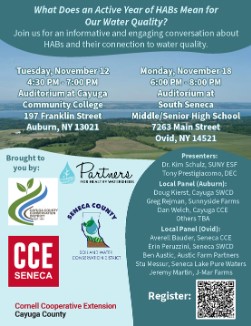
Paul Szmal: We have these two events coming up. One is Tuesday, November 12th, 4.30 to 7 o'clock at the auditorium at Keuka Community College in Auburn. The other is Monday, November 18th, 6 to 8 p.m. at the South Seneca School Auditorium in Ovid. Are they going to be fairly similar in content, or would it be worth somebody's while to go to both and get some different perspectives?
Judy Wright, Kirsten Workman: Well, I'm a fan of more information the better, right? Yeah. Our two main speakers are Dr. Kim Schultz from SUNY ESF and Tony Prestigiacomo, who's one of our Finger Lakes Water Quality Specialists with New York State's Department of Environmental Conservation. So they're going to be sharing the science piece. Their two presentations will be pretty similar, although they're going to try to tailor it to each community and each set of lakes that we might be discussing those evenings. But then really the heart of the evening too will be our local panels, and so those will be very local. And so you'll get to hear from the folks from Cornell Cooperative Extension if you're at the Seneca event, and you'll get to hear from the folks from Keuka Cornell Cooperative Extension if you're at the Auburn event. And likewise, we have our Soil and Water Conservation District partners who will be talking about the projects they've been working on. And then we have different farmers also who will be sharing their perspectives at each event too. And then we have some folks from watershed groups that will be talking about partnerships, which is really the key of this work. And what we're trying to really highlight is all the work that really is being done and the partnerships it takes to do that work.
Paul Szmal: Yeah, one of the groups that's involved in this I don't think I've heard of before, and that's Partners for Healthy Watersheds. Tell us about them.
Judy Wright, Kirsten Workman: Yeah, so Partners for Healthy Watersheds is really awesome. So they're a group of groups, and they're a group of farmer groups. And so they have been working for a handful of years. They recognize as farmers that water quality is important to them and their community. And they wanted to show not only what farmers are doing, but help each other learn what the right practices are. And so Partners for Healthy Watersheds includes American Dairy Association Northeast, the New York Animal Agriculture Coalition, Cayuga County Farm Bureau, and really New York Farm Bureau, and the Northeast Dairy Producers Association. And then they work closely with folks like myself at ProDairy, Judy and others at Cornell Cooperative Extension, and their Soil and Water Conservation District partners as well to get their technical information.
Paul Szmal: You can sign up for these events on either the Cayuga County or Seneca County Cooperative Extension websites. And like you said, each one's going to be somewhat specific to their lake, but really anybody who's a property owner, and not just on a lake, because we've talked about this runoff. I mean, if you're a property owner on a tributary of a finger lake, it would be well worth your time to find out the latest science and see what you can do to help. And ask questions.
Judy Wright, Kirsten Workman: Yeah. It'll be... It's very... Oh, I was just going to say, Ted, for me, hearing the work that Dr. Kim Schultz has been doing is fascinating, because she's actually looking in the lake to see what might be going on in there. And she's been able to demonstrate, last I knew, a correlation with HABS and the invasive mussels that we've ended up with in our lake.
Paul Szmal: Yeah, I just... I've been learning a lot. Like you said, the seminar that you put on was fantastic. People still talk about that. These discussions are Tuesday, November 12th, 430 to 730 at the auditorium at Cayuga Community College in Auburn. Monday, November 18th, 6 to 8 p.m. at the South Seneca School Auditorium in Ovid. Sponsoring organizations include the Cayuga County Conservation District, Partners for Healthy Watersheds, Seneca County Soil and Water Conservation District, Cooperative Extensions of both Seneca and Cornell... Seneca and Cayuga Counties, and, of course, ProDairy. Thanks to you both for your time, and let's hope we're getting closer to figuring out the magic bullet to just get rid of these things once and for all.
Judy Wright, Kirsten Workman: Yep. Thanks so much, Ted. We appreciate the opportunity.
Paul Szmal: All right. Thanks, Judy. Thank you.