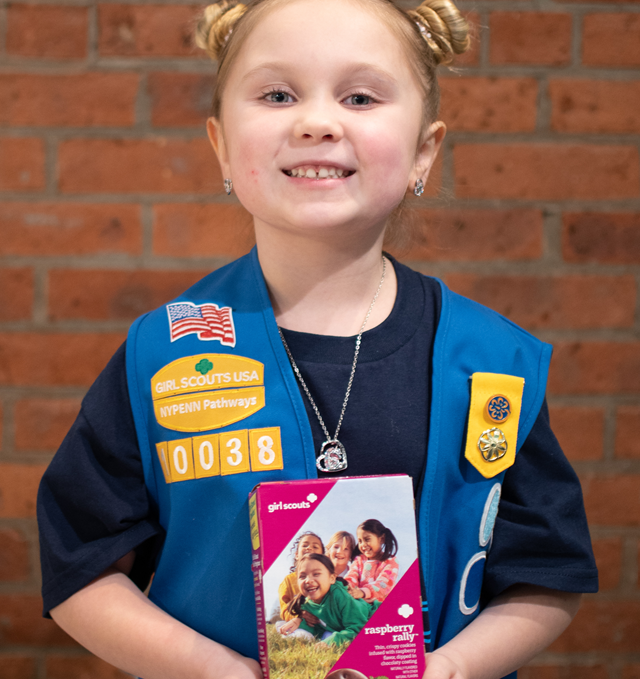
Paul Szmal: Joining us on Zoom from the Girl Scouts NYPEN Pathways Council, Jamie Alvarez. We haven't talked in a long time. Welcome back.
Jamie Alvarez: Thanks. I think it was probably last cookie season.
Paul Szmal: Wow. So it's good to talk with you again. Every time of year is time to join Girl Scouts, but especially this time of year. And I want to start with this because this is new to me. You can join a troop, of course, in your area, but if you don't have a troop where you are, you can join as what's called a Juliet, which is an individually registered member. Number one, is that new? And number two, how does that work?
Jamie Alvarez: It's not new. It's something that has been part of our program all along. I think, like you said, just a lot of people aren't aware of it. They're called Juliets after our founder, Juliet Gordon Lowe. And what everything in Girl Scouts is girl led. So, you know, when you're in a troop, you're under the advisement of an adult volunteer. When you're a Juliet, you have an adult mentor. It can be your caregiver, your grandmother, your older sister who's in college. And then you go through the programming and you pick and choose what you want to do as an individual member. So it's just another pathway for girls to be able to, you know, continue to stay in Girl Scouts among all the other activities that they're involved in.
Paul Szmal: Wow. All right. Well, more people know about it now, including me. Run us through the age levels of Girl Scouting, beginning with Daisies.
Jamie Alvarez: Sure. So we are open to girls in grades K-12. Like you said, Daisies are our youngest. They are K-1. Brownies, 2-3. Juniors, 4-5. Cadets, 6-8. Seniors, 9-10. And Ambassadors, grades 11-12.
Paul Szmal: Let's talk a little bit about some of the programming at Girl Scouts. People know about cookie sales, for example, and they know about camping out and the outdoor kinds of things. But there's a lot more to it than that.
Jamie Alvarez: Absolutely. So we are a youth, you know, leadership program. We teach Girl Scouts to gain courage, confidence, and character, leadership skills to last a lifetime and make the world a better place. And like we said, there's different pathways. You can come in through a troop. You can come as an individual. A lot of Girl Scouts like to spend time at summer camp. We have four properties in our council area. Travel is part of Girl Scouting. Obviously, community service is a huge component, making the world a better place. We have highest awards, bronze, silver, and gold. And that's working on a take action project, either with a group when they're younger or as an individual as they age through the program. And if they achieve the gold award, it's the highest achievement a Girl Scout can earn. It's devoting 80 hours to a service project. So they find and identify a problem either in their community or a global problem and come up with a sustainable solution.
Paul Szmal: Let's talk about some of the service projects. What are some of the ones that stand out to you over the years? Because I'm always amazed at the perceptiveness of these girls in identifying problems and their creativity and helping solve them.
Jamie Alvarez: Right. And our gold award projects really do run the gamut. Every year, we have about 25 girls that complete those. So it is a small percentage. We have close to 14,000 members between girls and adults in our council area. Some of the projects that stand out to me are they've come up with you know, solutions to do a community garden right to help maybe with a food shortage in that community. So coming up with a garden where people can grow vegetables and have a sustainable source of food. We've had a musical lending library at a school that didn't have as much money to be able to give students, you know, their own musical instruments without having to buy them on their own. We've also had Girl Scouts work on projects about health, all different sorts of things related to that as well on mental health, especially with teenagers. So we've had some really interesting projects over the years.
Paul Szmal: We've talked a number of times about the various aspects of cookie sales, which is probably the best known Girl Scout activity. But it just there's so many skills involved. There's business administration, there's sales, there's advertising, marketing, really, there's a lot of learning going on behind the scenes while those cookies are being sold.
Jamie Alvarez: Absolutely. Like we like to say, it's so much more than just a box of cookies. You know, the Girl Scouts are getting so much out of it. Like you talked about those business and entrepreneurial skills. We actually have two product programs that are fundraisers that help the Girl Scouts, you know, earn money either for their troop to, you know, go camping, travel, do activities, badge work, community service, or as individuals. So they're always setting goals, like you said, you know, decision making, money management, business ethics, and we have the cookie program right in the winter and early spring. But right now, we're actually in the middle of our treats, reads and more program, which is a fundraising business skills program, where they're selling magazine subscriptions, nut and candy items, Travis tumblers, and Girl Scout themed bark boxes. So it's not as well known. But you know, it's a great way for the girls to learn those skills. And then they earn those really essential startup funds, because we're in the beginning of what we call our member year. So October one, through September 30, is our member year kind of kind of similar to the school year, but a full year.
Paul Szmal: We're talking with Jamie Alvarez from the GS NYPEN Pathways Council, the Girl Scouts. Talk about the progression into the girls taking more responsibility for running their own meetings. When you start as daisies, the adult leaders are heavily involved. And then as they grow, they take over more and more. By the time they're ambassadors, they're pretty much in charge of everything.
Jamie Alvarez: That's very true. And like I said, at the beginning, everything in Girl Scouts is girl led. And obviously, right now, we're at the beginning of our member year, we're really trying to recruit, you know, either the youngest girls to start new daisy troops or older girls who maybe fell out of Girl Scouts or never were involved. Because again, you can join it anytime you don't have to join as a daisy and work your way up, you can come in at any point. And a huge part of that is also our volunteers, right. So everything we do is run by our trusted adult volunteers. So we're always looking for adults who are passionate about mentoring the next generation of leaders, you know, help Girl Scouts find their voices and be their best selves and make a difference. And you don't have to have a child of your own and Girl Scouts to get involved. You can come in, obviously, as a caregiver, a mom, a dad, a grandparent, an older sibling, you know, over 18. Or you could even just be a Girl Scout alum. You were a member of our movement as a child all the way up or even just a few years as a child, and now you want to give back.
Paul Szmal: A lot of people are wondering, you know, do I have enough time for this? What's the time commitment involved in getting into leadership?
Jamie Alvarez: Well, really, it's the time commitment is what the Girl Scouts want to make of it, right. So some troops meet every week, some troops meet every other week or twice a month, some troops meet once a month. If you're, you know, participating in an individual Juliet, you set your own schedule with your adult mentor. So it's really, again, everything girl led, how much they want to be involved, how much do they want to do, what do they want to participate in.
Paul Szmal: The GS NYPEN Pathways Council is very big, 26 counties across New York and Pennsylvania. I know there are a number of joining nights coming up. One of those in our listening area is next Monday at the Newark Public Library in Wayne County at 530. If that's not close to somebody listening, what's the best way to find out about their nearest unit and about joining?
Jamie Alvarez: Sure. So we have staff and volunteers who are, you know, attending both community events and set up at libraries. They can go right to our website, which is gsnypenn.org. Click the join button right on the homepage and learn about upcoming events or just get in touch with our customer care folks who can walk you through the information, help you get registered, find a local troop or start your own. And that number is 315-698-9400.
Paul Szmal: It's called Customer Care 315-698-9400 or info at gsnypenn, as in New York Penn, n-y-p-e-n-n.org. The annual membership is $25 and you do have financial assistance for families who need it.
Jamie Alvarez: We absolutely do. We want Girl Scouts to be accessible to anyone. We want members from all walks of life, so we offer financial assistance not just to offset the cost of membership, but also, you know, expenses associated with essential resources and activities like program guidebooks, uniform pieces, summer camp. So that's something that they can talk to customer care about when they're inquiring about joining.
Paul Szmal: I've talked to people in other organizations like 4-H, for example, about the science and technology in the curriculum. Are Girl Scouts doing a lot more STEM and STEAM kinds of things these days?
Jamie Alvarez: Yes, STEM is a part of our programming and we, you know, we offer programming both through the council. GSUSA, our national organization, offers programming that we can push out for the troops to use and leaders to use. And then we also have over 100 community partners across our entire footprint. Like you said, it's big. We have 26 counties that we cover. So we've been really working hard to make these new connections with community partners who offer programming that either is completely tied to Girl Scout badge work or has components that can then be transferable to Girl Scout badge work. So lots of options.
Paul Szmal: Give us the final pitch for somebody, a girl or a parent who's kind of, I'm not really sure why they should join Girl Scouts.
Jamie Alvarez: I think the easiest thing to say is, you know, if they, if you have a girl in your life who wants to try new things, make lasting memories, discover hidden talents, and have some like real world learning experiences, but most importantly, find a really safe space to be their unique self, then Girl Scouts is for them.
Paul Szmal: All right, sounds good. Jamie Alvarez with the Girl Scouts NYPEN Pathways Council. Always great to talk and don't hesitate to reach out. We'll keep the conversation going.
Jamie Alvarez: Awesome. Thank you so much, Ted.