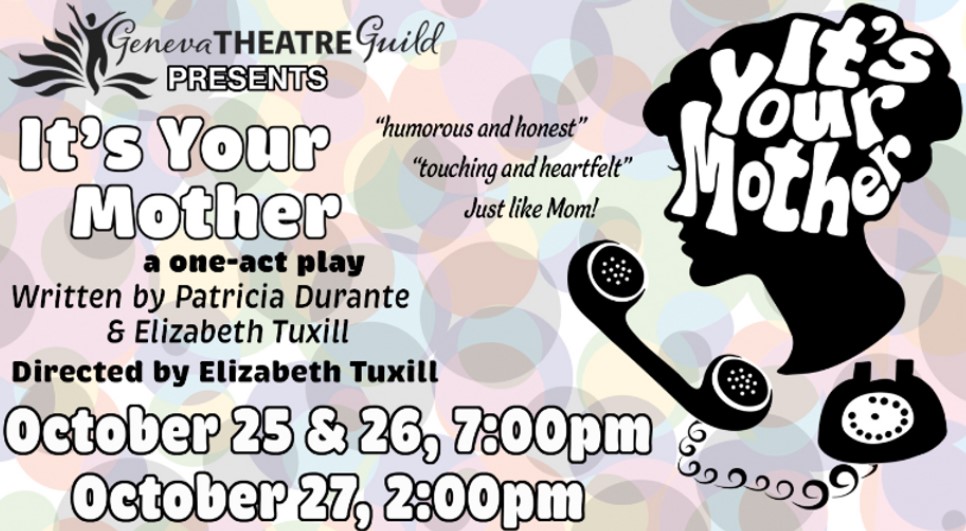
Paul Szmal: Good morning, it's 7.51, it's the Friday Extravaganza on FLX Morning and it's Geneva Theatre Guild time doing It's Your Mother, a one-act play and joining us are Mary Cook and Ellie Stearns. Good morning to you both. This is Betsy Tuxel. Oh, I thought you said it was going to be Ellie. I did, oh I'm sorry, I did say that, but we changed. Okay. That was my fault. Okay. We changed. It's okay. Take two? No, I'm just, I'm getting older and I'm afraid I'm going to start. No, I did say that and Ellie goes, you know, I've got other things I have to do and Betsy goes, I'll do it! Oh, well that's good. Betsy is the director and co-writer of this play.
First, I want to congratulate you, Mary, on your 39th performance of the season. Do you like drive-by schools and stuff looking for plays and go, I'll be in it? She's excellent. She is excellent. I'm having a blast. She is the funniest character I've ever seen on stage and every time she gets up there, I laugh.
Mary Cook, Betsy Tuxill: So this sounds neat. I know nothing about the play other than the name, but just from the name, It's Your Mother, there's so many different directions you can go. That's exactly it. So talk about the process of writing this along with Patricia Durante. Well, my friend and I were roommates for seven years and this was back in the day when you had answering machines. And we would come home and one of our mothers was always on the answering machine giving us information. So we, years later, sat down and said, hey, why don't we write about that? So that's what it is. It's a series of ten vignettes about mothers and daughters and what happens and our experiences with them. And they're based on true stories, but we won't tell you whose mother we're talking about at the time. And it's a lot of fun. It's a lot of laughs.
So are you going to do an updated version where your hip vibrates and it's your mom texting you? Yeah, it's kind of like that. There are a lot of phone calls. And we do use the cell phone now, but the answering machine still is in existence in our play.
Paul Szmal: Now, I said I would get into all the details right away so I wouldn't get distracted and start rambling off. And that's exactly what I did. So let's do the details. It's October 25th and 26th at 7 p.m. And 27th. And the 27th at 2 p.m. First United Methodist Church of Geneva. 7 o'clock shows, 25th and 26th. 2 p.m. on the 27th. The church is at 340 South Main Street in Geneva. Free parking behind the church. Parking lot entrance on William Street. And there is ADA accessibility to the basement level. That is the most complete set of instructions for attending a play that I've ever seen.
Mary Cook, Betsy Tuxill: What I'm loving about this, in addition to the material, is it's a really neat little venue. The stage is cute. I shouldn't say little because it's not really small. But it's tables and chairs that you'll be sitting at. It's not like a theater seating. And it's very relaxed. In fact, there will be desserts and coffee to purchase to have while you're watching. It's one act. So it's a little over an hour long. So it's solid. It's solid. There's something happening every minute. It's just a lovely way to spend an evening.
Paul Szmal: Almost like a dessert theater. Oh, nice. Is that a thing? Well, it is now. I'll go to that. I don't even care what the play is. Exactly.
So, for both of you, what is it about moms and daughters that we don't understand as men? There's no way we could explain it in the time frame we have. I'm trying to think how to explain it. That would be a whole other play, I guess. Because you're so close to your mother as a woman, because there are so many similarities between you and a female mother, you have that trying to cope through all the experiences and ups and downs. Whereas with a father, he's got his little thing about cars and all this other stuff, and you're like, eh, I want my mom. Fathers, we just tell our kids to just rub dirt in it and walk away.
I often say that I couldn't go a day when I lived in my mom's home, in between jobs and whatever, we couldn't go a day without an argument. Until the day I moved out. And from that day on, every day, we talked. Every day. And we were the best of friends. Until she wasn't there anymore. So, it's such an interesting relationship because she means so much, and she drives you so crazy.
Mary Cook, Betsy Tuxill: Yeah. And this touches it all. Planning a wedding, what should we do with grandma, how are we going to get through a family outing. It touches it all. It really does. And their ideas of stereotypes. And as you grow, your world changes, and their world stays the same, and you're thinking, but we're moving ahead, and we don't need to think about those things anymore that way. We're moving ahead. And they don't. They stay in the past.
Well, and the thing is, now being at this age, where I'm the older age, I'm looking back at my thoughts of my mom, and I'm seeing my kids having the same reactions. I don't have daughters, but thank God. But their reactions to me like, mom, that's not how that does anymore. And I'm thinking, oh, my gosh, these are the things I used to think. So, it's fair. And I kind of think it's funny. I don't mind that my kids laugh at me.
Paul Szmal: And there's that whole dynamic where you want to find your own identity, and you want to do things different. But then as we get older, we realize that mom was kind of right about almost all that stuff. She was right about it all. Yeah. Yeah. Some of the, yeah, I mean, the really basic human. And the thing is, I think what happens is as you get older, you begin to be comfortable acknowledging that.
Mary Cook, Betsy Tuxill: Yeah. When you're younger, it's kind of corny, like, yeah, okay, whatever. But when you get older, it's like, you know, I'm okay with that. That's the way it is. I'm good.
Paul Szmal: Well, and I'm finding, this is just, now we're talking about aging in general here. But now I understand what I didn't before about old people struggling through the world. It's just like every day there's, I say that they're going to find me dead someday because I can't open food packaging. I mean, how are you supposed to tear that stupid thing apart? I know. Let's talk about packaging bacon. Shall we? I'm looking for a screwdriver, you know, to hack open the M&M. Anyway, we'll get back to it.
But we're having a blast. We've got some really new people to the GTG, which is exciting. And we've got some people that are, you know, Ellie's been around for a long time. Well, since the 70s. Since the 70s, she's been there. On the board anyway. I mean, so there's people with a lot of experience and there's people that are new to this whole experience. And it's a lot of fun to see that. A cast of nine. Yep. It's a small cast, which is great. We even have a young person in there who's 15 because we needed a scene with, you know, younger people. And it's nice to see the ages because we go from the 80s to the 16s. And everyone's getting along and everyone's having fun and it's just a really good experience. It's a very easygoing fun. It's a fun show.
Mary Cook, Betsy Tuxill: Yeah, this is going to be neat. Relaxing and a fun show to see. Go to the website GenevaTheatreGuild.org. You'll see all the information October 25th through 27th at the church. ADA accessible. And I can just tell it's going to be fun. And I just love these conversations. I mean, we spent about two minutes talking about the play and the rest is just all our life angst coming out on the air for everyone to hear. It's therapy. It's therapy.
Paul Szmal: So thanks you both. I appreciate it so much. Thank you. Great visit, as always. It is now 7.58 on FLX Morning and we've got more guests coming up after 8 o'clock this morning.