Paul Szmal: Good morning, it's 8.37, it's FALX Morning Thursday, and that's our monthly Geneva Rotary Club segment. And what we've done a few times this year is talk to some of our relatively newer Rotarians. So we have Mary Sue Dean with us and Gary Adamson. Good morning to you both.
Mary Soudine, Gary Adamson: Good morning, Ted.
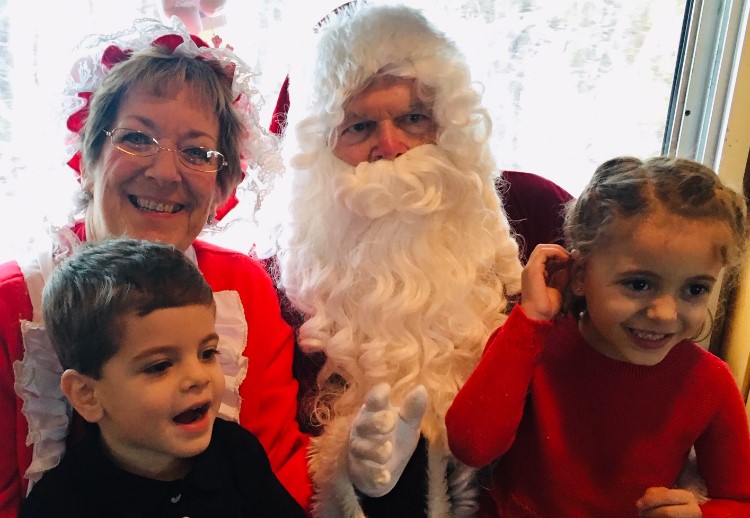
Paul Szmal: Before we meet our new Rotarians, we're going to talk a little bit about the Santa train. Tickets are going fast, so you better get them. Go to the website GenevaRotaryClub.org. The Santa Express is on Saturday, December 7th. Five trains will board downtown Geneva right near the Public Safety Building. And they'll depart at 10, 11.30, 1, 2.30, and 4. You board 15 minutes before. Individual tickets, $25. Those are available online at our website GenevaRotaryClub.org. And talk to co-chair and good friend of Santa, Dave Cook, if you'd like to be a sponsor of our train. You can talk to Dave at 607-279-3152. We've had him on and we've had Santa on to talk about the train. It's a terrific event.
So Mary Sue, we're going to start with you because you've been on before in your capacity with UR Medicine Finger Lakes Health. So tell us a little bit about you and that position.
Mary Soudine, Gary Adamson: Well, I started at Finger Lakes Health here in Geneva in April. And one of the things that was really important to me coming in as the Director of Development for the Finger Lakes Health Foundation was to get to know the community where I was going to be working. I had had exposure to Rotary prior to that in my previous job when I was working down in Dansville at Noise Health. I attended Rotary meetings occasionally as a guest to talk about whatever was going on at the hospital or whatever fundraising was going on, whatever events we were having. As a community based organization, Finger Lakes Health is integral to this community. And I just really felt strongly that I needed to get to know more about Geneva. I'm not from Geneva originally. There are people in Rotary who've lived there their whole lives. There are also people who've just landed because of work or family or whatever reason. And I was like, well, I'm going to join Rotary and see what it's all about.
Really, it is about community. And instantly, you know, you find this welcome and you just start learning. Every lunch I've been to, I've learned something about, you know, the Seneca Lake preservation, about, you know, about the historical societies building. Whatever is going on in Geneva and the surrounding area, I learn. And that's all part of my growth as the development director at my job. But more importantly, I really get to know this community. I've loved every minute of it.
Paul Szmal: Also, I think it's a requirement for your job because I've interviewed the last four people to hold your position and I think they've all been Rotarians.
Mary Soudine, Gary Adamson: Well, maybe it should be. I don't know if it's an actual requirement, honestly. For me, I'm just glad that I can do it. And, you know, I also am grateful that if I miss a meeting, while I'll pay my little fine, it's not like if I can't make every meeting, it's still okay. And I think that was one of the barriers a ways back when people would be afraid to commit, right? But now I think people, they understand that there's competing priorities.
I had not been involved in Rotary. I mean, actually, I live in Pittsburgh. So I had not been involved in Rotary locally, but that's also because at the time, when I was, prior to this, right, four young kids, you're involved in other things. I was deeply involved in PTSA, for instance, or other community organizations that you might be involved in and you give your time to. I don't think I was aware how much Rotary does, other than the spaghetti supper, you know, after the election up in Pittsburgh. I have learned so much about what Rotary does, not just locally, but worldwide. And even as we travel, and I'll talk a little bit about that. Like, I was out in Vancouver Island in September, and there's this huge suspension bridge, beautiful suspension, that was built by the Victoria Rotary. You know, it has the rotary seal and all this. I was like, hey, look, there's the rotary. And now you see it everywhere. And you realize what a commitment Rotary is to the communities in which they exist.
Paul Szmal: One of the things I'm glad you mentioned, you mentioned not having to attend every meeting. We love it when people do. But then the other thing is that in terms of service, you don't have to, there's not pressure to participate in every project. There are some Rotarians who have one thing that they grab ahold with. By the way, Judge Lisa Petronio-Tool just passed. She was hugely involved in the Santa Trena a group of us went through for the calling hours the other day. So there are people like that that that was pretty much all she had time for with her judge and lawyer duties. And so some people grab into one thing. Some people are into a whole bunch of things. But there's never, and I've been in since I think it's 2011 now, never felt the pressure, you have to do this, you have to do that. Because that's, I think, what makes some people maybe a little reluctant, is they feel like if I join, they're going to rope me into everything.
Mary Soudine, Gary Adamson: Right, and I think the opportunities are there to do the small things or the big things, right? So I'll go ring bells on Christmas Eve. I'm going to be here anyway. Yeah. And I do it, I did it at home with my kids. I'll do it here in Geneva, you know. That's an easy, that's an hour, whatever, two hours. I'll tell my annual bell ringing story. For years and years and years, I went and rang with Mary Luckern, who was the Geneva town supervisor. Before that, a beloved educator in the area. In fact, when they put the list out every year, our names would be typed in on it, because it was just a permanent thing. And, you know, I'm Mr. Media Celebrity here, so I'd go out and ring the bells with Mary and keep track of the people who came up. Mary, hi, Mary, it's so good to see you. Wow, Mary. And it would be like 19 for Mary and 2 for me at the end of the day. So it was a lot of fun. But there are ways to, and then the Santa train, I'm going to, I can't wait, actually, to help out at the Santa train.
Paul Szmal: Yeah, that's fun. Because of the reputation and everything I've heard about it, I haven't seen it. I cannot wait to help out.
All right, I want to move to Gary here, so you don't get a chance to say everything about Rotary and leave nothing for him. So tell us a little bit about yourself and your background.
Mary Soudine, Gary Adamson: Well, Ted, I was, I believe in the, well, the theme of the Rotary Club, which is service above self. And I look back on my own life, I'm 76 now, and I realize that I've witnessed service above self throughout my life. And at this stage, as we get older, we tend to want to contribute even more because we know it's our last gasp of doing it. And I grew up in a blue-collar household. And the beauty of a blue-collar situation is blue-collar folks depend on each other. They tend to share more, work together, the community. If one needs help in, say, a house repair, they join together and do it. I've seen the Amish do similar. But the blue-collar did leave an impression on me. But I did grow up in the 60s, so besides the phenomenal music we had, which has not been replaced, I can assure you, I did get to have the opportunity to go to college. And I did, and I became a teacher.
Now, it was a pure love. I grew into loving teaching more and more. I did teach English and social studies. And the literature, in a sense, much, much literature you read basically is a study of human nature. It's basically psychology laid out in an enjoyable way, and that's service also. So you're becoming, you're growing as a person. Now, I taught at Caledonia Mumford, which is a fabulous little school. For 36 years, I happened to hook up with some truly wonderful, brilliant teachers. And had that, so in a sense, once I finished at Cal, Mom Hillside over here needed help. And I found it was a great situation because I lived in Rochester, and I always wanted to live on a finger lick. So I happened to find a place for sale. It turned out to be a bed and breakfast, which I did not want to do. But I took it, and it's on the water, so I found out I love doing it because I'm serving people from all over the world because Geneva, the Finger Lakes, has become a hotspot.
Paul Szmal: So let me just jump in for a second, because I always wanted to ask an educator this, is how you can reach and determine what each individual student needs, which is what good teachers do. You know, if I had five or six classes through the day, I'd be challenged to just remember their names. How do you evaluate each student as an individual and figure this one needs this, this one needs that, this one learns this way, this one learns that way?
Mary Soudine, Gary Adamson: Well, that's a really good question, because I did witness a great deal over my career teachers who failed to come to that understanding. What you have to do as a teacher, and this is a different topic, and I won't overdo it, but you have to embed yourself in your profession. You have to say, I'm going to know my material so well, and then I'm going to transfer it to the students. That way, you start to realize what the students are taking in or not. I happened, as I said, to talk with a phenomenal group. I happened to be on a team later in my career, and all five of us would get together every other day in a team meeting and discuss our common students. So by that, we were able to make sure there was no bullying, and we could hit the needs of kids. Another thing we did do is right in the 90s, when they started to include resource teaching into the classroom, many teachers resisted it. I saw it as a great opportunity to learn techniques that would be very good for all levels of students. I could see teaching some of these resource techniques in a college classroom easily.
Paul Szmal: I've always heard it said that the greatest honor an educator can get is to have a student surpass him. Have you had that opportunity where a brilliant student has just gone on and run with what you've taught him or her?
Mary Soudine, Gary Adamson: Yes, I have. I had one unique experience. It must have been either the Secret Service or CIA come to my room and say, we have a young soldier who is going to be in the Presidential Guard, and we want you to give input on him. So right there, I was so proud of that young man because he wasn't the best student, but he put service above self, and that was him. So as far as the reaching students, it's a broad topic and an important one. But anyway, back to Hillside. When Hillside realized I moved into the area, I knew a couple people, and they asked if I'd volunteer there. I did for about two and a half years. Now, Hillside and Romulus was very dangerous, but it was very fulfilling because I was able to bring my experience, as you particularly pointed out, reaching out to individual students. I brought lesson plans that were reduced to bringing people from a base level up step-by-step to higher.
Paul Szmal: Right. Oh, that's a fine example. You forget to turn it off, yeah. I'm sorry about that. I got called at a meeting one time by another Rotarian from another club. I think he did it on purpose.
So I guess to sum up, I found, like Mary, I've been here for 15 years, and I've been joining different groups and doing different volunteer work, but it all was mismatch. So suddenly my neighbor, who I've been blessed to have next to me, Kathy Fuchs, right next to me, she said, try the rotary. I did, and I found it to be the one magnet that drew so many things into it. And the more I read about it and looked at it, I did join. And then, as Mary said, I'd go to the luncheons, the meetings, and I'd see a variety of people. I had to throw this out. In the song Atlantis by Donovan, when Atlantis is being swept under the sea, they sent out for survivors every one of every occupation so that the community's society could continue. Right. And so that's what you see in these meetings, people from all jobs, blue collar, white collar, and they all contribute. And I do want to say this is what really tagged me is when the Rotary Club began in about 1917, 1919, one of the big pushes was internationally helping people. And the Rotary Club is probably incredibly responsible for eliminating polio.
Paul Szmal: Yeah, that's been a big push over the years. Polio. Almost gone. They recognized the need for the scientific study of this disease, and they pushed the vaccines.
Mary Soudine, Gary Adamson: And acted on it.
Paul Szmal: And acted on it, and still do. And they also act on international education.
So we have just a couple of minutes left here, so I want to ask you the question I always like to ask our new Rotarians. How much were you aware of rotary, and how much did you know about it coming in? And when you got inside, was it different than what you might have thought it would be?
Mary Soudine, Gary Adamson: Yeah, I'm embarrassed to say I really didn't know anything about it, because I would look at different groups, different needs in the community, food, kitchens, and such, and I didn't realize until, as I say, my neighbor, Kathy Fuchs, so I do push her, thank her for this. Yeah. I did find that magnet that drew it all together. So the Rotary Club is what I consider pivotal in community society.
Paul Szmal: Sounds like we just need to blow our own horns a little more and trumpet that information. So I guess I need to start talking about rotary more often on this show, because that's what I hear from a lot of people. They say, gee, we really didn't know the full scope. Thank you both for coming in. This is one of the better segments we've had. I mean, you're both very eloquent in what rotary is about to you and to the community, and I thank you for sharing that with us today. Go Syracuse.
Mary Soudine, Gary Adamson: Appreciate the opportunity, Ted. Thanks.
Paul Szmal: And again, go to GenevaRotaryClub.org and click on your links for the Santa train Saturday, December 7th. And again, if you want to be a sponsor or help out, call Dave Cook, Santa's best friend, at 607-279-3152. It's 852.