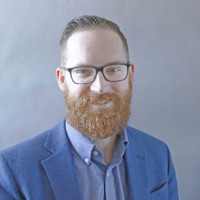
Paul Szmal: Good morning 837, it's FLX Morning Monday and we're joined for our monthly visit with the City of Geneva's Planning and Economic Development Director, David West. Good morning and welcome back.
David West: Good morning Ted, thanks for having me again.
Paul Szmal: We're going to talk a lot about the city budget and its implications for economic development, but one of the things that came up in City Council discussion recently was the possibility of moving the Farmers Market from the Lakefront Welcome Center back to downtown. A lot of people have said that might lead to more foot traffic and more locals visiting, but you told the Council that it is growing pretty significantly in its current location.
David West: It is. The Farmers Market is doing great. It's I think at an all-time high right now with the number of vendors that we've had in here. We have over 97 different vendors involved this year. You're getting great traffic and our staff person who's been heading that up has spent years really growing the relationships with the market, with the vendors, and with the community really. I'm really proud of where it is right now.
Paul Szmal: So the city has a new budget now. What are its implications in terms of your department and what you do?
David West: It was a tight budget season. We were asked to make important investments, but also be very restrained. My department has grown. We have a grant coordinator now who's really doing fantastic work to keep us on track with all the various grants that we manage. We have over a dozen open grants that are bringing state and federal money into our community, and it's really important that we are on top of that. Building good relationships with our funders so that we can keep that flowing and also making sure that the processes are really smooth.
So we've grown there. We had to take some cuts in the budget. So the city manager brought a budget to council and they then subsequently asked her to cut about $1.3 million out of that budget. So, you know, some investments were lost. We lost some money for grant writing, for pursuing more grants. We did not receive funding we were hoping for that would kind of smooth our process with the summer concert series. Our department puts on the concerts at the lakefront through the summer. And, you know, it's always a struggle getting the amount of support that we need from the community for that.
Cities are in an awkward position where we can accept donations, but we can't request them. So we're always hoping that we get the donations to fund that. And we were hoping to have a little more guarantee in the budget this year for that process, but that didn't work out. So we've had some cuts. We're making some investments. I think overall for economic development, we're in a good position. The cuts to the tax rate will help development be more attractive. And I think we're looking in a good direction.
Paul Szmal: Earlier this month, you unveiled to the public the economic development plan. Finger Lakes Times quote you as calling it an ambitious plan, but one that you believe has achievable goals. So run us through some of the highlights of what's in the plan and how you hope to achieve these goals.
David West: Absolutely. So that this plan has been officially adopted by the city of Geneva IDA and the Geneva local development corporation. It's going to have some more discussion before council before they adopt it. And we're also working with the downtown business improvement district on that. The goal of the plan is really allocating work to each of those four organizations, my department, the bid, the IDA and the LDC. And moving forward with those, what we're really looking for is to all be pulling in one direction. We want to significantly increase both jobs and housing in the community.
What we're hearing from companies is that one of their biggest barriers to increasing jobs here is the fact that they're already pulling people from outside of the county from far away. We don't have enough housing for the workers that they need. And we also have shortages with child care and education. So we're looking to address those. And really, a lot of the tasks in the plan are building kind of the basic ecosystem for economic development, the systems that will help us ensure that we're connecting well with the development community, that we're following up with businesses, that we have the resources that we need. When someone wants to come here to direct them in the right location, support them as much as we can, and help businesses build and succeed in the city of Geneva.
Paul Szmal: Is it more difficult to do this with multiple agencies involved in a perfect world? If it were just one, would that make it easier for you?
David West: If one agency could do all of the things that the four agencies involved could do, that would certainly be a little bit more convenient. The reason that the different agencies exist is because IDAs have powers that city governments don't and LBCs were created because they have powers that IDAs don't and then bids serve a different function. So we really do need all of these players. And I'd be remiss if I didn't say that there aren't a bunch of other players as well. Cornell University's Research Center at the Agritech Park does amazing economic development. They're bringing companies from all over the world. We know that we have groups like Ibero involved in the economic development space, even groups like Blueprint Geneva, Geneva 2030, our library, they're all partners in the work that we do. So we really need a large swath of the population being engaged in this. And that's been part of the development of the plan is making sure that we're reaching out as broadly as possible.
Paul Szmal: Talking with David West, City of Geneva Planning and Economic Development Director, one of the parts of the plan is already moving ahead and that is finding somebody for what's called the OEO site on South Exchange Street. Remind us about that facility, what it might be suited for in the process of finding someone to inhabit it.
David West: That's right. So we have an RFQ out right now. That's a request for qualifications. We want to recruit a developer who will work with the city to develop a project for the OEO site, which is on South Exchange between downtown and the rec center. And it's a big hole in the ground right now was formerly buildings and is zoned for five story development. So we're looking for a mixed use or it may just be housing development for that site, something that will increase our tax base that will add value to downtown and that will get more people on the street enjoying the things that are great about Geneva.
I think it's a great site. It's got waterfront views, proximity to all the things a person needs in a day, really easy place to get around, could lend itself to car light living would be great for seniors, people who need to get access to things downtown. So we just extended that process. So we're hoping that in the next month we'll be able to identify a developer to work with us on that site and move forward a project in the next year or two.
Paul Szmal: One of the things that's not in the plan is what you referred to as the silver bullet project, the big home run thing like a Micron. People are starting to get a little bit nervous because that project isn't really moving forward very quickly. So is that part of what you're thinking that it's risky kind of putting all your eggs in one basket?
David West: Absolutely. My general philosophy is that if we spread out, diversify the way that we're working, if we do a lot of small bets, we can afford for some of those to not work out to have learning experiences. But by being broad and diversified in our approach, just like in investing, we're protected, we're safe, and we can grow more sustainably.
Paul Szmal: There's also a study underway now to discuss uses for the Geneva Recreation Complex. What do you hope to learn and what kind of ideas are beginning to come forward?
David West: That's right. So discussions about the future of the Rec Center have been ongoing for many decades, and I know a lot of people have a lot of opinions about it. It's a real asset for our community, and it's one that we haven't been doing a lot of investment in in terms of the physical in quite a while. It's an older facility. We've made some improvements in closing it, but a lot of things that people remember as being new are 10, 20 years old at this point.
And we're working on a study now with engineers, the Beardsley Group, to really understand where everything is at in terms of the physical structure, the roof, the ice, the ice making, the rest of the building, all of the amenities there. To understand where that's at and what it's going to need over the next five to 10 years, and also to have some discussions about structure and partnership. So we have a great partnership in that building already with Hobart and William Smith Colleges and their hockey teams. There's growing use in the summer for lacrosse and for soccer. We want to have conversations with all of those partners about how the building is managed and how it's used going forward and how it can be most effectively leveraged for the community.
Paul Szmal: I know with Hobart Hockey doing so well, two straight national championships, there's been discussion about the fact that the building isn't big enough, both from a seating capacity and locker rooms and things, to be able to host NCAA tournament games. But when you talk about expansion, you've basically got kind of a cliff on one side. Has there been any discussion about any way of expanding the building to seat more people and to be able to host NCAA events?
David West: You know, the options there are pretty limited due to the structure of the facility. There's some little things we're looking at that we could tweak with the layout of where the bleachers are and how that works. I don't think it's going to be something that makes sense to make a big change, but really optimizing what we have, getting the most out of it. And having that, I think it's a success when the building's full and we have more people who want to experience it than can get in. And that's probably where we're going to be at for a little while. But seeing what we can do to make the best of the structure that's there is our goal right now.
Paul Szmal: David West has been our guest, City of Geneva Director of Planning and Economic Development. We appreciate the update and the great information every month. Thanks again.
David West: Glad to be here, Ted.