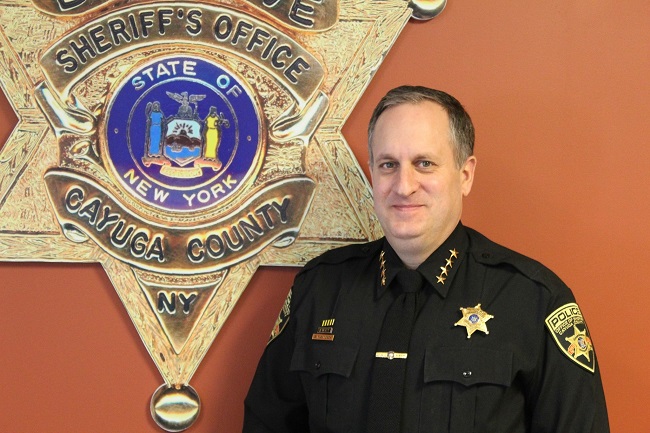
Paul Szmal: FLX Morning continues. It is 8.39. We're at 20. And again, there is a lake snow advisory in effect till 7 o'clock tomorrow for Wayne and Northern Cayuga Counties. Closings, cancellations, delays throughout the day. You can find those online at fingerlakesdailynews.com. Time to welcome in Cayuga County Sheriff Brian Skank as he joins us for his monthly visit. Brian, morning. How are you this morning?
Brian Schenck, Lauren Walsh: Doing well. Good morning, Paul. Good morning to everybody listening today. You know, it would be appropriate at this time because we're dealing with possible bad road conditions and we've already had some school closings and whatnot this morning to talk about weather advisories that the Sheriff's Office puts out. These are the travel advisories, no unnecessary travel statements. I think there's some confusion as to what each one of them means. So let's start with a traveler's advisory. When that comes out, what is the intent? What is the purpose behind that? What do people, what should people do?
Paul Szmal: Sure. So we do have three levels of advisories that we typically will utilize depending on the weather and the conditions. But the first one, as you mentioned, is our standard travel advisory. And that's just warning motorists that conditions are such out there on the roadways that we need to use caution and to be careful. One thing that's challenging when we put these advisories out there is our county is so long and so large that at times we'll put an advisory out that might have an impact on the northern end of the county. But, you know, you may not have any weather event at the southern end of the county at the same time. But the lowest level travel advisory is just warning the community that, you know, there's some inclement weather that we're seeing or is forecast. And just be aware that you need to use caution if you're going to travel. And then there's a step up from that, I would say. No unnecessary travel. Does that mean you're not allowed to be on the roads?
Brian Schenck, Lauren Walsh: So when we put that warning out, we're basically saying that if you don't have to travel, please don't. But we leave the decision to drive up to the motorist. But that level two warning, no unnecessary travel, is basically, you know, we're telling you that if you don't have to travel, please don't. Because conditions are such that it's very hazardous out there and you shouldn't travel if you don't need to. But again, that's not closing the roads. That's basically leaving the decision to drive up to the driver. But we're telling you that it's recommended that you don't. So then we get to the highest level, which is when roads are actually closed except for emergency.
Paul Szmal: Sure. And knock on wood, you rarely see this one. This would be a situation where the roads are going to be closed, but they're such that they really are impassable. And we've seen this in the western part of the state in recent years where there's so much snow that, you know, cars and regular pickup trucks just can't pass on the roadway. So if that warning comes out, we don't want people to be stuck on the highway out into a snow event where, you know, people can't get to them because there's so much snow. So if we get feet, you know, feet and feet of snow all at the same time, then, you know, that that might come out. But that would be the extreme. And thankfully, we don't we don't see that often.
Brian Schenck, Lauren Walsh: We're talking with Cuyahoga County Sheriff Brian Skank here on FLX Morning. And Brian, you have a guest with you here because we want to talk about dealing with depression and, you know, maybe having thoughts of suicide during the holidays. This does happen to people.
Paul Szmal: It does. And unfortunately, being a law enforcement agency, we do have to respond to those incidents. So my guest with me today is Lauren Walsh, our local director of community services and mental health director here in Cuyahoga County. We partner on a lot of initiatives, and I wanted to have Lauren come and join me today to, you know, talk about this issue. It's not easy to talk about depression and suicide, but it's something we need to talk about because if you are struggling or if you know somebody that's struggling, there are resources and things that are available. And I was glad that Lauren was willing to come out and join me today to talk about that. Lauren, good morning. How are you this morning?
Brian Schenck, Lauren Walsh: Good morning. I'm good. How are you?
Paul Szmal: Good, good. And to pick up on what Sheriff Skank was saying, there are resources available. There is help out there.
Brian Schenck, Lauren Walsh: Yes, I think our county is very robust in the amount of services that we do offer and have available. The Cuyahoga County Mental Health Department is an open access clinic, so there are no wait lists for any services as far as getting in to see a therapist, as well as if anybody needs any psychiatric evaluations, they are available there as well. We also have a mobile crisis team both in the day and in the evenings and weekends. Our clinic runs the daytime mobile crisis team, which is available to respond to any urgent mental health needs in the community, they'll come to you no matter where you are in our county to offer support, provide assessment, and connect you to ongoing services. That same service is also available in the evenings and weekends. It goes from 5 p.m. to midnight, as well as 6 a.m. to midnight on the weekends, and that's run by, we have a contract with Liberty Resources that provides our mobile crisis for those hours. There's also 988 that you can call and talk to a licensed mental health professional. But yes, it is really important to talk about it and to talk openly about depression and suicide because that does not increase risk, it actually can reduce risk and help people reduce stigma and for them to seek out resources.
Paul Szmal: Do you find particularly that the holidays are a bit tougher for people to deal with?
Brian Schenck, Lauren Walsh: Yeah, I think research shows that holidays are not joyful for everyone. I think this time of year can intensify emotions, so for anyone already experiencing depression, anxiety, stress, and grief may also feel those emotions more strongly around this time. It's very common that people will feel low during the holidays, some reasons why that might happen is, you know, loneliness, isolation this time of year, you know, with the weather like we were just talking about, it's hard to get out and to do the things that you would do in other times of the year. And I think grief can really resurface due to, you know, memories or traditions and not having that person at the table during the holidays can really bring up a lot of, you know, reminders of those loved ones that are no longer present.
Paul Szmal: Yeah, I think that's especially true if you've lost a relative during the course of the calendar year because you're coming into that first holiday season where they're not there.
Brian Schenck, Lauren Walsh: Yes, 100 percent. It's very difficult and things change, right? Families are used to traditions and the person being there and if they're no longer there, it can bring up a lot of emotions for them.
Paul Szmal: How much do you think economic stress factors in this time of year?
Brian Schenck, Lauren Walsh: Yeah, I was actually just going to mention that. Yes, financial stress, you know, family conflict, caregiving demands, that all spikes during this time because you're around your family a little bit more usually around this time. But yeah, there's the pressure around, you know, buying gifts and, you know, we all know everything is more expensive now and that puts a lot of pressure on families during this time.
Paul Szmal: Is there one particular starting point that people can go to to access some of the local services? We talk about 988 being an excellent resource. You can dial that literally 24-7 anytime.
Brian Schenck, Lauren Walsh: Yeah, I think that is a good starting point. But also, you know, we have two local mental health clinics right here in Auburn. At the county mental health clinic, you can walk in any day between the hours of 8 30 and 3 30 and you will see somebody. Whether you're there to start services or you just want to talk to somebody, you don't have to have, you know, your case doesn't have to be opened there in order to see a therapist and talk to them about, you know, anything that might be going on in that moment. So, that is also available. There's also acute counseling services and also East Hill Medical also provides behavioral health services. So, those are also different avenues so that the person has choice in where they go for services.
Paul Szmal: Well, Lauren, I certainly appreciate the information. Brian, back over to you for this one. You jumped in the lake here recently.
Brian Schenck, Lauren Walsh: I did last Sunday. I believe it was my fourth time supporting Special Olympics with their annual polar plunge at Oneida Shores at Oneida Lake. But a number of members of our Sheriff's Office and I took the plunge to support that awesome cause and our agency and a number of partners, including Moravia Police Department and some other folks joined us to raise almost or actually a little over $7,000 for it. So, we were glad to be a part of it. I think altogether they raised $176,000 with the local Central New York event, but this was the coldest year to date. They were literally beating a hole in the ice so that we could go in and all I can say is that it was a little bit painful this year.
Paul Szmal: I can imagine. You are a braver man than I am for doing that. So, this Saturday, a special event is coming up and I know it's one that is near and dear to your department's heart and that is the Shop with a Cop event.
Brian Schenck, Lauren Walsh: It is. Every year around this time, we take some deserving children out for a shopping trip and we'll be doing that this Saturday. Many thanks to the Wasco Fire Department for letting us start there. We'll start there, meet the kids, give them a ride to Walmart, do some shopping and thanks to a lot of people who have donated to this great cause and to our benevolent association, we're able to give each child a $200 gift card to go shopping and then we'll return back to the Wasco Fire Department, help them wrap presents and sometimes depending on a schedule, Santa will pay a visit and visit with the kids there. So, it's a great day. It's one of my favorite days of the year and we'll be doing it again this Saturday.
Paul Szmal: Yeah, this has a couple of benefits too. Not only are the kids getting out to do some shopping and maybe buy gifts for the brothers, sisters, moms, dads, what have you, but it fosters a relationship with members of the Sheriff's Department starting at a young age.
Brian Schenck, Lauren Walsh: It does and we love that community outreach. We love having, you know, a positive interaction with children that sometimes it's not always the case. Law enforcement might be viewed negatively depending on, you know, the situation, but it's great to have just a positive experience with the kids and we're glad that they get to have one with us.
Paul Szmal: All right, Sheriff Loren, happy holidays to both of you. Stay safe and we will check in with you in the new year, sir.
Brian Schenck, Lauren Walsh: Thanks, Paul.
Paul Szmal: Thank you. All right, it is 8 50 as FLX Morning continues.