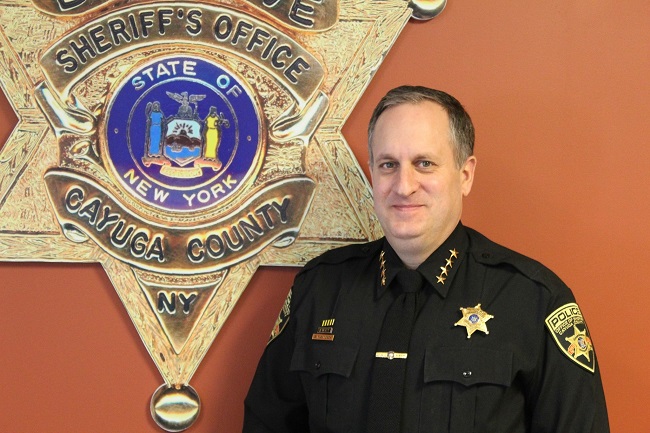
Paul Szmal: Good morning, it's 8:39, it's FLX Morning Thursday, it's our Law Man Thursday with Cayuga County Sheriff Ryan Skagg, good morning.
Brian Schenck: Good morning, Ted, good morning to everybody listening today. It's good to have you back with us again.
Paul Szmal: This is No Shave November for law enforcement people all over the country, and you raise money and awareness for various local groups, and the Custody Division has picked out a Children and Family Cancer Charity, tell us about that.
Brian Schenck: They have, we participate in this detail every year, and the primary goal is to raise awareness, it began with raising awareness for different types of cancers that people are addressing, but this year we're actually participating and allowing all of our members of our Sheriff's Office to choose their own location where they want to donate, and our custody officers this year chose the Rory Sparkle organization, which is a great organization here locally in our community that donates money to families that have children that have been afflicted with different cancers to try to, what they say in their mission, bring some sparkle back to those children and to the families, so I'm really excited that they chose that organization to donate to because they're a great one, and I think we're going to continue this beyond November, our members have agreed to continue donating to various causes if we continue to allow them to put up the razors beyond November, so you might recognize and see that Sheriff's Office, Patrol Deputies, and some of our custody staff even beyond November will be donning the beards.
Paul Szmal: Wow, that's great. Has anybody ever decided they liked their beard and kept it?
Brian Schenck: Well, quite a few people here do, and there was quite a push to get me to allow this to continue beyond November. Last year we actually continued it, I don't know if many people in our community noticed, but I think we continued it to May and might find next year that we continue it throughout the whole year if it works out, but the great thing is every quarter they'll be donating $25 per member to a worthy cause in our community and beyond.
Paul Szmal: Well, another month and another scam. This one's a telephone scam, people are looking for Social Security numbers, they say it has to do with Medicare.
Brian Schenck: It is, and you and I talk about different scams periodically and I appreciate the opportunity to do that because the only way we combat these things is through education and making people in our community aware, but the most recent one we had reported this week, individuals calling people on the phone looking to get their Social Security number and pretending to be someone that's helping the individual obtain Medicare or do something with their current Medicare benefits, so we just really need to continually remind folks in our community and educate especially our elderly neighbors that, you know, if somebody calls you looking for your personal identifying information, whether it's your date of birth or your Social Security number, steer clear because just never give that out over the phone to somebody that's reached out to you unexpectedly.
Paul Szmal: And it just seems to me that if it is something legitimate, they'll get back to you and you'll get it straightened out eventually.
Brian Schenck: Absolutely, and if they're calling you, if you're already enrolled, they should have that information. They don't need that over the phone.
Paul Szmal: Right. So, yeah, do your due diligence, you know, contact, you know, whoever the provider is. Just make sure that you're talking to who you think you're talking to, but if somebody reaches out to you out of the blue and is looking for your personal information, it's most likely a scam.
Paul Szmal: We've talked a lot this year about the changing way law enforcement is responding to mental health emergencies and the task force that you put together. And just recently, you under Sheriff Peenstra and Detective Sergeant Stewart attended a conference from a great group. It's called NAMI, the National Alliance on Mental Illness, and it was an education conference in the latest in what law enforcement is doing. How does that, what you learned, match up with what you've been doing?
Brian Schenck: We did attend that conference this past Friday in Albany, and this is our third year in a row that we went, but it's really great to go and see what innovative things police are doing in partnership with their mental health providers throughout the state of New York and beyond. And we're doing, we've implemented many things that we've learned from our partners with NAMI and from this educational conference. One of the biggest things that I think we've really come a long ways with over the last few years is actually partnering directly with mental health therapists and social workers, actually having them come out to the scenes to address crises. It's just great that we're not working in silos anymore. We literally have teamed up and we will respond to different calls. And the goal is we want to bring a mental health response to a mental health incident. Our law enforcement members need that, need that help. But we're continually looking at new ways to be innovative, to try to make sure that we're addressing these types of crisis calls in the way that they should be.
In this particular conference that we went to on Friday, it's just a great way to see what's going on out there and actually come up with new ways to address these types of incidents.
Paul Szmal: He had one of your partners on earlier this year, so talk about how this partnership came about to work with the mental health providers in Cuyahoga County.
Brian Schenck: Well, we started realizing that by bringing the social workers and the therapists on board with us, that it really made our job easier and it brought the right response to these types of calls. So we've had very good working relationships here with Cuyahoga County Mental Health. And the head of mental health and I and our staff members started to recognize that, hey, you know, this would be a lot easier if we start working together. So we started working together. We started bringing crisis resources out to the scene from mental health, and we started even using iPads to link our social workers and therapists via an iPad to somebody on a scene. If the social worker or therapist couldn't get to that location, somewhere out in the county, our deputies all carry the iPads in their vehicles with them, and they can link up the individual immediately to a crisis counselor.
We've come a long ways in the last five years in building upon these partnerships and just doing a much better job, I believe, dealing with these situations that just keep coming at us. Unfortunately, the mental health problem in our community and all of the communities in your listening area and beyond continues to be challenging and seem to get more challenging, but we're doing the best we can to meet these challenges with new innovative ways to address them.
Paul Szmal: Lawman Thursday with Keuka County Sheriff Brian Skank, you've had your jail population drop recently, which has created an opportunity to take in boarders from other counties. Does that have a net positive financially, or does the reimbursement pretty much cover the cost?
Brian Schenck: Well, it does have a net positive because we have so many fixed costs anyway. So if we take an area of our jail, for example, we have a pod that's a 40-person pod, and we have to have that open anyway. We might have 20 individuals in that 40-person pod. If we can bring in 10 additional boarders, it's certainly positive income because we don't have additional fixed costs as a result of those boarders coming in.
But right now we have, I believe, 51 individuals boarded into our jail from other counties. We have people here from Jefferson, Oswego, and Tompkins counties, and that's due to the fact that the sheriffs might need a little help. They might not have the space to house those individuals. Tompkins County right now, they are doing an overhaul of their jail. I believe they're putting a new kitchen in their jail. So that remodeling project has forced Sheriff Osborne to find another location for about 30 of his individuals. And we're housing them here and boarding them in and generating some revenue, which helps offset some costs in our budget. But overall it is a net positive. We don't have to open additional areas or take on additional fixed costs to bring those boarders in. So it is positive to have them here.
Paul Szmal: It's been a while since we've talked about this, so remind us about the offender watch system that lets people locate sexual offenders near them.
Brian Schenck: Sure. I did want to bring this up, and I appreciate the opportunity to do this again. We do have the offender watch system that we utilize so that the public can stay informed as to where sexual offenders may be living near their homes or place of work or within their communities. It's an app that you can actually, you can utilize it on your phone. You can use it through our website. The easiest way to find it is actually going to the homepage of our Sheriff's website. And there's a tab for sex offenders on the homepage, but it'll allow you to get into the offender watch system. You can plug in your address, and it'll show you a map that you can extend out as far from your home as you would like, but you can see where offenders are registered, where they're living near your residence or place of work, as I'd mentioned. You can track them. You can receive real-time alerts if somebody moves into your community and registers with our Sheriff's office. You can receive an alert that will tell you where they're living.
That does work for our county, with the exception, the City of Auburn isn't utilizing the system yet, so unfortunately that won't work within the City of Auburn, but it will work outside the County of Cougar. And I believe a number of agencies, Ted, in your listening area, a number of Sheriff's offices use Offender Watch, so they can go onto the app and utilize that. It's really good, too, if you drive to another location anywhere within the country that is utilizing Offender Watch, you can track offenders from your phone or whatever piece of technology you have, as long as that agency utilizes the platform.
Paul Szmal: One of the people we met earlier this year was through your Civil Division, and we talked about what that division does. One of those things is processing evictions, 290 so far this year, and on track for a record.
Brian Schenck: It is, unfortunately, and I think we talked about it before, but we set a record in 2022, we set one in 2023. In 2023, we had 302 total evictions, and we're at 290 right now, so it looks like we're going to beat that. But it's an unfortunate thing that we see this continue to increase, because we have such a homelessness problem in our community and all of the communities here locally in Central New York and beyond. It's causing a lot of challenges for our municipalities, for us. There's a lot of budget challenges we're dealing with, trying to house individuals, especially when the weather gets colder, but I think it's important for everyone in our listening community to understand that this issue is impacting our budgets and impacting a lot of children that are living in hotels here locally and not in great environments. So we got to continue to work hard as a community, and certainly our local legislator and elected representatives have to work on trying to address some of these challenges that are making us continue to have this problem grow and grow, because we've got to figure out a way to move this in a different direction.
Paul Szmal: Kuka County Sheriff Brian Skanks has been our guest today. We appreciate the time as always, and we really appreciate the education, because we've really learned a lot about what your office does over the years, and we appreciate that and happy to share it with our listeners.
Brian Schenck: I appreciate the opportunity. I always look forward to it as well, and look forward to next month, Ted. Thank you.