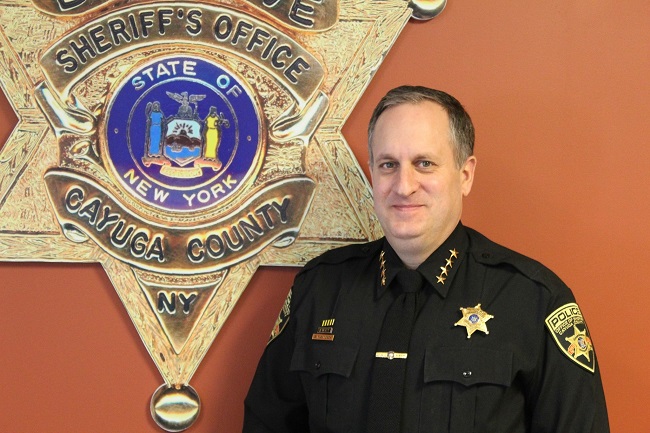
Paul Szmal: Coming up on 838 here on FLX Morning on Finger Lakes News Radio, it is Lawman Thursday and that means we welcome in Cayuga County Sheriff Brian Skanks. Sheriff, good morning, how are you today?
Brian Schenck: Good morning, Paul, and good morning to everybody listening today. I know you wanted to start off by saying a special thank you to Ted Baker, so I'll go ahead and let you have the floor for that.
Paul Szmal: I did. I wanted to tell Ted I appreciate all the years of interviews that he and I were able to do. Unfortunately, I didn't realize when we spoke last month that he was planning to retire and that came about really quick, so I don't know if he's listening or not, but if he does get this message, I wanted him to know that I appreciate all of the opportunities and his partnership. We appreciate our media partners that help us get information out about the work that we do, and I appreciate all that Ted did to help me, so I wanted to thank him and wish him well in his retirement.
Brian Schenck: Absolutely. Let's dive into some of the stuff that we want to talk about this time around on Lawman Thursday. The first one being that we're hearing about immigration enforcement. We're hearing in some parts of the country where police are not working with federal agencies, other areas where they are working with federal agencies or under certain conditions. What's the stance of the Keuka County Sheriff's Department in terms of working with immigration enforcement?
Paul Szmal: Sure. I appreciate you asking about this. This is a topic that's getting a lot of attention at the national and local level. We've been asked here at the Keuka County Sheriff's Office by quite a few citizens within our community how we will handle these types of issues, how we will handle enforcement, and I've been very clear, along with a number of sheriffs and local law enforcement leaders across the state, it's my position that we approach this primarily from a public safety standpoint. There are certain things that we have legal authority to do. State law does not allow for local law enforcement in New York State to enforce civil immigration law. If somebody commits a civil immigration violation, for instance, if they cross into our country illegally the first time, it's a civil violation under federal law. Federal authorities have jurisdiction to enforce that. We do not have jurisdiction to enforce that locally. The New York State courts have made that clear that our criminal procedure law does not give us the authority to do that. So that doesn't mean that we won't assist our federal partners. I feel very strongly that if our federal partners need assistance in enforcing federal law, we would certainly do that, but it can't be our primary function. We're not authorized to do that. But if there's a crime committed by somebody who's in our country illegally, whether it be crossing a border for a second time after being deported or certainly committing a crime at the federal or local level, we will absolutely aggressively pursue individuals that commit those crimes. If they're here illegally, we will hold them for federal authorities. And that's where I approach it from. So public safety standpoint, that's primary, but we have a law enforcement responsibility and it's about public safety. And we have to make sure that we prioritize getting these criminal aliens out of our community and certainly across the country. But we've had some very dangerous individuals that we've arrested. Certainly two that we arrested last year that were, one was preying on a child, actually raping a child, and one that had intentions to. These are the individuals that we're going to aggressively pursue and certainly cooperate with the federal authorities to do just that.
Brian Schenck: Thank you for the clear and concise explanation on that, Sheriff Skank. We're coming up on Valentine's Day tomorrow. Unfortunately, sometimes domestic relationships don't always go all that well.
Paul Szmal: No, they don't. And unfortunately, domestic violence is a topic that, you know, typically in October, it gets a lot of attention. It's Domestic Violence Awareness Month. But this is a topic that is a problem year round here in our community, throughout your entire listening area and certainly across the country. But I think we need to continually let people that are victims of domestic violence know that there is help out there. Seek out that help if you need it. There's never an excuse for abuse, period. If you need help or know somebody that does, there are 24-hour hotlines in your local community that you can find online and an easy way for people to get information about what's available in their local community is to go to the New York State Office for Prevention of Domestic Violence. They have a website that will link you with local resources to get that help you need and confidential resources that will help you safety plan, get the help you need. And certainly if you're in a situation that's, you know, some type of an emergency or you need immediate help, certainly, you know, call your local law enforcement or 911. Don't hesitate to do that and they will get you the help that you need.
Brian Schenck: I have to imagine that sometimes these domestic situations for you and members of your department can be difficult to navigate.
Paul Szmal: They can be very challenging. And one of the challenges that we find at times is victims can sometimes be reluctant to cooperate. And sometimes I think that, you know, there's a misunderstanding as to why that might be. But, you know, sometimes victims are very, very concerned with their safety and rightfully so. You know, sometimes, you know, that can be very volatile at the point that they're seeking assistance and trying to get help. But I think victims need to know that that's a time when they absolutely need to reach out for help with safety planning and, you know, getting maybe some safe housing away from the perpetrator or offender. So there's reasons sometimes that victims are reluctant. You know, they might be thinking of their own safety and trying to navigate this in the best way that they know how. But I just want to reassure victims that, you know, we do have the resources and our victim advocacy services are here to make sure that, you know, that help is provided to keep a victim safe and hold an offender accountable.
Brian Schenck: And with any holiday, even Valentine's Day, there are the possibilities of some types of scams being run. Have we found anything on the radar in terms of Valentine's Day related scams?
Paul Szmal: Well, it's interesting that we're discussing this, but romance scams are something that we're seeing periodically. I know that, you know, sometimes when we think about these types of scams, you know, we might chuckle a little bit, but these scams are real. And, you know, I want folks that are listening today to know that if you if you have been scammed with this type of scam, you're not alone. The people that perpetrate these scams are relentless. And these consist of scams where somebody, you know, might be utilizing social media sites or might receive an email from somebody. And these can be oftentimes individuals that maybe live alone or don't have somebody in their life to to spend time with. And these scammers will prey on that. They'll they'll start some communication and pretend to be somebody they are not, especially on social media. They might provide pictures of, you know, who they want to pretend to be, but it's not really that person. And they will spend a long time building a relationship through communication. And then at some point, you know, they may start asking for money. They might need money for what they'll tell you is a medical concern, or maybe they want to get a ticket to come visit you, visit the individual and meet them in person. And, you know, they can really pull somebody into this fantasy that, you know, here's somebody that that I can spend time with that really understands me and wants to spend time with me. And we're seeing this happen more more often than I would like. I just am very concerned because people have lost a lot of money with these scams. And I think the only way we combat that is through education. So if you are potentially being approached by somebody online that you think is a potential companion, be very weary. And if you know somebody in your life that may be an older parent or somebody that might be alone and looking for some companionship in that way, make sure that they're educated about these hazards, because it's such a shame to see people lose thousands and thousands of dollars to these scams online. And these scammers are relentless. They're good at what they do. And it's really unfortunate that these things happen.
Brian Schenck: Yeah. The scammers, especially online, are very difficult to track, aren't they?
Paul Szmal: They are very difficult. Oftentimes they don't even live in our country. So I really try to promote the fact that education is key. The only way we can combat this crime typically is by not letting it happen in the first place. So knowledge is power. If you know what's going on out there, you understand it. And not only you, but help educate others that could fall victim. That's how we combat these things so that we, you know, we don't get sucked into them in the first place, because once that money goes, you know, to these scammers, oftentimes in other countries, we just cannot get it back and we cannot hold people accountable.
Brian Schenck: We're coming up on the President's Day break and we're talking with Cuyahoga County Sheriff Brian Skank here, Lawman Thursday on FLX Morning. During the school break, there's going to be some more active shooter training happening?
Paul Szmal: There is. We take advantage of these breaks, oftentimes getting into our area schools to not only learn the layout of the schools, our deputies and partner agencies that participate in this training with us get to learn the layouts of the buildings. But we do some active shooter training and some scenario based training in these these schools. And it's something that you never want to think about, you know, God forbid. You never want to see that happen anywhere, but we try to do all that we can to be prepared in the event that there could potentially be an emergency. And we take advantage of that. We will be doing that again during the school break. And I believe that the Auburn Police Department and Camillus Police Department will be participating in this training with us. And we've invited some other state entities, including the state police. So not only are we trying to do this within our agency, but we try to partner with other agencies that would potentially respond with us in the event of an emergency. And we do make that a continued priority to stay on top of that.
Brian Schenck: And can you give us an update on any recruiting, hiring, job openings coming up within the department?
Paul Szmal: Sure. We just posted our road patrol exam. We have an entry level road patrol exam that will be coming up in May. You would need to register by April 2nd. And it's very easy. Go to our civil service site online and you can find the registration there. And I know there are a lot of other counties and local law enforcement agencies in your listening area that will be offering exams as well. So I would encourage anybody that's listening to this today that would like to take that exam or look into a law enforcement career. I would highly recommend it and go to your local civil service site and sign up for that. And we're also recruiting for our jail division. We'll be putting out some flyers relative to that. We are looking for some staffing for our jail, but we're recruiting there. And we would like to talk to anybody that might be interested in this type of career path.
Brian Schenck: All right. Fantastic. Well, Sheriff Skang, thank you for joining us this morning. As always, a pleasure to speak with you, sir.
Paul Szmal: Always a pleasure, Paul. Thank you so much.