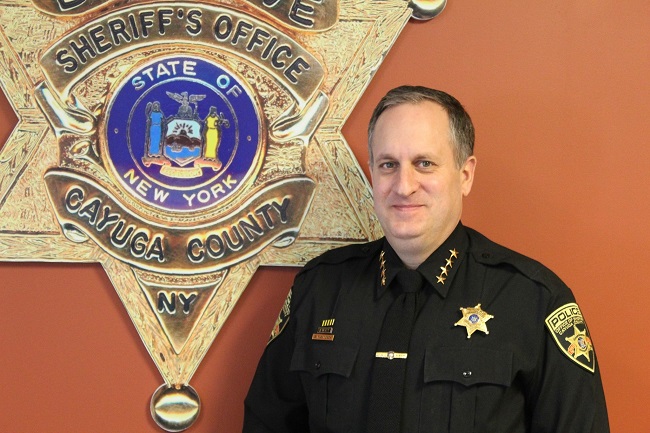
Paul Szmal: And welcome back to FLX Morning, it is 8.38 here at Finger Lakes News Radio, and we are joined by our resident lawman, that would be Cayuga County Sheriff Brian Skank. Good morning Brian, how are you this morning?
Brian Schenck: I'm doing great, good morning Paul, good morning to everybody that's tuned in today. We're on I guess the backside you would say of the corrections officers strike and dealing with now, some of them going back to work, more on that in a minute. But one thing that I think maybe needs to be explained is one of the key issues that brought about the strike in the first place, and that's surrounding what's called the Halt Act. Sheriff, can you explain to people what the Halt Act is and what effect it has had on the prison populations?
Brian Schenck: Sure, I can do that, and I think it's important to explain how it's impacted our local jail as well as our state correctional facilities. But the Halt Act is the humane alternatives to long-term confinement. It was a law that was enacted in 2022 by our state legislature, and essentially it limits the amount of segregated confinement that can be used in disciplinary proceedings when it comes to an inmate that's violated rules, whether it's something very minor or whether it's something very serious as far as, you know, a serious assault against a corrections officer or another inmate. Corrections facilities, corrections officers prior to 2022 were able to use segregated confinement to lock somebody in if they were violating rules or certainly if they committed a very serious offense. There's been some serious limitations on what can be done as far as segregated confinement and how that can be utilized, and as we've seen since 2022, especially in our state correctional facilities, assaults and serious violations have just, the numbers have gone through the roof.
So, I mean, the data is there to show that the Halt Act needs to be tweaked, it needs to be revised. I'm a very strong proponent of continually, you know, looking at how we deliver public safety services and what we do both within our jails and correctional facilities and what we do on the street and always fine-tuning those things, policies and procedures to make sure that we're doing the right thing to protect public safety and certainly treat, you know, those that are arrested and are inmates in the right way. But the Halt Act as it was enacted in 2022 went too far, much like bail reform did originally. It needs to be revised. I understand, you know, the corrections officers at the state level that went out on strike, you know, have been saying for years that we need to do something different. People are getting assaulted every day, people are getting hurt, this isn't working. The data supports that, you know, and we've seen that in our local facility here, in our local jail as well. We've seen our use of force numbers just skyrocket since 2022. So it needs to be tweaked, it needs to be revised. I think it's unfortunate that it's come to this to bring attention to this issue and, you know, I believe it's pretty evident that the state, you know, the governor and our state legislature is still not willing to fix this. So the unfortunate thing is not only is it bad for corrections officers that are in the facilities doing the job and dangerous, it's dangerous for inmates. Inmate assaults are up at the state and local level and it needs to be fixed. It's got to be fixed now.
Paul Szmal: That's Sheriff Brian Skank joining us here on FLX Morning. The situation with Governor Hochul indicating that any of the COs who did not go back to work and remained on strike were not only going to lose their jobs, but also be disqualified from potential state and law enforcement employment. Do you have a comment on that?
Brian Schenck: I do, and under her most recent declaration, emergency declaration, Executive Order 47.3, she did suspend some sections of law and make some declarations that will not make it an option for our local jails, certainly for me and other sheriffs throughout the state to hire any of the corrections officers that were terminated by her administration. You know, I know all of our sheriffs out there are looking for staff. I've had a number of state correctional officers reach out to our agency that are interested in employment, interested in coming here. But if they've been fired according to this emergency declaration, we don't have the ability to make a local decision as to whether or not we want to hire these individuals. And I think that it's an overreach. I think that we should have the ability to make that local decision. And I have brought that to the attention of our local legislature because I believe they need to chime in on that. And I applaud Sheriff Machel in Oneida County and his County Executive. I know they did a press conference yesterday. They are looking to address this potentially with some legal action. And I don't think any municipality across the state can allow our state government to dictate and mandate what decisions can be made at a local level. So I'm going to push that our local legislature do the same.
Paul Szmal: I understand that there are some state corrections-ready inmates that have been sentenced to state time, but the state is not taking them. Is this a fallout from the corrections officer strike, or is this a different issue?
Brian Schenck: Well, I think this is an issue relative to the fact that there's a staffing crisis and an ongoing situation within DOCS where, you know, they basically told local sheriffs across the state that any state-ready inmate who's been convicted of a felony and sentenced to state time, they're not taking them until the end of March is the latest date I have. I'm concerned that that number, that date could get extended depending on, you know, how they address their staffing crisis. But we currently have 11 in our facility that are ready to go. The state will pay us a board and fee after 10 days if they aren't taking them. So we will get compensated to a certain degree. But, you know, it could be concerning if it went long-term. We could have some challenges with, you know, those individuals being in our jail and the numbers climbing and climbing. Other sheriffs could have some challenges with that, you know, sheriffs that are having a serious staffing crisis or just don't have the space that's going to become problematic for some of our sheriffs out there. So I'm hopeful that by the end of the month, the state will take them. But I am very concerned because I know they do have a serious staffing crisis. They just let go, you know, 2,000 corrections officers. And they were short prior to that. So this is going to be a crisis for a long time for them.
Paul Szmal: And as part of the remedy, if you will, Governor Hochul instituted deployment of the National Guard members. I understand one of your road patrol is actually part of the National Guard. So he is deployed for the purpose, I take it, of working in some of these correctional facilities.
Brian Schenck: He is deployed right now and he is in a supportive role with the National Guard for state corrections. We don't know how long he'll be away. But certainly, you know, when he's away, we don't have him here performing his supervisory function. He is a sergeant here with our road patrol division. But I know that our agency isn't alone. We're only missing one person due to this. I know, I believe Sheriff Milby in Wayne County, he's got a few people that are in the National Guard that are gone. And I believe Ontario County is in the same situation. And I wouldn't be surprised if all of the sheriffs in your local listening area are dealing with this as well. So it's another impact on our agency that the general public may not necessarily see. But it is another challenge with us losing our resources to the National Guard and to address this issue as well.
Paul Szmal: Talking with Keuka County Sheriff Brian Skank here this morning on FLX Morning. Let's shift gears and talk about some upcoming events that the department is going to be starting off with a Red Cross blood drive, appropriate enough that we are in Red Cross Month in March. But this one is actually at the beginning of April.
Brian Schenck: It is. We are hosting. We do two every year. And I'm really proud that we support the Red Cross. Our staff comes out and donates blood and a lot of community members and other county employees sign up for this. But we will be hosting our next one here at the Public Safety Building at our Sheriff's Office on Friday, April 4th from 9 a.m. to 2 p.m. So if anybody's interested in donating here or if they're just interested in donating really anywhere in your listening area, they can go on the Red Cross's website at redcrossblood.org and look up a particular event and sign up for that. And there's there is a critical need. There has been for quite some time. I'd urge anybody that's able to do that to please consider donating.
Paul Szmal: Coming up here in the month of March, a couple of voter safety courses in the county.
Brian Schenck: Yeah, so our members of our Sheriff's Office, our Navigation Division, we have two voter safety courses scheduled, one for March 22nd, one for March 30th. One will be in Locke, New York, and one will be in the town of Ired at the north end of our county. But anybody can go online and look up a voter safety course or get more information about that on the New York State Parks website at parks.ny.gov or .ny.gov. And anybody as of January 1st of this year is required, anybody that navigates a vessel or is boating on the lake, no matter what age, needs that safe boating certificate. So there's a lot of people out there that are looking for those. I know you can take those classes in person or online, but we're trying to support safety on our waterways here locally and our members will be hosting those classes and we probably will be setting up just a couple more too as we move forward. So keep watching for additional courses that will come up here in Cuba County.
Paul Szmal: And leaning towards the amount of openings that you have in your department for various functions, there's going to be an open house coming up on April the 7th.
Brian Schenck: We are having one here on April 7th, primarily focused on our Custody Division, our Jail, and our 911 Center. So we'll be hosting an open house for 911 dispatchers as well. That doesn't fall under my umbrella. We do have a director that oversees 911, but we are partnering with the director of 911 here to have this open house on Monday night, April 7th, from 5 to 7 for anybody that might be interested in those career fields. They can come out and talk to anybody that works there and take a tour of our building. And I would like to mention that all of the sheriffs and agencies within our local listening area here are looking for staff and doing similar things. So I encourage you to look online or look on their social media for these events and other locations as well.
Paul Szmal: All right. And one word about this weekend, because, well, St. Patrick's Day is coming up. It's going to be a busy weekend of celebrations.
Brian Schenck: It is. I want everybody to have a great time. I will be marching, actually, Saturday with the Auburn Hibernians, Shortest Parade, I think they call it, in New York State, St. Patrick's Day Parade. It's a really short parade, but there'll be a lot of celebrations. I urge you to celebrate responsibly, you know, have a plan if you're going to drink. Make sure you have a ride, and we don't want to see you on a traffic stop if you're drinking and partying this weekend. Just have a plan.
Paul Szmal: All right. Sheriff, as always, we appreciate the time. Thank you, sir.
Brian Schenck: Thank you so much, Paul. Have a great day. It is 8.50 on FLX Morning.