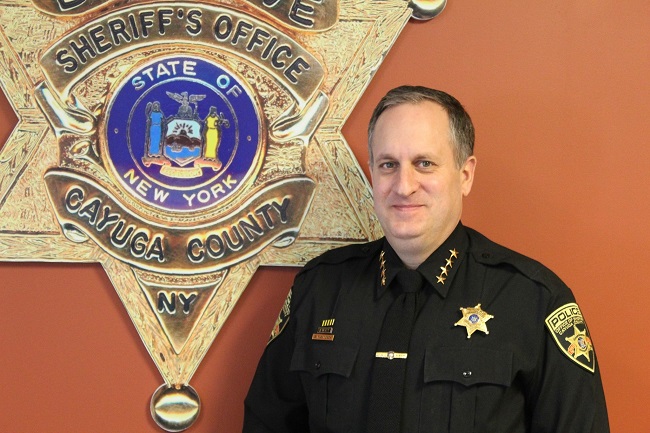
Paul Szmal: FLX Morning continues now. It's 839. It's Lawman Thursday. Our lawman, Cayuga County Sheriff Brian Skank is on the line with us. Good morning, Brian. How are you today?
Brian Schenck: Good morning, Paul. How are you today? Good. You've had a busy 36 hours or so with the department dealing with some of the flooding issues that were happening in the county.
Paul Szmal: We have, especially Tuesday night, and I know quite a few areas in your listening area were dealing with this as well. But we had a lot of flooding at the south end of our county. And it seems when we get heavy rains, we tend to see that in the Moravia area. But with Tuesday night storms, we had some roads closed all the way from Niles to Moravia to King Ferry in our county and quite a little bit of flooding. But fortunately, overnight, everything subsided and we were able to get a bunch of roads back open. But our first responders, a lot of fire departments, our emergency services office, a lot of our law enforcement members were pretty busy all night. I know that was going on in multiple counties throughout central New York.
Brian Schenck: Is the Sheriff's Department the primary when something like that happens and then the fire departments are notified? Or is it just based on like eyewitness accounts coming in saying, hey, there's water over the road at a particular location?
Paul Szmal: Well, really, it's a team effort by all of our first responders as far as our Sheriff's Office and law enforcement. Oftentimes, we're just assisting with the road closures and that type of thing. But our fire departments and our emergency services office, they're very busy during those times dealing with flooded basements or more serious emergencies if there's accidents or things along those lines. But it really is a team effort. All of our first responders come out and sometimes we forget our 911 center, but they're taking all of those emergency calls and it can get quite busy in the 911 center as well. But it's generally a team effort. We're all involved when those things happen.
Paul Szmal: We're talking with the Cayuga County Sheriff Brian Skank here on FLX Morning. We're celebrating a couple of important occasions this week, Brian.
Brian Schenck: We are. So this week is National Corrections Officer Week and as well as National Nurses Week. So we're recognizing and honoring our staff that work in the jail, within our correction divisions. And that's not just our local jails, but that's certainly the State Department of Corrections. And we often forget that those members in those divisions are a really important part of our criminal justice system. They house incarcerated individuals, care for them. And without them, we're not able to hold those people and lock up and keep them off our streets. And pretty dangerous individuals that they're dealing with every day. But President Reagan established this week in 1984 and every week since we've recognized our correctional officers. And we're also recognizing our nurses in the jail this week and our nurses throughout our community. We appreciate all they do every day in service to our community.
Paul Szmal: You took a little field trip to Albany.
Brian Schenck: I did. A few days ago, I joined under Sheriff Peenstra and we partnered with Sheriff Don from Columbia County to meet with a number of legislators to talk about pending legislation and some of the concerns that our different sheriff's offices have across the state. And this is an initiative that our New York State Sheriff's Association started a few years ago. Usually once a week, a number of sheriffs will come together from different parts of the state to meet with our assembly members and our state senators to talk about different type, different legislation. And I was fortunate to be able to go on Tuesday and speak with a number of legislators about pending legislation with one of the highlights being first responder wellness. We've got a lot of individuals in the law enforcement field, certainly in the fire service or 911 folks, you know, EMS providers that are dealing with some very difficult calls every day. And that can take a toll on your mental and physical well-being. So we're trying to get some support for some legislation to support first responder wellness and make sure, you know, just as we try to take care of, you know, individuals in our community that might be suffering from some mental health challenges, we want to make sure that we're taking care of our first responders and law enforcement officers to keep them healthy and keep them out in the field. So they were very receptive. We had some really good conversations and, you know, I'd like to say that we met with individuals on both sides of the aisle. For me, these things aren't, aren't, you know, partisan political issues. They're really, you know, they are really things that we should all be coming together on. And we had good conversations with individuals from both parties. So I believe it was a good day for us.
Paul Szmal: I'm sure as well, you and others that have been going to Albany these past few weeks, too, have been talking about the whole corrections officer situation in the wake of what has happened here over the course of the past six months.
Brian Schenck: Yeah, we have had some conversations about that. There's certainly still a crisis at the state level that is impacting our local jails. One of the challenges is we have individuals in our jails now they're ready to go to docks. They've been sentenced to state time and the Department of Corrections is supposed to be taking them right now from our local communities, but they're not. So we have 22 individuals in our jail right now that are state ready and have been sentenced to state time that should be gone, that, you know, we shouldn't be, our local taxpayers shouldn't be settled with caring for these individuals. But unfortunately, due to this crisis, the state has not taken them yet. They have indicated that they will be. They're going to start taking about 75 to 100 incarcerated individuals a week from jails throughout the state to the state system. But there's over 2,000 right now that are ready to go. So that's going to take quite a while to to get that done. So, yeah, there's still a crisis. It's impacting our local communities. It's impacting, you know, public safety in the state has got to get this the situation fixed because it's having a negative impact on public safety.
Paul Szmal: You were talking about physical and mental health of first responders, and that dovetails nicely into our next little topic here. The fact that May happens to be Mental Health Awareness Month.
Brian Schenck: It is. So in May, we recognize Mental Health Awareness Month and we try to highlight the fact that there are resources in our community and certainly throughout the listening area here with WAUB. If you, you know, utilize the 988 resources or go online to look for local community resources. If you are dealing with a mental health situation or you know somebody that is, you're not alone. I try to highlight these things and I believe we talk about these things periodically throughout the year when we do these interviews. But I think it's important to know that there are a lot of people out there in our communities everywhere that are that are suffering. But there are there are resources available and we do share those from time to time on our social media. And I believe I shared those with you today, Paul. But there are things that people can do and things they can do to get help. So I encourage people to take advantage of those.
Paul Szmal: Yeah, absolutely. Other than some of the obvious ones, the list, by the way, that Sheriff Skanks sent me is three pages of different organizations, counseling services, mental health facilities. There's confidential help for alcohol and drugs, the National Alliance on Mental Illness. Even folks like Nick's Ride for Friends are on this resource list.
Brian Schenck: They are. That's an organization that I'm extremely proud of. I'm actually the board chair of Nick's Ride for Friends, but that's a peer support organization that provides peer support for those that are dealing with addiction and substance abuse challenges. I've been involved with them for a very long time and we have local peers that are embedded in our jail here too as well from Nick's Ride for Friends. But they're a great organization if you know somebody that's dealing with an addiction issue or even a mental health issue, have them reach out to Nick's Ride and speak to a peer who has lived experience and can help them out. But we deal with a lot of mental health calls with the Sheriff's Office. Quite a few calls that we go to in the course of a year due to a mental health challenge that somebody has or someone in crisis. And sometimes those calls could be handled a little bit differently if individuals knew what resources are available. So please take advantage of the resources online and 988 and some of those things. And there's help out there. Like I said before, you're not alone.
Paul Szmal: I mentioned the field trip that you took out to Albany, but there was another field trip, so to speak, out to Syracuse with the DA.
Brian Schenck: So I did. I did join again under Sheriff Painstra and Detective Lieutenant Franklin with our office along with Brittany Antonacci from our District Attorney's Office and Chief Androsco from the Auburn Police Department. We were invited by the newly appointed United States Attorney John Cercone to come to the federal building in Syracuse to talk about partnerships between our local law enforcement agencies and the federal agencies that we work with. We had a really good meeting with Attorney, U.S. Attorney Cercone and very clear to me that he's all about partnering and working closely together. He had also invited a number of federal agencies to the to the meeting, including the Drug Enforcement Administration, the FBI, Homeland Security, Secret Service, the ATF. They were all there as well. So we had a really good roundtable discussion about the cases that we handle, how they overlap, how we can partner together to bring some of the most dangerous individuals to justice, how we can get them off our streets. And it was a really good meeting, an encouraging meeting, and I like that U.S. Attorney Cercone really values, I see that he values the partnerships, and I'm glad that we were able to do that. So he's meeting with a number of counties throughout the northern district of New York State, and he's really bringing some good new energy to that position, in my opinion.
Paul Szmal: And finally, to wrap things up for our visit here this morning, you've formed a brand new investigative task force. What is that focused on?
Brian Schenck: So we have, we're working closely, our Sheriff's Office with our District Attorney's Office and our County Department of Social Services to further address welfare fraud and benefit fraud in our community. And unfortunately, there's quite a few people in our community that take advantage of the benefits that are out there in the system that's designed to help the people that really do need help when they've fallen on tough times. So we've taken an active stance on working together to identify these people, to hold them accountable, to sanction them, to arrest them. And the goal here is to weed out this abuse and make sure that any benefits that are out there are available for those that really need it. And that, you know, our local taxpayers aren't saddled with this fraud that costs, you know, millions and millions of dollars across, you know, across the country each year. So it's an issue everywhere, but we're trying to be a little bit more proactive here and do a better job of working on these cases hand in hand with those different agencies. And I think it's going to pay some dividends. We've already arrested three individuals in short order since forming this task force, and we're going to continue to aggressively pursue individuals that commit fraud.
Paul Szmal: Sheriff Brian Skank, as always, a pleasure to have you on board. We'll chat with you next month.
Brian Schenck: Thank you, sir. I appreciate it, Paul. Thank you so much.
Paul Szmal: It is 8 50 on FLX morning.