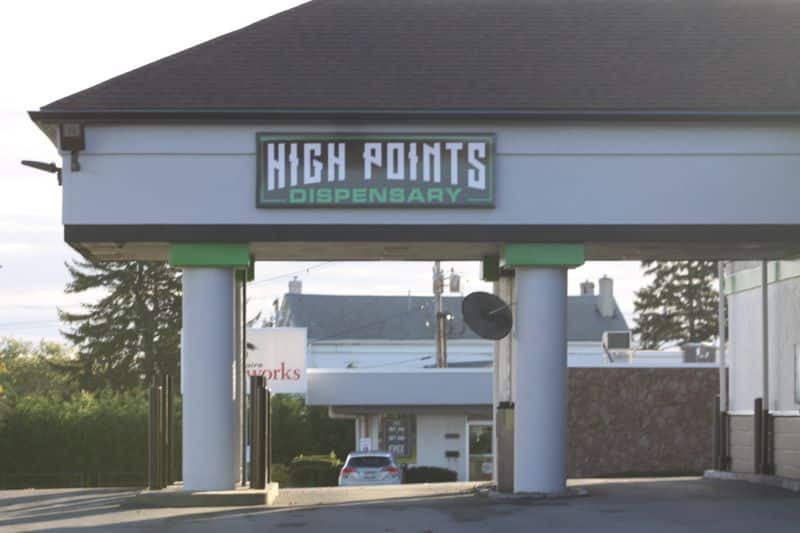
Paul Szmal: And it's coming up on 749 here on FLX Morning on Finger Lakes News Radio, and we're joined by our cannabis correspondent, he is from High Points Dispensary, because not everybody wants to get high, some just want to get better, Darrell Hillcurt is here with us, Darrell good morning, how are you sir?
Darryl Hilkert: Good Paul, how are you doing today?
Paul Szmal: Doing well sir, doing well. And one of the things we wanted to talk about today was, you know, there's different types of cannabinoids, and they produce different effects on the body through different means of ingestion, because there's more than one way to ingest a cannabinoid, so why don't we start there, with the different methods of ingestion that there are, that you can use these products for.
Darryl Hilkert: Well yeah, you know, you've got your standard smoking, which has been the go-to thing for everybody throughout many years, but now with the edibles and drinks and chocolates, and even putting different cannabinoids in with the THC, for the edibles and stuff like that, you can get different effects.
Paul Szmal: Now does every cannabinoid have THC in it, or are there other varieties that don't have THC?
Darryl Hilkert: There's cannabinoids that do not have THC, CBD is a cannabinoid, CBC, CBG, THCV, CBN.
Paul Szmal: Oh my god, this sounds like an alphabet soup.
Darryl Hilkert: Yeah, there's a lot of different cannabinoids that they add in with the THC, and it helps you with different things, and get you where you want to be, like CBN will help promote sleep, CBD helps with pain, CBG is like CBD times 10, CBC is a really good one for pain. So I mean, they use these different cannabinoids and they add different amounts of them also. You may get a 5 milligram gummy with 5 milligrams of CBN that work for some people, but as everybody's body is different, it affects different. Some people need a 10 milligram THC with 10 milligrams of CBN to actually get that really good night's sleep.
And also smoking is going to be an instantaneous high to the head, the edibles and the stuff you ingest will affect your body more than your head.
Paul Szmal: Now is there, is it the same, I'm trying to figure out how to phrase the question, let's take CBD as an example. Now there's multiple different ways you can ingest that, right?
Darryl Hilkert: Oh yeah, there's tinctures, gummies, you can use it for topicals, I mean there's a lot of different uses of CBD, not even just ingesting.
Paul Szmal: Now for people that are uninitiated, we use the term tincture, what exactly are we talking about there?
Darryl Hilkert: A tincture is a liquid form, it comes in a little bottle and it has like an eye dropper in it. So it's milligrammed out, whether you use three drops, a half of an eye dropper or whatever your dosage is recommended. But you just put a few drops underneath your tongue and it works instantaneously.
Paul Szmal: And as you said, things like the gummies or the drinks or some of the other edibles, those take a little bit longer because they have to pass through your digestive system to get into your system. The majority of them do, they do have a nano emulsified that they're using now in the edibles and the drinks, which passes the liver, so it goes right into your bloodstream. So that's why a lot of our stuff, you get the effects in 20 minutes or so, rather than waiting an hour or so, like a lot of the stuff that's not nano infused.
We're talking with our cannabis correspondent, Darrell Hilkert here on FLX Morning. And one of the things that we wanted to get into in talking about these different types of cannabinoids and different means to take these cannabinoids, the different uses, is also the potential effects that they can have on your system. So what are some important do's and don'ts when you're starting to take a cannabinoid for a particular purpose?
Darryl Hilkert: The biggest thing is starting low and slow. New York regulations have it to where you don't, you're not going to over consume on a single dose, where a lot of the black market stores, you're going to get, you might get a gummy and take it and you might be on cloud nine for five to eight hours. And a lot of people don't want that. They want to use it for the means of the use of it. Like our slogan, not everybody wants to get high. Some people just don't want to feel the pain or some people just need something to help them get the edge to go to sleep and stay to sleep. And other people do just want to catch a buzz, but everybody's body's different. You may take one gummy and not feel it at all. Another person may take it and feel it a lot.
Paul Szmal: So what's a good rule of thumb in terms of if you're going to be taking one of these products for the first time, I would think that probably one of the first things you want to do is you want to avoid driving a vehicle the first time.
Darryl Hilkert: Oh yeah. Definitely always avoid driving while you're under the influence. It's not legal. So we never suggest that anyhow, but yeah, definitely find a place where you're going to be and you're going to relax and it's all about the good time. It ain't nothing to be nervous about. Most of the effects are gone within an hour or two. When you smoke, you get the instant high, but it goes away quicker. When you ingest, it takes a little bit longer to kick in, but then it sticks with you for two to four hours.
Paul Szmal: And some of the therapeutic purposes of some of these particular items, like I know I've used some CBD to ease some neck and back pain. It's truly amazing that all these different varieties have come together and the means in which that you can take them have come together. Has this been a fairly recent development where things like the tinctures and the gummies and the edibles and stuff, are these more recent developments or have these things been around for a little while and just being more refined, shall we say?
Darryl Hilkert: For New York based, this is all pretty new. I think it's been out there for quite a while and the other states have been legal for years. I don't know. I've never really seen the difference of all this stuff until we actually got stuff going here in New York. But the stuff that's out there now, I've been a cannabis consumer for 30 plus years and I've never seen the stuff that's out there now that I've seen in the last year.
Paul Szmal: I imagine it's got to be pretty crazy trying to keep up with all the new materials and the new uses for them as well.
Darryl Hilkert: Oh yeah. It's been a chore over there when you have 500 plus items and we stock every single one of them.
Paul Szmal: Wow. 500 items?
Darryl Hilkert: Yeah. We have over 500 items in the store right now.
Paul Szmal: That's amazing. So now we're really, if we have that many items, we're really drilling down into some specific uses.
Darryl Hilkert: Oh yeah. For sure. There's something for everybody in there. Even just plain CBD, we've got our own CBD line now. So people that are still looking for something for pain or the topicals and gummies we have, tinctures, all CBD related will help. For people that still don't really want THC, but they wanted the use of having something that's non-pharmaceutical.
Paul Szmal: Now you mentioned, I'm used to CBD, but you mentioned that there are some other different substructures if you will, that are non-THC related that serve similar purposes. I guess I'm not following that question.
Darryl Hilkert: Meaning that CBD isn't the only thing that you can take that's non-THC?
Paul Szmal: It is, but it comes in different forms.
Darryl Hilkert: Ah, okay. Yeah, like you can have a gummy or a tincture or a topical. All that comes in just a CBD form also.
Paul Szmal: Right, right. So if you're somebody that's thinking about it maybe for pain management purposes, because I know that means a lot to a lot of people, what's the best step for people, the best first step? I imagine it would be to come in and talk to one of the people over at High Points at the dispensary and that way they can kind of discern what's going to be a good application for what it is you're looking to do.
Darryl Hilkert: Yeah, we can definitely point them in the right direction, tell them what the effects are from each cannabinoid, what products have that cannabinoid in them, and then let them choose because ultimately it's going to be their body. They know in their head if they're going to need something a little bit stronger or not. And if they don't, always start low and slow. You can start with a half of a serving or some people need two or three servings to get the effect that they're looking for.
Paul Szmal: All right. And for people that want to find out more, how do they find High Points dispensary? What hours are you open?
Darryl Hilkert: We're open Monday through Saturday, 10 a.m. to 8 p.m. and Sundays, noon to 6. And we're right at 811 Canandaigua Road, right next door to Denny's. We're open anytime, even if you're just browsing and want to check stuff out. No need to purchase anything if you're just coming to figure out what things are all about and then decide if you want to purchase something.
Paul Szmal: Yeah, there you go. All right. Much appreciated, sir. We'll talk to you again soon.
Darryl Hilkert: Thank you. Good to see you as always.
Paul Szmal: Absolutely. That's our cannabis correspondent, Darrell Hillcurt from High Points dispensary, one of our proud sponsors here on WGVA. It is 7.58 here on Finger Lakes Newsradio. We're headed towards the CBS World News Roundup coming up at the top of the hour, along with local news from Greg and more newsmaker interviews coming up in our eight o'clock hour, including a visit with Chris Lajewski from the Montezuma-Auburn Wildlife Center. And yet, when we visit the doctor, our treatments don't look that different. Why is that? Because we just don't have enough information.