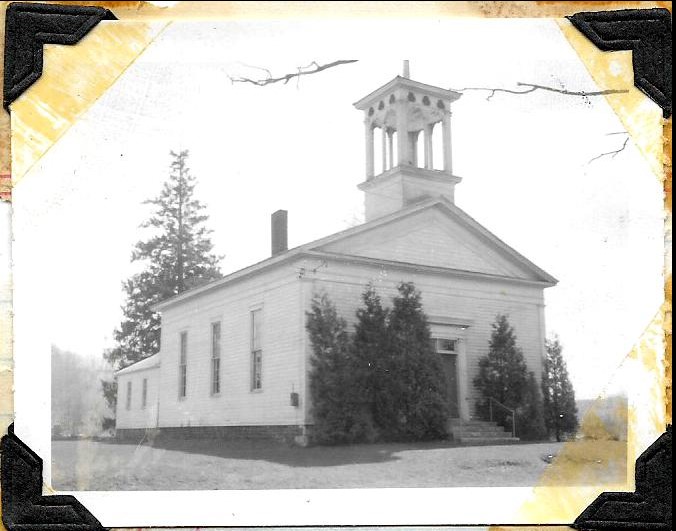
Paul Szmal: Good morning, it's 7.50 now, FLX Morning Monday. We're joined on the phone by Lori Schmidt, she's the Town Historian with the Town of Butler, also a trustee with the Butler Historical Preservation Society, which is what we're going to focus on this morning. Good morning.
Lori Schmidt: Good morning.
Paul Szmal: We're happy to have you here. We had a little Zoom mix-up first time around.
So tell us about the Butler Historic Preservation Society and the former church that you're working on renovating.
Lori Schmidt: Well, I'm going to start way in the back history here. In 1826, Butler was set off as a town from Wolcott. And at that point in time, people were meeting in their homes, in school buildings, to do their religious get-togethers. And they decided in 1836, they gathered up enough money, $1,000, and they bought this property in Butler Center. And they cut down the trees right on site. If you look under the floorboards of the church, you can still see the stumps. And they processed the wood at the sawmill, which is not far from the church building, and in fact is still in operation today. So they built the church, things were going great.
And in the 1960s, things started slowing down, and then the church sat empty. And in the late 1990s, a group of like-minded community members got together, and they decided they wanted to restore the church. So they went to the town board, and the board decided to purchase the church for $1 from the Methodist group. And they started the process of fundraising and getting volunteers together to restore the church, which then the Historical Society got started. And that's kind of how things started rolling along. We got the building on the New York State and National Historical Register, and we've been going ever since then.
The thing is with us, we rely solely on membership dues, and we do a lot of fundraising. Last year, we were able to replace our handicap ramp, which was in pretty sad shape. So that pretty much depleted what we had, and we decided we needed to, our bicentennial is coming up in next, 2026. And so we thought, well, it'll be a nice project if we freshened up the church museum, and there's some rotted wood that needs to be addressed. So that's kind of where we are right now. If you go to the Butler website, townofbutlerny.com, and click the historian link, you'll see all about this effort, and you'll see pictures of the church.
Paul Szmal: So you've told us a little bit about what it needs. Tell us about how you're raising funds for this project and how the public can help.
Lori Schmidt: Well, we're doing, our next big fundraiser is on Election Day. We have a bake sale at the Butler Town Hall, which is just down the road from the church museum, and that really, we really do really well there. We've done other fundraising things. We've had booths at the Wolcott Festivals and things like that. And I decided to try to see what we could do on GoFundMe. So I've set up that account. If anybody is interested, you can go there. And the whole page, or whatever you call it, is called Support Butler Historical Preservation, and that's where you can go to donate whatever you can, because we are a very small but mighty preservation society, and we try to keep our dues low.
We're in the middle of our membership drive right now, and our dues for a family is $15, and for an individual is $10. So we get a lot of support from the town. They pay the taxes on the building and the utilities, but anything else that needs to be done, we pretty much take care of. And we also have another building that we came into ownership of. It's the 1824 Roe Cobblestone Schoolhouse, which is located on Route 89 and Van Vleck Road in the town of Butler. And as far as we know, it is the only existing cobblestone schoolhouse in the United States. We got a hold of that after they did the church. They waited a few years and were able to get a hold of that building, and they proceeded to do the whole routine over again. Funding and grants and volunteers, and they fixed it up really nice, and it's restored, and we open it up to the public. We start with the open houses in May, and we go through October, the first Saturday of every month, from like 10 o'clock to 2. We're open for people to stop by and check the place out.
Also, if you go to Facebook and search for Butler Historical Preservation Society, you'll see a whole bunch more pictures. And I know as Butler Town Historian, you're always looking for people's artifacts, hidden treasures in the attic, and that sort of thing. You never know what's going to pop up. It's something else. We got a cigar box, and there was a thing on it that said, South Butler Cigar Company. And I've looked through books, I've gone on the internet, and they used to grow tobacco here back in the 1800s, but there was no mention of a cigar company. We've got the box on display at the museum. I call it the history mystery, because we really don't know much more about it than that. So yeah, there's always something that somebody pops up with a picture or anything. We're always looking for people to find something and bring it in to us, because that's what makes the museum interesting.
Paul Szmal: And again, area residents, you can support the Historical Society. Individual memberships are only $10 a year, $15 a year for families. You can get a life membership for $250 and help the Butler Historic Preservation Society keep fixing up this church that goes all the way back to 1836. Remind us that website again that you gave us.
Lori Schmidt: Well, the Facebook page is Butler Historical Preservation Society-Wayne County, New York. And then there's the GoFundMe, and that's the Support Butler Historical Preservation. We're trying to raise $25,000 because that's the estimate that we've gotten so far to paint the building, and we need to do the wood replacement first on some of the wood. But that's what we're going for, and we'd appreciate any help that anyone can send our way.
Paul Szmal: Alright, best of luck with the project. Thanks for sharing it with us, and keep in touch and let us know what we can do in the future.
Lori Schmidt: Okay, Ted. Thanks a lot for your help.