Paul Szmal: Good morning, it's 8-16, it's F-Helix Morning Tuesday, Mo's on the way, so when she gets here she had a couple of things we're going to talk about, but most of what we're going to talk about today was with Emma Wilson anyway, who is the Ag in the Classroom and Dairy in the Classroom educator. Good morning. How are you?
Emma Wilson, Moe Tidball: Good morning, Ted. Good. It's good to have you here.
Paul Szmal: So tell us a little bit about how you bring education on agricultural in general and dairy specifically into the classroom.
Emma Wilson, Moe Tidball: Sure. Through the Ag in the Classroom program, typically I'll visit schools or a library for about 30 minutes and I focus on mostly elementary students, but we will focus on one topic of agriculture and just discuss that for about 30 minutes. And with Dairy in the Classroom, dairy is our area's biggest agricultural industry, so we kind of try to put a dairy spin on everything and make sure that youth really understand the industry that's in our area.
Paul Szmal: How much do they know going in? Do the kids, are they not really that well-informed?
Emma Wilson, Moe Tidball: That's a great question, and I think it really depends on the class. Only about 2% of our county is directly involved in agriculture, so some kids really know what's going on because they live it every day, but I would say the majority of children that I see really don't have a great idea of where their food comes from or the fact that it's happening right in our backyard a lot of the time.
Paul Szmal: So in the spring, you did a whole unit on composting in conjunction with Compost Awareness Week. Tell us what you did.
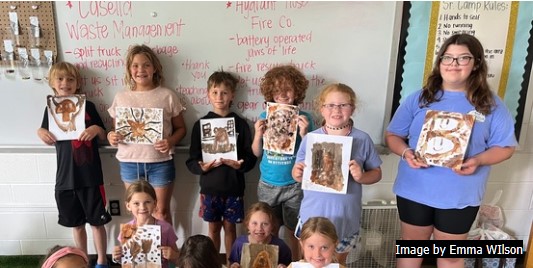
Emma Wilson, Moe Tidball: Yeah, so Compost Awareness Week was kind of a push into lots of classrooms, lots of elementary classrooms, and I did that in partnership with Ontario County Sustainability and Solid Waste Management. So myself and their educator, Caitlin McCombski, went into classrooms and we talked a little bit about landfills and how using our land efficiently is very important because there's only so much land to live on and to farm, and then they got to do a sorting activity. So we brought in essentially a trash can of maybe everyday garbage, and the kids sorted through it with us on what could be composted, what could be recycled, and what actually needed to be thrown away so they could see that we could dispose of things more efficiently.
Paul Szmal: Wow. Now, you did recently with some kids in Canandaigua, some kindergarten kids, you talked about popcorn. Here's a dumb question from an adult in the classroom. What's the difference between popcorn and regular corn?
Emma Wilson, Moe Tidball: Sure. That's actually not a dumb question. Lots of people didn't know, and before I researched this, I wouldn't have been able to tell you the answer either. But I talked about with the students essentially four types of corn. So there's the field corn that we see every day, which is for cows. So when you're driving in your car and you look out the window, you're probably seeing field corn. And then, of course, sweet corn that we'll get at the markets in the summer, and then flint corn that we decorate this time of year with that's really colorful. And popcorn is a type of flint corn that has really, really round kernels, and it's the only kind of corn that pops.
Paul Szmal: Wow. You also worked with three different schools on cranberries. Do we have, I know Massachusetts, like the Cape Cod area, has a lot. Do we have any in New York?
Emma Wilson, Moe Tidball: We don't really have any that I'm aware of. I think our closest would be in New Jersey, but that was a really fun lesson around this time of year. Of course, at Thanksgiving coming up, we got to make some cranberry ooblecks, so like slime. And mostly we talked about how farming is a lifestyle, and we followed a cranberry farmer through an entire year and saw that every day there was something to do on the farm.
Paul Szmal: Okay. Mo is here, by the way. Good morning, Mo.
Emma Wilson, Moe Tidball: Good morning. So what were you going to say about cranberries? I believe there are cranberries in the North Country. I was just saying that the focus of that lesson, we had a lot of fun with the oobleck, but really was that farming is a lifestyle as much as a career, and the students got to see just how much work goes into farming those cranberries, and that applies to lots of other different kinds of farms.
Paul Szmal: So you've got all kinds of cool things coming up in the future. What's ahead for Ag in the Classroom and Dairy in the Classroom?
Emma Wilson, Moe Tidball: Yeah. What I'm most looking forward to will be coming up in the spring, and that's our Incubation and Embryology Unit. And over four weeks, I visit a classroom or a series of classrooms, and we're incubating chicks right in the classroom. So they have the incubator right there. We put them in. They get to see how that chick develops right in the egg. We do some candling and look inside. And during those four weeks, we watch the chicks develop. The kids are so attached to them. They get to be farmers in their own classroom, and it's really a great opportunity to talk about other aspects of agriculture while in there as well.
Paul Szmal: Wow. That's really cool. Well, thanks for sharing that with us. We appreciate it.
Emma Wilson, Moe Tidball: Thank you for having me.
Paul Szmal: So a couple of things, Mo, from your side, and I just forgot what they were. Hang on. Let me scroll back up to the note you sent me. Oh, yeah. The venison donation program. Now, did I see? I thought I saw a TV ad on that the other day. I'm not sure. Or maybe it was social media. I don't know, but I saw something about the Ontario County venison donation just recently.
Emma Wilson, Moe Tidball: Oh, that's excellent. We are trying to push it out. So the Venison Donation Coalition is a not-for-profit, and they actually pay the processor to donate to process the meat into one-pound frozen packages, and then call the food pantries, and the food pantries pick it up and distribute it to the people that need it. So I think we talked about it last year. It wasn't really going in Seneca County, but we were able to get Finger Lakes Meat Processing to come on board, so it's still going strong in Seneca County. And now in Ontario County, Serendipity Acres Farms Meat Market up on Route 96 will process deer meat. So if someone's out there and they get an extra deer and they've got plenty in their freezer, they can donate it.
Paul Szmal: Is there, do you think, good awareness among hunters of the program?
Emma Wilson, Moe Tidball: That's what we're really trying to push out. So any hunter out there, I hope you hear this and share it with your friends. We're trying to get it out to the sportsman's clubs and out through social media.
Paul Szmal: Is there any other similar program for other game?
Emma Wilson, Moe Tidball: There is, through I think Feeding the Hungry, which is the food bank system, there is a venison donation program that DEC is promoting, but I'm actually not quite sure how that works, like where they get processed or things like that.
Paul Szmal: Another thing to remind people, if you hit a deer with your car and they are running around right now, you can call the police and they can come and do an accident report and you can actually get a tag for the meat and you can donate that or you can have it yourself. I'm not suggesting anyone go out there and start aiming for deer, but if you happen to hit one, you can save the meat. My father was the one-man police officer in our town, so we used to get all the roadkill.
Speaking of which, I just had some moose jerky the other day.
Emma Wilson, Moe Tidball: Oh wow. I don't even know where it came from, a friend of ours, but good stuff. Moose is delicious.
Paul Szmal: Oh man.
So that leads into the wildharvesttable.com and of course we've got holidays coming and lots of hunting season's coming, so what's on the Wild Harvest Table these days?
Emma Wilson, Moe Tidball: There's lots of great things. So I think the most recent recipe is a tenderloin recipe and so a lot of people confuse the loins, which are the big muscles along the back, along the spine, and the tenderloin, which actually are small and tucked inside. So the tenderloin you can harvest right after you gut them from the inside and so you can eat them right away before you do the whole process of skinning.
Paul Szmal: So remind the, oh it's gamey people, we always have this discussion about how you can prepare wild game meat and how you have to prepare it a little bit differently, largely because of the lower fat content.
Emma Wilson, Moe Tidball: Correct. So brining, brining is really your friend. So most of the things that, if I take something out of the freezer, any kind of cut of venison, I will defrost it in a brine, which is a simple two tablespoons of kosher salt, maybe some parsley, some garlic, a quart of cold water, maybe a little pinch of brown sugar, mix it up, defrost your meat in there, and or if it's fresh meat, put it in there for a good hour or two and you'll see that a lot of the blood will come out of the meat and that will make it less gamey tasting.
Paul Szmal: We have a neighbor who regularly provides us with venison and we're very happy about that. And I've had the venison stroganoff and hopefully it's the exact recipe you have, but tell us about that one.
Emma Wilson, Moe Tidball: That's great. So Jenna, our dietetic intern, came up with that one. You know it's a classic dish, beef stroganoff, and she adapted it for venison. And again there we suggest that you brine the meat a little bit before you proceed to preparing it.
Paul Szmal: I know we have a Canada goose season because we have so many of them around because they used to all fly away and now they don't, they stick around because there's so much food. Is there anything you can do with them?
Emma Wilson, Moe Tidball: Absolutely. I brought you some smoked goose jerky. Oh my goodness, look at that. So smoked goose jerky is great, again that's something that you really want to brine and smoke, it's delicious. You know you can grind it up and put it in chili and things like that, and marinades are your friend with the goose as well.
Paul Szmal: So how long have you been with Ontario? There's Greg, go ahead and get started. How long have you been with Ontario County?
Emma Wilson, Moe Tidball: That one's venison, that's a goose. So it's been six months, I started May 1st.
Paul Szmal: So how's it been? You all settled in?
Emma Wilson, Moe Tidball: It's been great. Yeah, we had our annual meeting, so people came to a nice dinner and we had a presentation by Hans, the grape guy, and he was warning people that the spotted and lantern fly is here and we need to kind of eradicate the tree of heaven, which is their host. So it was a great time, I got a really great team, you had a nice chat there with Emma, so I'm excited about the future.
Paul Szmal: All right, terrific. Well it's good to see you again, it's great to have you come in, thank you for the food, that's terrific.
Emma Wilson, Moe Tidball: Absolutely, it's hunting season.
Paul Szmal: And Emma Wilson, Ag in the Classroom, Dairy in the Classroom educator, thanks for what you do and thanks for sharing with us today.
Emma Wilson, Moe Tidball: And thank you for having me.
Paul Szmal: All right, we really appreciate it. It's coming up to 826 now, it's the Tuesday morning, AFL-X Morning on Finger Lakes News Radio.